
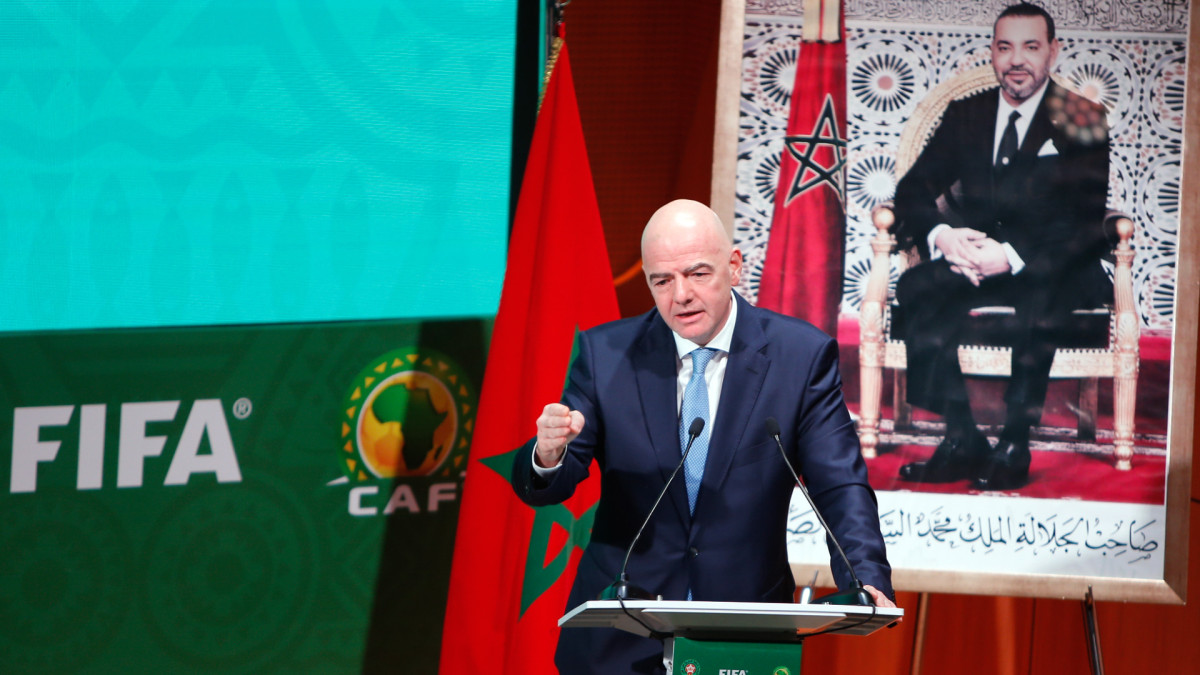
The organization of the 2030 World Cup represents an important geopolitical bet. Designed as a macro Iberian-Moroccan event, the project driven in the offices of FIFA and firmly backed by Moncloa seeks to transcend sports to become a diplomatic bridge between Europe and Africa. For Pedro Sánchez’s Government, this joint candidacy is a strategic tool conceived to consolidate the new stage of cooperation, neighborhood relations, and stability with the Alawite kingdom. However, the sociological snapshot provided by Cluster17’s survey presents a major challenge for the Administration: high diplomacy moves faster than public perception, and Spanish society shows deep, cross-cutting skepticism, heavily conditioned by the recent Ceuta crisis.
“61.9% of Spaniards oppose Spain and Portugal sharing the tournament with Morocco”
Data show that public opinion has not yet absorbed the integrative narrative surrounding the event, something probably logical given the immediate context. The survey captures the mood of a country traversed by border tension experienced in late July and during August in the autonomous city. In global terms, 61.9% of Spaniards oppose Spain and Portugal sharing the tournament with Morocco (36.4% “strongly oppose” and 25.5% “somewhat oppose”). Against them, barely 9.9% approve the initiative, while almost a quarter of the country (23.6%) remains indifferent.
Far from awakening the nationalist enthusiasm that World Cups usually generate, the project clashes head-on with migration concerns, forcing the Government to undertake a massive educational effort if it hopes to reverse this trend.
The pedagogical challenge in the progressive bloc
The first complex task for Moncloa lies in its own electoral base. The Government’s foreign policy, oriented toward pragmatic strategy with Rabat to guarantee border stability, encounters notable resistance among left-wing voters. These bases, usually highly sensitive to human rights and to the Sahrawi cause, now see Ceuta’s crisis dominating the national debate. Only 17.3% of the Socialist electorate approves sharing the event with Morocco, compared with 42.7% who express rejection.
“The Government’s foreign policy, oriented toward pragmatic strategy with Rabat to guarantee border stability, encounters notable resistance among left-wing voters”
In the Sumar space, disapproval reaches 46%, with barely 11% in support. This coldness among the coalition’s bases shows that the soft power of football has limits in the face of immediate crises. For Pedro Sánchez, this does not necessarily signal a fracture of loyalty at the polls, but it does reveal the difficulty of selling the virtues of sports diplomacy while managing a humanitarian and administrative emergency at the southern borders.
Ceuta and the opposition’s security framework
On the right-wing spectrum, skepticism takes on a different character. The migration crisis in Ceuta seems to act as the perfect catalyst to harden opposition to the World Cup, tightly linking it to borders, sovereignty, and national identity. For conservative voters, influenced by images of pressure at the fence, Morocco is currently seen more as a source of tension than a reliable strategic partner.
Among voters of the Partido Popular, opposition to the joint candidacy rises to 78.7%, with more than half (51.3%) settling in absolute rejection. In Vox, resistance is nearly unanimous: 86.9% of its supporters reject the tri-continental project.
“The 2030 World Cup thus fits into their narrative of criticizing the Government’s foreign policy”
In the sociological clusters that feed the right, such as the “patriots” (the profile that bestows greater importance to nation, identity, and sovereignty) or the “traditionalists” (the profile that emphasizes more conservative social and cultural values), any concession of institutional protagonism to Rabat is interpreted as a weakness of the State amid the migratory crisis. The 2030 World Cup thus fits into their narrative of criticizing the Government’s foreign policy, using it as a symbol of bilateral relations they deem unbalanced.
Geography and youth distance
The territorial map of the poll confirms that sports diplomacy has a hard time anchoring amid the current crisis. Madrid leads national opposition with 71.7% rejection. Andalusia, the community that acts as a physical border and absorbs the direct impact of realities like Ceuta, shows 66.5% against. Even in Catalonia, 55% of the population also opposes this collaboration.
Yet the most striking data for the organizers is the disconnect with the youth. 66.4% of Spanish youths aged 18 to 24 reject the candidacy, while a meager 10.6% support it. The event fails to lure the citizens who should be its main audience.
“The 66.4% of Spanish youths aged 18 to 24 reject the candidacy, while only 10.6% support it”
The takeaway from this sociological deep-dive is that long-term strategic vision and short-term public sentiment travel along different tracks today. The government of Pedro Sánchez has demonstrated the ability to swim against the current of public opinion, accepting the initial wear in favor of state bets. The 2030 World Cup aims to stabilize the southern border through interdependence. However, the data warn that, with Ceuta’s crisis still latent, the Administration has four years of intense work ahead: not only will it need to build stadiums, but to craft a narrative of mutual trust that can convince a deeply wary Spanish society.
The pan-European pollster Cluster17 has established itself as one of the most precise in Spain. Its 2023 general election survey was the second-most accurate in votes and the third in seats, according to Electomanía. In 2024, with the survey published in Agenda Pública, it achieved the most precise estimate of the Catalan elections and, also with this outlet, the third-most accurate in the ranking of seats and votes in the European elections.
For a sample of this size, the conventional precision at the 95% level is ±2.4 percentage points.
The voting intention is calculated among those who express a party option and takes into account their declared probability of voting, measured on a zero-to-ten scale. The cross-tabs are shown for groups with at least thirty interviews.

Natalie Foster
I’m a political writer focused on making complex issues clear, accessible, and worth engaging with. From local dynamics to national debates, I aim to connect facts with context so readers can form their own informed views. I believe strong journalism should challenge, question, and open space for thoughtful discussion rather than amplify noise.