
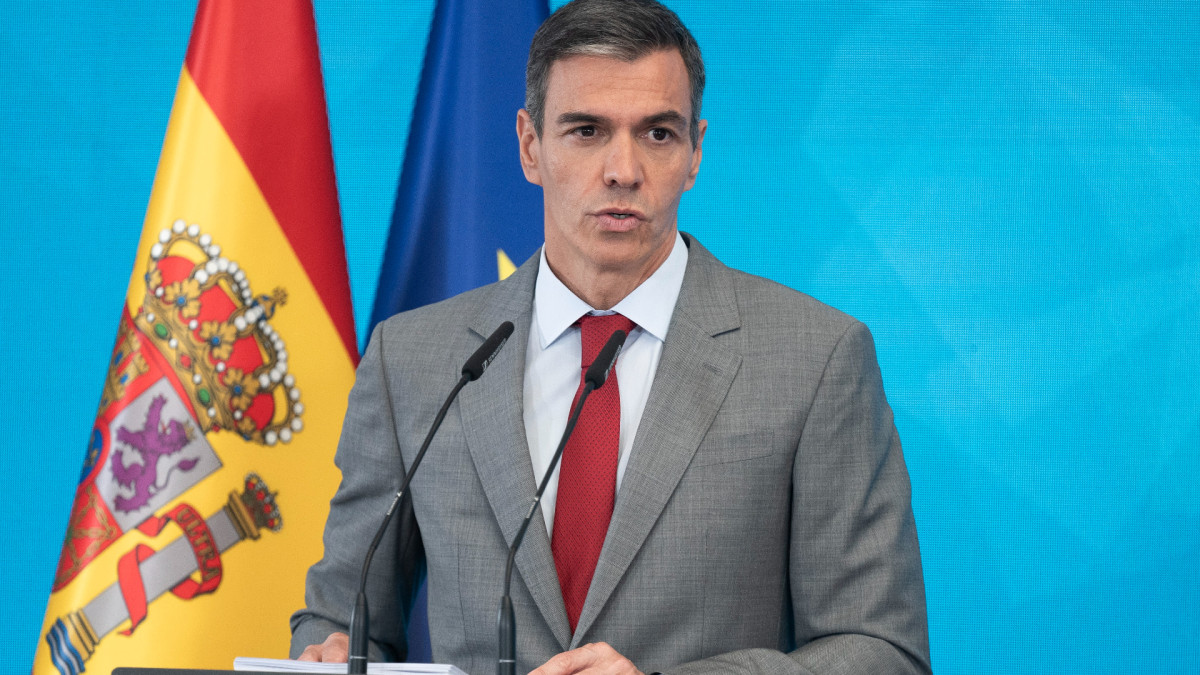
Pedro Sánchez’s bid for continuity earns broad support among those who brought the PSOE to La Moncloa in 2023. 73.9% of socialist voters consider the prime minister’s most appropriate move to be to see out the legislature to its scheduled end. Only 13.5% would prefer early general elections, while 6% would call for a confidence vote and 4.9% would resign to make way for another candidate from his party.
The question in the Cluster17 poll for Agenda Pública, which does not pit continuity against elections alone, offers the options of a confidence vote and replacing Sánchez with another socialist leader. However, neither option wins significant backing.
“44.6% of Spaniards would opt for early elections and 41.7% would choose to carry the term through to the end of the legislature”
The nationwide snapshot is much tighter than that of the Socialist electorate. 44.6% of Spaniards would opt for early elections and 41.7% for completing the term. After these two majority options, 6.2% consider it preferable that Sánchez submit to a confidence vote and 5.4% propose resigning and being replaced by another PSOE candidate.
Two blocks with few doubts
In the two large right-wing electorates, the call for elections is almost unanimous. 81.4% of those who voted for the PP on 23J want an early election, while barely 1.4% favor Sánchez completing the term. Another 9.8% would prefer a confidence vote, a percentage slightly higher than on the socialist side. Among Vox voters, the gap is even wider: 90.8% demand elections and only 3.9% defend continuing the legislature.
On the left, the opposite occurs. In addition to the 73.9% recorded among Socialists, 85.9% of Sumar voters want Sánchez to finish the mandate. Only 5% of those who supported Yolanda Díaz in the latest general elections are calling for early elections.
“The confidence vote, which at certain moments of the legislature has appeared in political debate, does not reach 10% support among voters of any of the main parties”
The gap between electorates is so wide that it leaves little room for intermediate solutions. The confidence vote, which at certain moments of the legislature has appeared in political debate, does not reach 10% support among voters of any of the main parties. Neither does the idea of replacing the president with another socialist gain traction.
The key may lie with Junts. 59.1% of those who voted for the independence party in 2023 prefer that Sánchez completes the legislature, compared with 28.4% who call for early elections. Another 6.5% would opt for a confidence vote. This datum is especially relevant given that in the current Congress, the continuity of the investiture majority and the laws approved until the next elections largely depend on votes from the Catalan party.
This situation does not necessarily imply backing for the Government or its president. The question measures what end to the legislature voters deem most appropriate, not their degree of satisfaction with the Executive. Even so, it shows a distance between the rhetoric of political confrontation and the willingness of a substantial portion of Junts’ electorate to rush to elections.
Women lean more toward continuity and youth toward elections
Beyond the party axis, the clearest difference appears when gender is taken into account. 46.9% of women prefer that Sánchez see out the legislature, versus 36.1% of men. Among men, early elections stand at 48.6%; among women, 40.8%.
Regarding age, adults aged 25 to 34 are the most favorable to going to the polls sooner: 54.8% want early elections and 31.1% opt to complete the mandate. Among those aged 65 to 74, the opposite is true, albeit by a narrow margin: 46.7% prefer to exhaust the legislature and 43.4% favor elections. As noted, a large portion of the Socialist vote concentrates in those older age brackets.
The Cluster17 clusters, which group citizens by their values and political attitudes beyond the party they vote for, reproduce a fracture that is also intense. Among the “multiculturalists” (the highly progressive, republican profile, favorable to redistribution and to peripheral nationalism), 91.7% favor completing the legislature; among the “laborists” (the profile at the intersection of social-democratic left and radical left, favorable to workers’ rights and to capital taxation), the figure reaches 79.6%. At the opposite end, 84.6% of the “patriots” (the profile that places the greatest emphasis on nation, identity and sovereignty) and more than 82% of the “traditionalists” (the profile that stresses more conservative social and cultural values) favor early elections.
“Across the country there is almost a tie between those who want to vote early and those who prefer to wait until the end of the legislature. Yet, when disaggregated by electorates, that doubt hardly exists”
In this sense the survey reveals a two-layer situation. Across the country there is virtually a tie between those who want to vote early and those who prefer to wait until the end of the legislature. However, when broken down by electorates, that doubt barely exists. N voters for the PP or Vox want elections while PSOE or Sumar voters want continuity. And for Sánchez there is a particularly telling datum: despite the electoral wear reflected in the poll itself, three out of four people who voted for him in 2023 still prefer that he lead the legislature to its end.
The pan-European pollster Cluster17 has established itself as one of Spain’s most accurate. Its survey of the 2023 general elections was the second most accurate in votes and the third in seats, according to Electomanía. In 2024, with the poll published in Agenda Pública, it achieved the most precise estimate of the Catalan elections and, again with this outlet, the third most accurate in the global ranking of seats and votes in the European elections.
For a sample of this size, the conventional 95% precision level places the maximum margin at ±2.4 percentage points.
