
It is one of the fastest-moving changes today. Five years ago, digital sovereignty barely left the desks of the European Commission. It was a topic reserved for cybersecurity specialists or the major telecommunications operators, about which the average citizen was hardly informed (nor concerned). At present, the dynamics are shifting.
Driven by the expansion of artificial intelligence, but also by other factors, technology is taking on greater importance in areas such as the distribution of power and the security of territories. And it does so in a very everyday way, since you do not need to know in detail how data centers and other kinds of infrastructures (physical and digital) operate to notice it. Now we can attach concrete figures to this issue.
The latest report on digital sovereignty produced by Telefónica Foundation asks 2,000 citizens and 300 companies about this topic. Only 29% of Spaniards had heard of the term “digital sovereignty” before the survey, but its results suggest that a broad segment of society already shares the diagnosis championed from Brussels: dependence on foreign technology is not merely a problem for companies, but a risk for Spain and for Europe.
“A broad segment of society already shares the Brussels-endorsed diagnosis: depending on foreign technology is not merely a problem for companies”
The knowledge of the concept and support for European alternatives, however, do not evolve in parallel. 35% of those under 35 had heard of digital sovereignty, compared to 24% of those aged between 50 and 64. Yet these older cohorts are the ones who most support Europe having its own platforms and technologies: 93%, versus 72% of the younger. The willingness to prioritise a European platform with equivalent capabilities also grows with age, from 63% among those under 35 to 77% among those over 65.
That social turn coincides with the steps being taken in European policy. The European Union, accustomed to a power-sharing arrangement that allowed it to act as a regulatory power while depending on others for numerous critical technologies, has moved to another plane.
Previously, the main digital platforms originated from the United States, while much of the semiconductors were manufactured in Asia and Europe handled regulation and the market. But already in the pandemic that scheme began to crack as supply chains became a geopolitical concern. And since Russia’s invasion of Ukraine, energy dependence has moved onto the field of national security.
The final blow has arrived with the rapid development of artificial intelligence. This dynamic has further consolidated in Brussels the idea that technological dependence also constrains political decision-making capacity.
“Even during the pandemic that scheme began to crack as supply chains became a geopolitical concern”
The European Commission has therefore placed technological autonomy alongside defense, energy, and access to critical raw materials. In other words, the so-called open strategic autonomy has ceased to be a merely economic doctrine. It rests on the premise that the ability to develop or control essential technologies conditions the sovereignty of states.
Data indicate that this concern has also reached society. 86% of respondents consider it important that Spain has national cybersecurity services. The same percentage supports having its own telecommunications networks. Likewise, support stands at 83% for data centers and 79% for cloud computing services.
The respondents, whose backing goes beyond industrial policy, link these infrastructures to independence, data protection, and decision-making capacity. In this way, telecommunications are added to a category previously associated mainly with ports, airports, power plants, or railway networks: 77% consider them a critical infrastructure for Spain’s digital sovereignty.
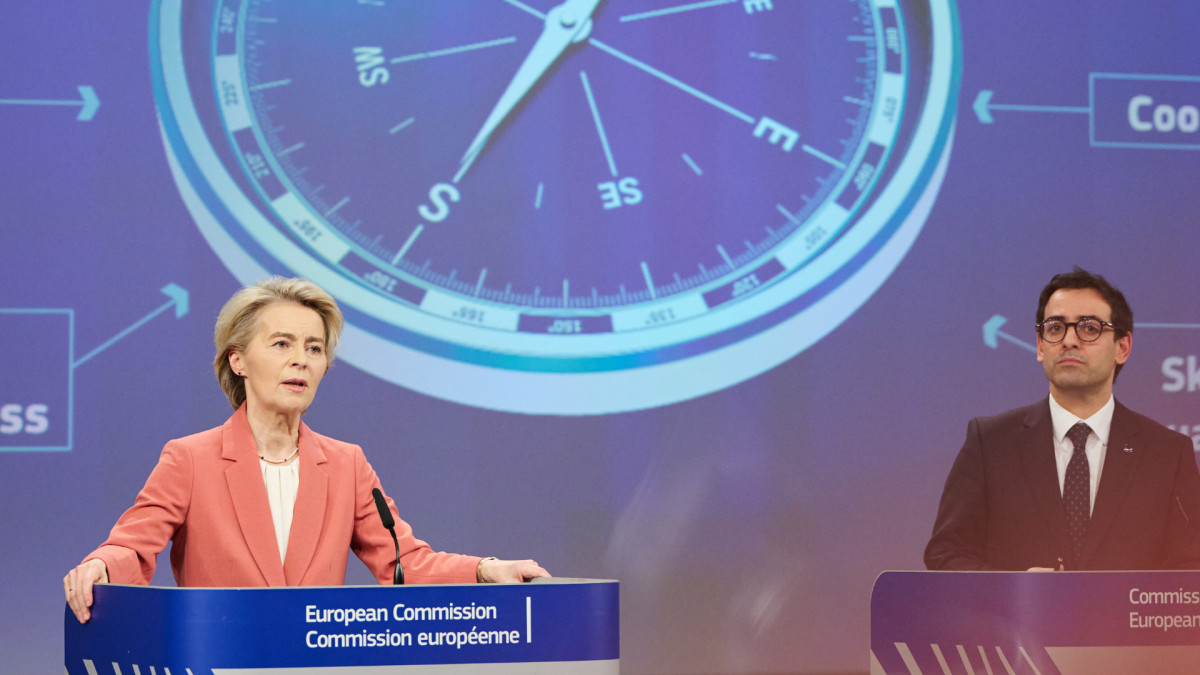
These results are, in a way, political backing for some of the priorities defended by the President of the European Commission, Ursula von der Leyen, such as developing European capabilities in artificial intelligence and semiconductors or reducing dependence on the United States and China.
“The ability to develop or control essential technologies conditions the sovereignty of states”
In line with this point, the survey records a high degree of distrust toward large tech platforms. 78% consider it likely that companies such as Google, Meta, Amazon, Apple, or Microsoft will sell or release personal data without authorization. And even 80% say they are uneasy about these companies’ access to their information. Casi two-thirds of Spaniards also acknowledge that they do not feel sufficiently protected against the misuse of their data when using digital services. Most depend on these platforms, but do not fully trust how they handle their information.
These data allow reading the European regulatory trajectory in another way. The General Data Protection Regulation opened the path, followed by the Digital Markets Act (DMA), the Digital Services Act (DSA) and, more recently, the European AI Regulation. Some sectors criticize that the model is based on a European regulatory obsession, contrasted with the innovative capacity of the United States. Yet, with these data it seems that community institutions are also responding to an existing social concern.
To a large extent, this was the stance defended by former European Commissioner for Internal Market and Services, Thierry Breton, in Agenda Pública. Regulation in Europe, he explained, did not aim to restrict freedom of expression, but to require those operating in the Community market to comply with the same rules as the rest of the economic actors. “If Elon Musk expresses himself using X, he must comply with European legislation,” stated one of the architects of the European digital framework, in an idea that condenses the principles of the DSA: platforms may have global reach, but they are not above European rule of law.
Breton also argued that the DSA and the DMA were not aimed at slowing innovation because their objective was to reinforce transparency, responsibility, and public trust in the digital environment. However, it is true that this regulation does not by itself resolve technological dependence. The continent continues to rely largely on infrastructures, platforms, and services developed outside its borders. On the one hand, the major platforms are American. On the other hand, much of the equipment is manufactured in Asia and American companies lead the AI race.
The gap to strengthen European technology is the major challenge
The distance between the aspiration for autonomy and everyday life remains wide. 69% of Spaniards acknowledge relying on smartphones, computers, or tablets. And one in two admit that spending several days without internet access would have an “important” effect on their daily activity.
“The continent continues to rely predominantly on infrastructures, platforms and services developed outside its borders”
In other words, dependence continues to grow and, with it, the concern about who controls the digital infrastructures and services. Technological globalization had downplayed the nationality of companies: what mattered was that they offered better or cheaper capabilities. The tensions between Washington and Beijing, chip export restrictions, the TikTok dispute, tech sanctions and the use of data as a power instrument have altered that perception.
Perhaps this is why technology has also become a arena of geopolitical competition. European policy now unfolds on two fronts: curb the power of large platforms and develop own capabilities. The discussion is no longer limited to what Google, Meta, or Microsoft can do in Europe. Today it includes the continent’s ability to offer alternatives in AI, cybersecurity, semiconductors, and a long etcetera. Hence digital sovereignty has both an industrial dimension and an eminently regulatory one.
“European policy now unfolds on two fronts: limiting the power of the large platforms and developing indigenous capabilities”
In this sense, citizens and businesses largely agree on much of the diagnosis and the response. In both groups, more than eight in ten perceive that Europe depends on foreign tech companies, about seven in ten would prioritise a European alternative with equivalent capabilities, and a broad majority call on governments to drive domestic technology. They also share skepticism: only 47% of citizens and 46% of business leaders trust that Europe can technologically compete with the United States or China. The largest gap appears when assessing security consequences: 62% of the public think dependence could pose a threat, versus 49% in the business sector.
Pese a the magnitude of the dependence, 54% of respondents believe European technological sovereignty will increase over the next decade, versus 29% who expect a retreat. It is a moderate expectation, but it indicates that a majority consider it possible to reduce external dependence. For the European Union, that backing widens the political margin to push investments and industrial projects.
Community initiatives had been justified mainly on economic grounds: to improve competitiveness, spur innovation, and create jobs. To those reasons, now another one related to security and decision-making capacity is added.
“Digital sovereignty covers the manufacture of semiconductors and the construction of data centers, but it does not end there”
Digital sovereignty covers the manufacture of semiconductors and the construction of data centers, but it does not end there. It also requires that Europe retain room to decide on the technologies that sustain its economy, its democratic institutions, and its security. Within this equation, Spain, another variable, has assets to participate in the process.
The expansion of data centers, the increase in investment in artificial intelligence, and the arrival of industrial projects linked to data processing offer significant opportunities. But the path will not be easy: there will be technological as well as political difficulties. Building domestic capabilities requires public investment, an industrial fabric, and decisions that go beyond efficiency criteria. It also requires determining where data is stored, who develops the artificial intelligence systems, and which infrastructures should receive the label of strategic.
A few years ago, these ideas would have been labeled protectionist. Today they form part of Brussels’ strategic consensus, a vision that is already beginning to spread among Spanish citizens.
