
The most straightforward way to understand what this projection means for Spain is to compare it with the rest of the EU, because continental averages conceal trajectories that are very divergent. There are three demographically Europe in EUROPOP2025, and Spain sits in one of them for reasons that deserve explicit explanation.
Three Europas in One
The first Europe has already peaked. Germany, Italy, Greece, Romania, Bulgaria, Hungary and Poland start in 2025 from their maximum and they do not regain it at any point during the projection horizon. Italy falls from 58.9 to 44.8 million by 2100: a 24% drop equivalent to losing the entire current populations of Andalusia, Madrid and Catalonia together.
On the other hand, Poland loses almost 12 million people, 31.6%. Greece, 30%. The countries of the former Eastern Bloc —Bulgaria, Latvia, Lithuania, Romania— present the most severe picture: westward migration within the EU, fertility below replacement, and cumulative aging.
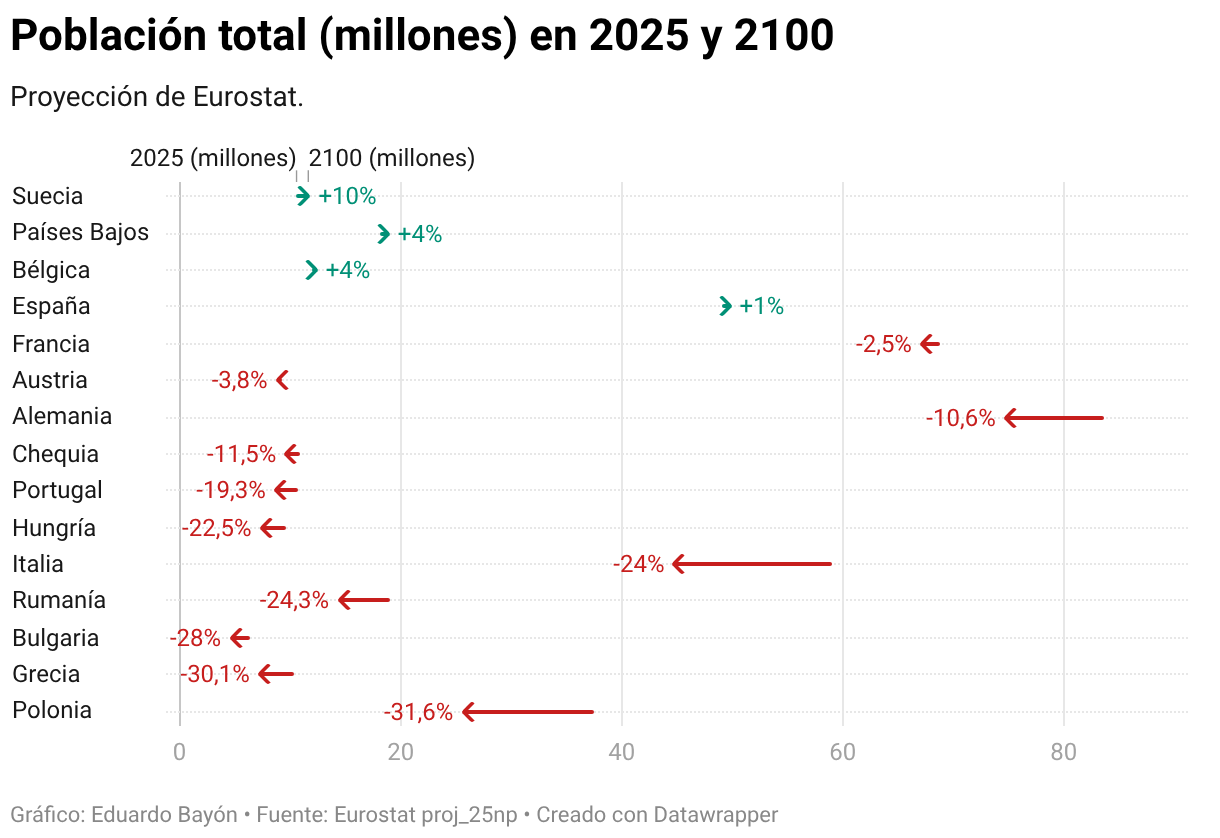
The second Europe grows for three or four decades and then stabilizes at levels similar to those of 2025. France reaches its peak in 2050 with 70.9 million and ends the century at 67.2. Belgium, the Netherlands, Sweden and Austria follow the same pattern: mid-level peak and prolonged flat stage. They are countries with somewhat higher fertility, stable positive net migration and labor markets that absorb flows in a sustained manner.
“Spain will end the 21st century, according to this projection, with more inhabitants than now, while the entire European Union loses one in eight”
And there is Spain. It grows from 49.1 million in 2025 to a peak of 53.9 million around 2050, remains flat for a decade and declines gently to 49.8 million by the end of the century: 1.3% above the starting point. Spain will end the 21st century, according to this projection, with more inhabitants than now, while the entire European Union loses one in eight. In that same context, between 2055 and 2060, Spain will surpass Italy as the third demographic power in the EU.
The Silent Mathematics of Migration
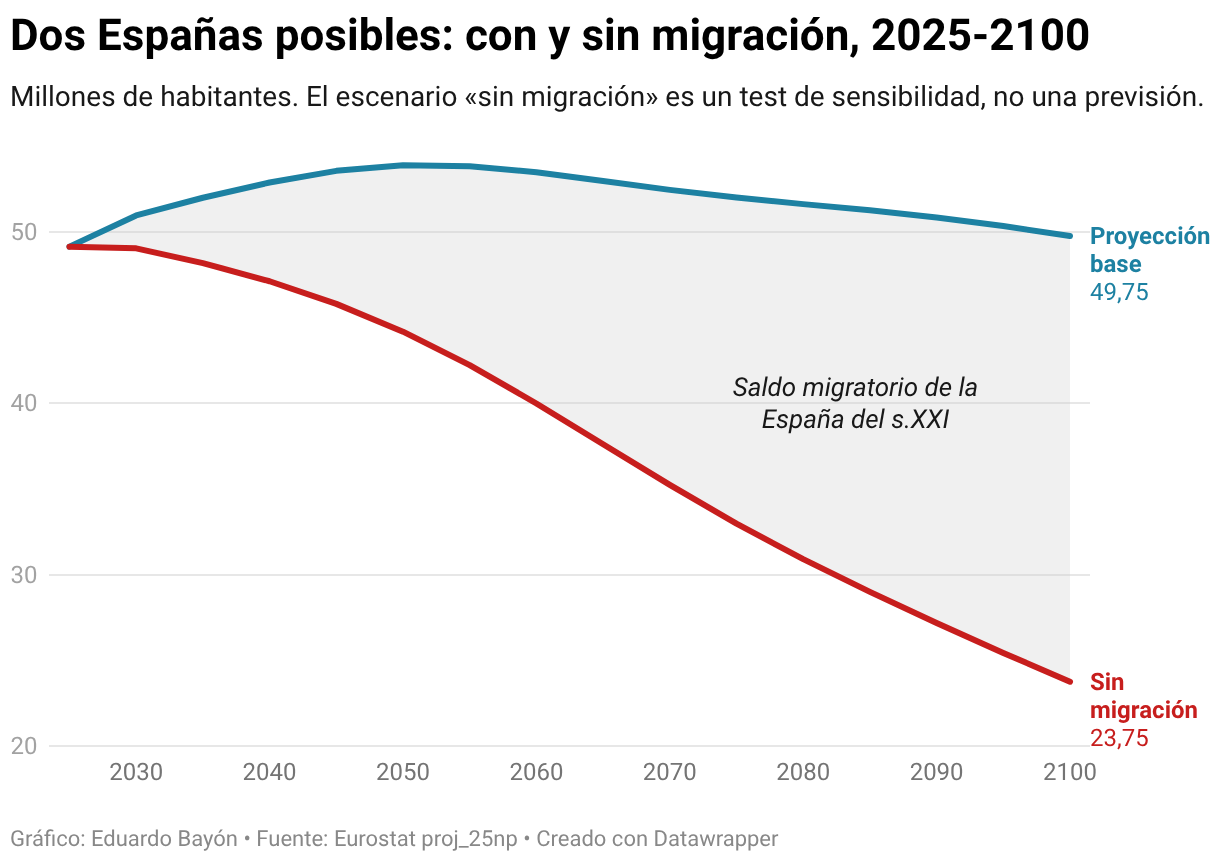
Eurostat publishes alongside the main projection an essential exercise: the zero-migration sensitivity scenario. It is a counterfactual experiment that estimates what would happen if the net migration balance were zero from 2025 to 2100. It serves to isolate the demographic weight of migration against that of fertility and mortality. The Spanish result is the most eloquent in the entire EU.
“The difference between the trajectory of the baseline scenario and that of zero migration is 26 million by the end of the century”
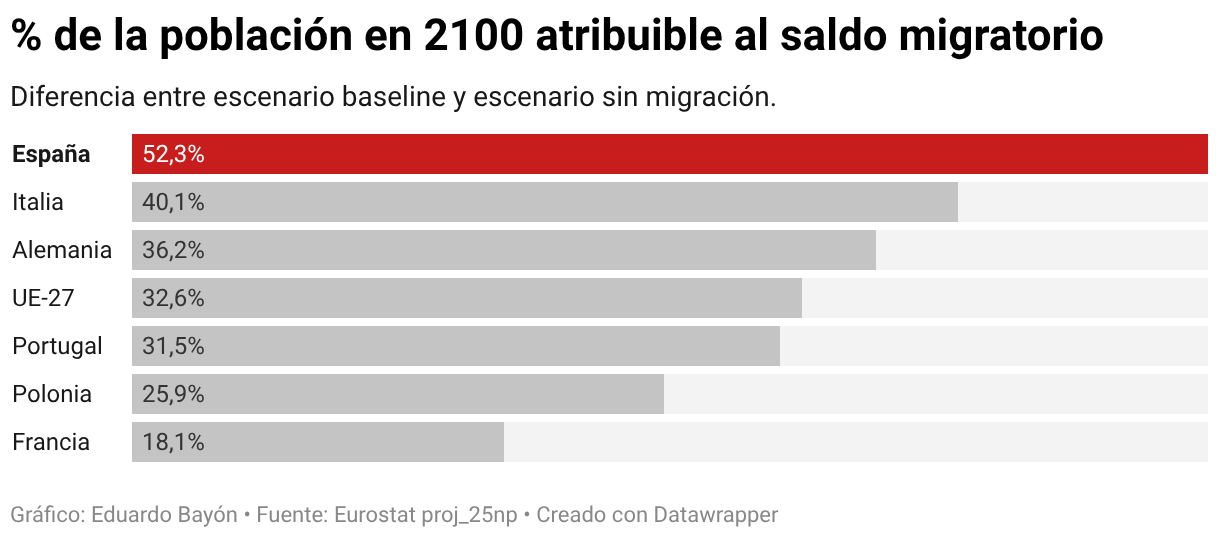
Without migration, Spain goes from 49.1 million in 2025 to 23.7 million in 2100. It loses half of its population. The difference between the baseline trajectory and the zero-migration trajectory is 26 million by the end of the century: 52% of Spain’s population projected for 2100 is due to accumulated migration and offspring. No other large EU country shows a comparable proportion. In Germany, the difference is 36%; in Italy, 40%; in France, 18%; in Poland, 26%. Spain is, in absolute and relative terms, the country in the EU where migration becomes the greatest demographic difference.
The Spanish natural increase —births minus deaths— has been in the red for more than a decade, and will remain red for the next fifty years. Every year Spain gains population, it does so exclusively through migratory input. Any debate on immigration policy that ignores this fact is talking about something else.
What Aging Does Not Leave in Peace
The issue is that the migration arithmetic figures out how many we are, but worsens how many work for each person who does not work. The EU reaches 2025 with 21.9% of the population over 65 and a median age around 44. By 2100, Eurostat projects, one in three people in the Union will be over 65. The 80+ share rises from 6% to 16%. The cohort of 85+ more than triples, from 3.2% to 10.8%.
The challenge is that immigration, which is the only variable that prevents Spain from shrinking, does not by itself fix the age structure problem. It mitigates it —because migration flows reach central and active ages— but it does not solve it. Immigrants age too. And fertility, which is the only factor that could durably straighten the pyramid, has long been below 1.3 children per woman; Eurostat projections assume partial convergence toward a European 1.64 that is never reached within the horizon.
“Without an orderly migration policy there is no sustainability of the model; without a policy to support birth rates, housing, reconciliation and care, neither”
From here emerge two political conclusions that in Spanish public debate tend to be presented as alternatives and are actually complementary: without an orderly migration policy there is no sustainability of the model; without a policy to support birth rates, housing, reconciliation and care, neither.
The Political Calendar Does Not Align with the Demographic Calendar
There is a mismatch between the horizon at which these changes occur and the horizon within which political decisions operate. Projections speak of 2050, 2070, 2100; electoral cycles last four years; the terms of European commissioners, five. The result is that demography appears in debates as a background issue —”demographic challenge”, “depopulation”, “pensions”— without translating into operational decision-making frameworks.
The migration debate has become decoupled from the demographic discussion. It is not a technical problem: it is a political problem. The European right —in Spain, Vox and growing sectors of the PP— has built a frame where migration is discussed from identity, security and pressure on public services, ignoring that data like the ones exposed here make any Spanish economic projection to 2050 untenable without sustained migration flows.
The left also lacks a complete narrative. The progressive defense of migration is usually articulated in terms of human rights and solidarity. The reality is also structural to the productive model. There is an opportunity here to reframe the debate in material terms: what happens to pensions if by 2050 the ratio of contributors per pensioner falls below 1.5; what happens to elder care when 10.8% of the population is over 85; what happens to the housing market if demand shifts toward areas drawing migrants.
A Minimal Roadmap that Data Forces
Eurostat projections do not prescribe policies: they describe trajectories. But they allow ruling out some options due to internal inconsistency with available data. At least four:
The first is migration policy. There is no sustainable Spanish demographic scenario without significant positive net flows for the rest of the century. The relevant debate is not whether to accept immigration, but how to manage it: which profiles, which legal channels, which labor integration, which access to rights, which nationality policy.
“If citizens understand that pensions depend on immigration, the migration debate changes in nature”
The second is fertility. The European countries with the highest fertility —France, the Nordic countries— pair universal 0-3 services, long and well-paid parental leave, affordable housing and job stability in the 25-40 age range. Spain has recognized deficits in all those dimensions. Without intervention in them, immigration policy bears the entire demographic adjustment.
The third is pensions. The latest Pacto de Toledo report assumes flows compatible with Eurostat’s baseline scenario, but the public communication of the debate has avoided making that dependency explicit. If the public understands that pensions depend on immigration, the migration debate changes in nature.
The fourth is territorial balance. Rural depopulation will not be solved by natural growth, because there is no natural growth. Either migrants arrive in rural areas —with infrastructures, services, housing and employment— or urban concentration will accelerate in terms that will further strain the housing market in Madrid, Barcelona, Valencia and the coastal axes.
Spain, Demographic Power by Choice
Spain’s demographic situation is not an accident nor an inexplicable exception. It is the result of decisions —migration, economic, health, and European integration— taken over the last four decades. That Spain could be the third demographic power of the Union in 2060 is not a fate: it is the direct consequence of open doors and of the fact that the labor market and the reception system have absorbed those flows more effectively than neighboring European peers.
This Eurostat prospectus coincided in its publication —the same April 16— with Royal Decree 316/2026, which seeks to regularize administratively about half a million migrant residents already living in Spain. It is the first measure of this scale since 2005. Eurostat data allow reading it as a rights-based measure, but also as a demographic decision coherent with the only trajectory that keeps the productive model and the welfare state viable.
“None of this is improvised. And nothing survives if the debate is built, as is the case in much of the European right, on the outright rejection of regularizing those who are already here”
At the same time, the question arises about how to construct a public narrative that makes it sustainable. Countries that have reconciled high migration flows with social cohesion —Canada, Australia, and some Nordic cases— have done so with broad political consensus and specific institutional architectures: transparent selection, rapid labor integration, stable residence, reasonable access to citizenship. None of this is improvised. And nothing survives if the debate is built, as in much of the European right, on the outright rejection of regularizing those who are already here.
The alternative lies in the Italian, Polish and Bulgarian data. They are countries with restrictive migration policies that have spent decades exporting workers to Western Europe without compensating them. The result is a demographic contraction that drags, with a delay, the economy and the institutions.
