
Madrid has grasped that sovereignty at the EU negotiating table is measured in volts. By flexing its energy muscle on the board, Spain isn’t merely aiming to steer industry; it’s also securing the right to veto Europe’s traditional energy order.
“Spain’s ability to produce the bloc’s cheapest renewable energy is no longer a local success story but a geopolitical challenge to traditional Franco-German hegemony”
As the Industrial Accelerator Act (IAA) advances through the European Parliament this April 2026, the legislative fight reveals a stark reality: Spain’s capacity to generate the bloc’s cheapest renewable energy has ceased to be a mere regional triumph and has become a geopolitical challenge to the long-standing Franco-German dominance. Berlin and Paris are now treating Spain as a contender in the race to shape Europe’s industrial core.
Germany’s Unease
The mood in Berlin is one of quiet trepidation. Once Europe’s unequivocal engine of industry, Germany is still reeling from the loss of inexpensive Russian gas. Spain’s energy miracle serves as a painful reminder to German industry of its own fragility.
Christian Ehler, the influential German EPP figure steering the ITRE negotiations, watches every development in the Ruhr region, Germany’s industrial heartland. The concern is simple: industrial flight. Should a chemical giant like BASF or a steelmaker like ThyssenKrupp discover that energy costs in Spain remain 30-40% below those at home, then the ‘Accelerator’ will not accelerate German industry but drive it to relocate to the Mediterranean.
“German negotiators are advocating that the IAA prioritize ‘logistical proximity to the end consumer’ as a criterion for receiving the extra economic support considered in the regulations”
German negotiators are pressing for the IAA to give priority to “logistical proximity to the end consumer” as a condition for the additional financial assistance contemplated by the rules, a move meant to penalize Spanish plants that sit far from Central European markets.
The French Counterattack: Nuclear versus Green
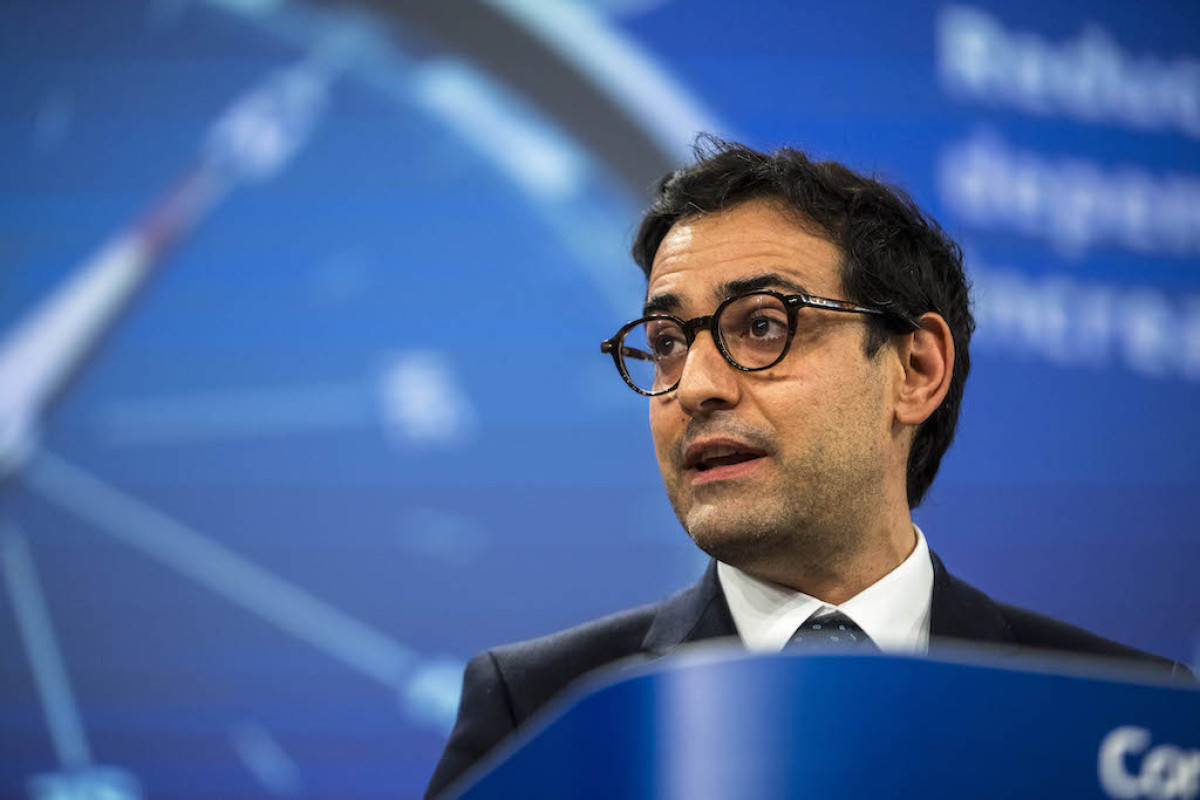
While Berlin frets about Spain’s lower prices, Paris worries about Spain’s green identity. For Stéphane Séjourné, the Commissioner overseeing the IAA, the law functions as a tool for French strategic autonomy — a term frequently used to describe France’s nuclear interests.
France sees Spain’s surplus of low-cost renewables as a direct challenge to its nuclear model. Within the IAA, a dispute has emerged over what qualifies as “strategic technologies.” Paris is spearheading a robust lobby to ensure that, when drawing the boundaries of so-called Industrial Acceleration Areas, ‘pink hydrogen’ produced by nuclear energy receives the same treatment as ‘green hydrogen’ produced in Huelva or Aragon using renewable electricity. These zones would operate as regulatory-free spaces where procedures are digitized and simplified, with tight timelines and the presumption of “positive administrative silence.” If Brussels does not respond in time, the French proposal will pass.
“If the IAA grants nuclear power the same ‘strategic’ status, then Spain will lose its proposition of unique value”
For Spain, this is a red line. If the IAA assigns nuclear power the same ‘strategic’ status, Spain will lose its unique value proposition. Between the steadiness of French nuclear energy and the low cost of Spanish solar, investor choices could tilt toward subsidies from Brussels. This is pivotal in deciding which energy sources will power Europe’s factories by 2030.
Nothing better illustrates the friction between France and Spain than the ‘interconnection gap’. Spain generates energy it cannot fully export because France drags its feet on electricity interconnections.
In the IAA’s framework, France’s blockade is a strategic instrument. By keeping the Iberian Peninsula isolated — an ‘energy island’ — France ensures that Spain’s low prices stay trapped behind the Pyrenees. While Spanish domestic industry benefits in the short term, this would prevent Spain from becoming Europe’s ‘energy bank’, which would grant Madrid enormous influence within the Council.
The Fiscal-Muscle Gap
The IAA’s most perilous flaw is its lack of a European-wide budget. As it stands in 2026, the law can expedite permit processes but relies on national budgets for subsidies. That arrangement plays directly into Germany’s hands. Berlin can afford to forgo some energy-price advantages if it can outpace Spain in direct subsidies.
“The IAA could end up financing ‘internal offshoring’ within the EU, where factories don’t relocate on grounds of efficiency or energy costs but instead seek out the country offering the biggest slice of public money”
Without a centralized scheme, the legislation fosters unfair internal competition: while Spain tries to balance deficit rules to fund its hydrogen plants, Germany can deploy its ‘fiscal bazooka’ to buoy its struggling industries. The risk is evident: the IAA could end up financing ‘internal offshoring’ within the EU, where factories relocate not for efficiency or energy costs but to chase the largest share of public money. In Brussels, this phenomenon is described as “the cannibalization of the Single Market,” operating under the banner of strategic autonomy.
The New European Map
In 2026, Europe’s map is being redrawn by the price of electrons. No longer the “sick man of the South,” Spain holds the potential to emerge as an energy powerhouse, and the Industrial Accelerator Act is the arena where the old guard (Berlin and Paris) tries to halt that ascent.
The verdict is clear: the IAA is a Trojan horse. Hidden within it lies either a revival of European industry or the definitive consolidation of a two-speed Europe, where the South enjoys clean, affordable energy while the North keeps the factories.
The true power resides in the markets, and as long as the Spanish sun outprices both German gas and French atomic energy, the gravitational pull of European industry will shift toward Madrid. The question remains whether the Accelerator will permit that shift or apply the brakes.
