
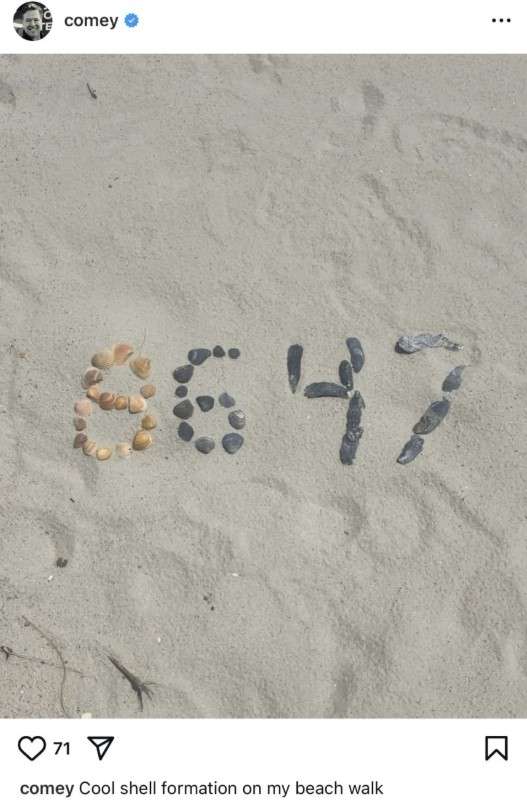
As stated in the current indictment:
Circa May 15, 2025, within the Eastern District of North Carolina, the defendant, JAMES BRIEN COMEY JR, knowingly and willfully issued a threat to cause the death of, and to inflict physical harm upon, the President of the United States, by publicly sharing on the social media platform Instagram an image that shows seashells arranged to spell out “86 47”. A reasonable recipient familiar with the circumstances would interpret this as a serious indication of an intent to harm the President.
In violation of Title 18, United States Code, Section 871(a).
A second count likewise contends that this action violated the federal interstate threats statute, 18 U.S.C. § 875(c).
I view this prosecution as unwarranted, and I anticipate it will be dismissed. Here is a concise analysis of my reasoning.
Threats: To “eighty-six” someone is, in the language of the Oxford English Dictionary, “to remove from premises; to reject or abandon; (in earlier usage) to refuse to serve a customer.” (In the given context, “47” references Trump, who is now the 47th President.) The OED provides several illustrative uses:
1942 — the term “eighty-six” signifies refusing to serve a patron any longer … for example, if the patron starts causing trouble, he is simply made to leave. Times Herald …
1959 — “eighty-sixed” someone from a venue means he has been expelled. Observer …
1963 — public notice that one will be “eighty-sixed” from a bar. J. Rechy, City of Night.
1968 — an anecdote from a barroom setting where someone is told, “You’re 86’d,” signifying that you are not welcome here. New York Times.
1980 — a discussion of campaign-management lessons from real and fictional races, including a scene in which a consultant tells a candidate to “cut your hair and eighty-six the sideburns.” New Yorker
Without additional context, the term cannot reasonably be read as a threat of violence. Of course, with the right context, many things could be construed as violent threats. If someone arrives at my home brandishing a gun and says, “I’m going to eighty-six you,” or similar language, that might well be perceived as a threat; but there is no context I am aware of that would justify interpreting Comey’s tweet as a serious intention to harm the President.
And First Amendment doctrine acknowledges that the exception for “true threats” only covers statements that a reasonable listener would take as threats. To quote Counterman v. Colorado (2023):
The “true” aspect of “true threats” distinguishes them from jokes, hyperbole, or other remarks that, given the context, do not reasonably signal a real danger of violence. True threats are serious communications indicating an intent to commit unlawful violence.
Moreover, punishment of a statement as a threat requires showing that the defendant consciously disregarded the substantial likelihood that his remark would be interpreted as threatening violence.
Nothing in Comey’s message can reasonably be read as an assertion that he intends to kill the President. Instead, a sensible reading is that he desires the President’s removal, for instance through impeachment or, as with President Nixon, resignation under the shadow of possible impeachment.
Indeed, even some statements that appear to be threatening on their face (and “86 47” is not inherently threatening) have been deemed not to be true threats when the surrounding circumstances show they should not be understood as genuinely menacing. The leading example is Watts v. United States (1969):
The incident that led to the petitioner’s arrest occurred during a public rally on the Washington Monument grounds, where the crowd split into small groups and the petitioner joined a discussion about police brutality. The petitioner, aged 18 at the time, declared that if he were drafted, the first man he would target would be L. B. J. and that he would not shoot his fellow Black men. The court emphasized that this was political hyperbole, not a true threat, and that the First Amendment requires robust, even harsh, debate on political matters.
We do not view the kind of political rhetoric used by the petitioner as fitting within the statutory term of a “threat.” The Court noted that the language, given its conditional nature and the audience’s reaction, did not reasonably convey an imminent threat.
Consequently, the Court voided a jury verdict convicting Watts. As established in instances like Bose Corp. v. Consumers Union (1983), courts reviewing speech-based judgments must conduct independent analysis rather than defer to the factfinder’s interpretation of ambiguous language. This independent review is particularly required in threats cases (see, e.g., In re George T. (2004)).
Similarly, a court evaluating a motion to dismiss an indictment (which I expect Comey to file) should determine as a matter of law that Comey’s statements were not punishable threats. (For a parallel, see State v. Metzinger (Mo. Ct. App. 2015) where a court dismissed a threat indictment on such grounds.)
Solicitation: Some may argue that Comey did not intend to say he would kill the President, but rather that he was urging others to do so. I still find that interpretation unconvincing: he likely was expressing opposition to Trump, but within a framework that aimed at removing him from office rather than inciting others to commit violence.
In U.S. v. Hansen (2023), the Court acknowledged that the First Amendment does not protect the solicitation of crime, explaining that “Criminal solicitation is the deliberate encouragement of an unlawful act,” and citing the Model Penal Code, which defines solicitation as:
- A person is guilty of solicitation to commit a crime if
- with the aim of promoting or facilitating its commission
- he commands, urges, or requests another person
- to engage in specific conduct that would constitute such a crime.
If a crime boss orders a subordinate to “86” someone, and this is understood as inciting lethal violence rather than excluding someone from a venue, that could theoretically amount to solicitation. Yet I strongly doubt there is proof beyond a reasonable doubt that Comey posted the seashell image with the purpose of promoting an assassination of the President.
And perhaps this very reason is why the indictment does not charge solicitation. It accuses a threat—and, again, it is not reasonable to interpret Comey’s post as a true threat.
