
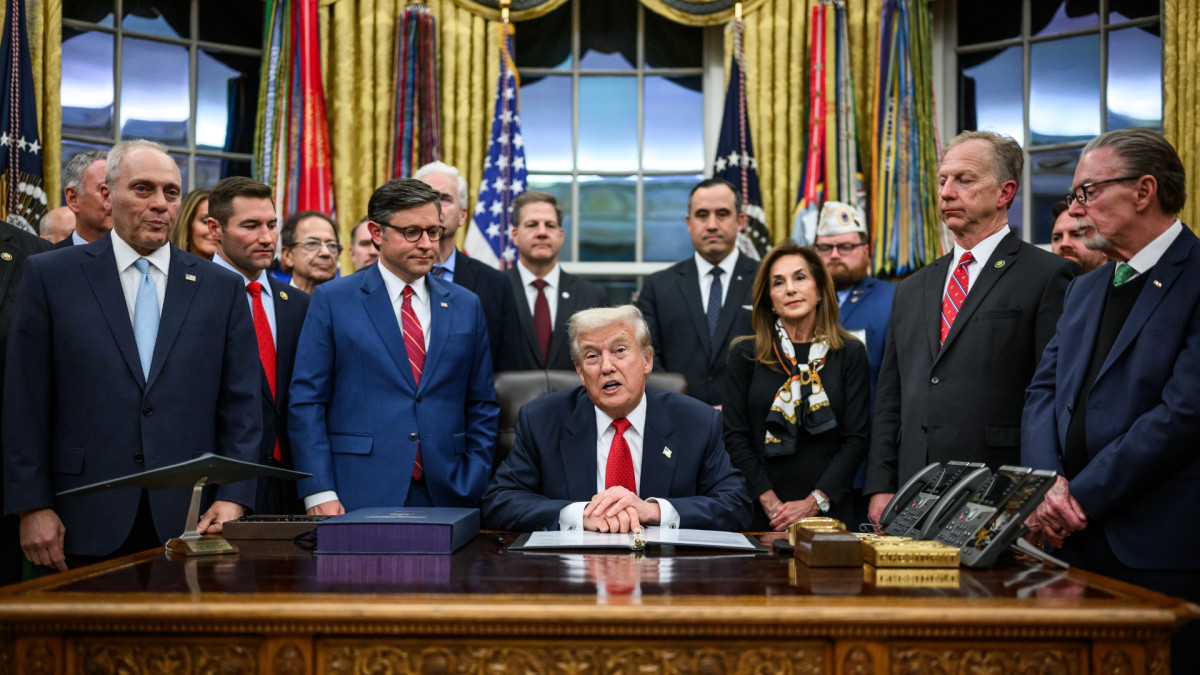
Every president, as soon as they win, starts thinking about their reelection. For now, Donald Trump is living through it in the upcoming midterm congressional elections, which are less than a year away. Second terms for U.S. presidents are often hollow, especially if they lose party control of Congress and become lame ducks. After Roosevelt, a constitutional amendment was passed to prevent more than two terms. The Trump presidency, already irregular by not having been reelected but instead chosen a second time after losing in 2020, is proving revolutionary. But the current president understands that the 2026 congressional elections matter, scheduled for November 3.
It’s not only that regaining control of Congress by the Democrats — at least one of its two chambers — could stall his work and the continuity of his project, but that a House of Representatives controlled by them could initiate an impeachment process against him. And he fears it. Trump and the Republicans are pulling out all the stops, including some subversive moves, to prevent that. And, in addition, the pursuit of a Nobel Peace Prize, which could mark the end of the war in Ukraine, looms. The great struggle began long ago and will intensify.
“An impeachment-proof House, not dominated by Trump and his allies (with dissenting Republicans kept quiet), could make life impossible for the president and his lawyers”
Whether after the next November 3rd a third term could be raised remains another matter (to be discussed). For the moment, Trump is treating the 2026 date as if it were his chance at reelection. The impeachment could be brought for various reasons, though it would not proceed if the Senate (which is renewed in one-third increments) remains under Republican control, as current polls indicate, since it would have the final say. Winning in November is also a strategy to secure control over his succession, as well as to protect himself for the rest of his term and beyond. A House not dominated by him and his followers (with silent dissenting Republicans) could make life difficult for Trump and his lawyers.
The Road to the Midterm Elections
Hence, he is going all out, leaning on the state apparatus in a bid to subvert it to his ends—an institutional-style coup. Even more so given his unusually low personal popularity, remarkable since he has not even been a year back in the White House, and the points Democrats highlighted in several elections last Tuesday the 4th. Perhaps the most striking result, both in substance and form, was the victory of the young social democrat—what we’d call it in Europe—and Muslim Zohran Mamdani as mayor of New York, a notable achievement (though New York is always a special case). Steve Bannon even described this win, which borrows some Trump-inspired methods, as “very serious.” Those results have given Democratic nerves a lift, but they faltered when they were ahead in public opinion as government shutdowns occurred and a number of moderate Democrats struck a deal, hurting the appearance of party unity. Despite last Tuesday’s results, Democrats are not fully capitalizing on Trump’s unpopularity, at least not sufficiently.
For Republicans, the top priority heading into November and also for 2028 is the crucial redraw of district lines to gain more House seats. The so-called gerrymandering, which Democrats also do when possible, is shaping up to be decisive. Normally, district maps are reviewed every decade after the census. This time, the process has been accelerated. The president’s party tends to lose votes and seats in midterm elections, and Trump aims to prevent that. That is why Republicans began this map-war last summer in Texas. The GOP currently holds a 219-213 edge in the House, but they hope to widen it through these manipulations in several states, securing at least 16 more seats. Democrats want to block this and plan to start in California, where voters approved Governor Gavin Newsom’s proposal to redraw the electoral map. According to calculations cited by The Guardian, with all the proposed changes the net gain could be two seats for the Republicans.
“Gerrymandering is a common practice, but restricting voting to those who lack identification has clear electoral aims, and is illegal”
The practice of gerrymandering is indeed routine. What is not routine, and may even be illegal, is Trump’s attempt to restrict voting for people who do not possess identification (often a driver’s license, which many African American Americans do not hold, or an official ID in a country without a national ID) or who have not registered well in advance (as with students, and we already see Trump’s attack on universities, which forms part of the ongoing culture war). This could be unconstitutional, especially as it affects the elderly more. Moreover, Trump intends to implement this via an executive order, even though it is a prerogative of each federated state. In fact, a New York court has already blocked the entry into force of his decree requiring voters to prove their nationality. But all this will ultimately be decided by a Supreme Court dominated by six to three conservatives, with some justices personally indebted to Trump, though they know they will outlive him.
The Reconfiguration of the Bureaucratic Machinery
The White House and the Trump loyalists’ offensive does not end there; it is also carrying out a profound purge of federal officials. True, the United States has a spoils system in which appointees rotate with administrations of different political stripes. Yet there is a stable base of independent institutions, including the Federal Reserve. Trump is targeting them. He has already done so in his first term, but in this second he is strengthening that strategy of controlling the bureaucracy. For instance, all those involved in drafting the most recent climate-change report have been dismissed, along with many statistical officials.
Even within the Pentagon, the Department of Defense—seriously renamed from the War Department—as headlined by Pete Hegseth, is removing—or sidelining—high-ranking military and civilian personnel at an unprecedented pace, reflecting a wish not only to transform but to dominate. The president is employing the armed forces not only externally but for internal control. Not to mention the FBI or the CIA. Trump spoke of and distrusted the so-called “deep state.” In reality, he is building one of his own. He is pursing lawsuits against those who pursued him, and he is pardoning loyalists convicted or absolving those charged—thousands. Although only the most famous names have been highlighted, among the latest are his lawyer and former New York mayor Rudy Giuliani and 74 others who attempted to overturn the 2020 election that Trump lost.
All of this affects the independence of watchdogs and internal auditors (such as inspectors general), with many being dismissed, weakening the fight against corruption. Trump is triggering a cultural shift in the public administration: moving away from civil servants oriented to public service toward officials more aligned with political loyalty and the leader’s agenda, even if it’s driven by fear. This could alter priorities and behavior, undermining the professional and apolitical handling of the bureaucracy and introducing fear of political punishment into the system.
“President Trump is reconfiguring a communication system that is increasingly in the hands of businessmen or firms with major economic interests tied to the Government”
Could a president not only reform but reconfigure the state apparatus to fit his wishes? It isn’t just the state machinery at stake. He is also reshaping the media landscape, increasingly controlled by entrepreneurs or companies that must defend substantial economic interests against the government. Musk took over Twitter (now X) and put it at Trump’s service (and he’s now pursuing a much larger ideological project with his Grok AI). Bezos, founder of Amazon, refused to let The Washington Post, the outlet he bought, support Harris in the 2024 elections, breaking a longstanding tradition. TikTok, the most-used network among young people and controlled by a Chinese parent company, is expected to end up in American hands aligned with Trump. Even the British BBC, widely seen in the United States, was toppled by its own misstep in reporting on Trump, forcing its chief to resign. And what about CNN and Warner, which looks like it could be for sale? “Instead of an independent, free press, Mr. Trump evidently intends to build a shadow ecosystem prepared to push his interests and arguments,” The New York Times recently editorialized.
This piece was titled: “Are we losing our democracy?” It referred to a whole string of what it saw as federal-law violations, political persecution of opponents, or dismantling agencies empowered by Congress, such as the Department of Education and the United States Agency for International Development (USAID), among others.
One must remember that he is the first reelected president who had previously been convicted by a court (in New York). He wants to make sure that never happens again, and not because he suddenly starts obeying the law. We are witnessing a capture of the state. Before, people called it a coup. It remains to be seen whether some essential institutions will withstand. In any case, undoing what Trump has done will be costly, if it can be done at all.
