
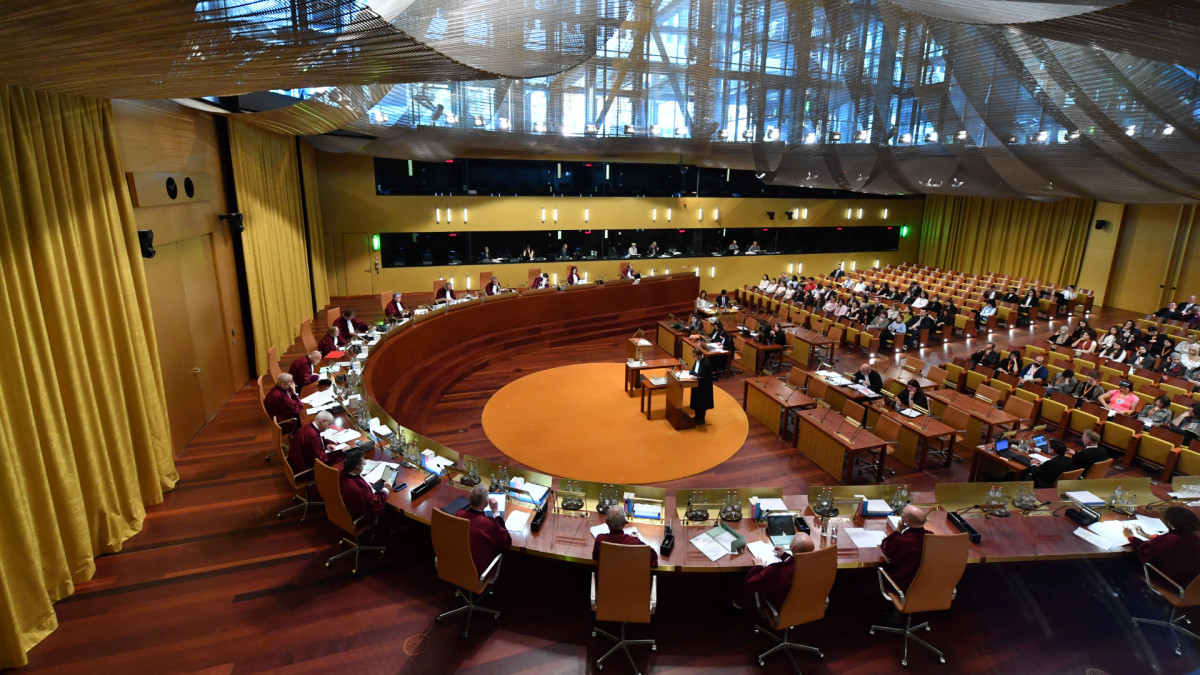
Viktor Orbán has suffered his greatest judicial defeat since his political demise at the polls, but that does not make it any less significant. The Court of Justice of the European Union has condemned Hungary this Tuesday for violating Article 2 of the Treaty on the European Union, an unprecedented verdict in which, for the first time, the judges find that a country has infringed the Union’s fundamental values.
“The rule, according to the ruling, directly infringes human dignity and clashes head-on with the Union’s principles”
Until now, Orbán’s Hungary had been condemned and punished for violating or failing to comply with EU rules. But on this occasion, the judges conclude that the Hungarian law against pedophilia discriminates against homosexuals. The rule, according to the ruling, directly infringes human dignity and clashes head-on with the Union’s principles, which would have exposed Hungary to being deprived of its voting rights in the Council of the Union had it refused to comply with the ruling, as would presumably have been done by Orbán.
The European Parliament and the European Commission had been trying for years to punish Hungary with that utmost penalty, provided for in Article 7 of the Treaty for countries that violate Article 2. But a majority of Union partners resisted wielding a weapon regarded as “the atomic bomb” in the club’s arsenal to defend themselves against their own enemies.
The turn of events, however, had begun to change in recent years in light of the continuous and growing disloyalty of Orbán toward a Union to which Hungary voluntarily belongs. The ruling on the law against the LGBTQ+ community has shown to what extent the outgoing Hungarian government had become a pariah.
Joining the Commission’s complaint were the European Parliament and as many as sixteen EU countries, including Germany, France and Spain, and three enlargement (accession) countries (Estonia, Slovenia and Malta), usually reluctant to penalize Hungary’s drift. Significantly, those sixteen countries account for 65.03% of the EU population, a few tenths above the threshold required for qualified majority voting to push forward any measure irrespective of Hungary’s position under Orbán.
“The ruling sternly proscribes the temptation for any other EU Government to imitate the discriminatory drift on grounds of sexual orientation or any other characteristic”
The immense judicial setback places Péter Magyar’s government, the architect of the crushing electoral victory against Orbán, before the unavoidable need to amend the law which, according to the Court, stigmatized and marginalised LGBTI+ people under the pretext of protecting children allegedly threatened by homosexuals. But, above all, the ruling sternly proscribes the temptation for any other EU Government to imitate the discriminatory drift for reasons of sexual orientation or any other cause.
The judges warn that the Hungarian rule constitutes a “violation of human dignity”, a right enshrined in Article 1 of the European Charter of Fundamental Rights. And they add that some of its provisions “treat a group of people, who form an integral part of a society characterized by pluralism, as a threat to a society worthy of special legal treatment”.
Those words from the judges can be extrapolated to any other form of discrimination on grounds of sex, race, birth, or ethnic origin and carry substantial weight in the context of arbitrary social policies that some parties are trying to push in the wake of Donald Trump’s xenophobic policies. This is the case of the so-called “national priority” agreed by the Partido Popular and Vox for the Extremadura government, which appears to be the draft of a possible national-level agreement that, if implemented, would hardly clear the bar set by the EU Court in its historic ruling of that April 21.
The same Court ruled illegal last week the Bavarian (Germany) rule intended to reduce the benefit provided for the education of children of workers from other European countries whose children did not reside in Germany. The Bavarian ruling recalls that “migrant workers must be able to benefit from the social policies of the host member state on the same terms as national workers”, since they contribute to financing those policies with the tax and social contributions they pay in that state.
In Hungary’s case, the elections ten days ago prevented the momentous verdict from triggering a Brussels-Budapest clash with grave political and legal repercussions, especially for the infringing country. After years of violating EU rules and exposing Hungary to multibillion-euro sanctions, Orbán crossed the red line with the law against homosexuality, violating Article 2 of the Treaty.
For the first time, a country has been condemned for crossing that limit, which would have facilitated, had Orbán remained in power, the full application of also for the first time, a Treaty Article 7 that allows suspending a country’s voting rights in the Council of the EU and reducing its role to that of a mere figurehead in the community’s decisions.
Because Orbán has been losing allies even among Central and Eastern European countries, mainly due to his repeated opposition to aid for Ukraine and to sanctions against Moscow. The Polish Prime Minister, the conservative Donald Tusk, was one of the first to publicly celebrate Fidesz’s electoral defeat.
Orbán’s isolation in the final stretch of his mandate was becoming increasingly evident. He even had to endure in 2023 the humiliation of the then German Chancellor Olaf Scholz suggesting that he temporarily leave the European Council table to proceed with a vote without him, so that the Union would move forward, bypassing and snubbing the Hungarian veto. Orbán stood up and the other twenty-six Member States approved the opening of negotiations for Ukraine’s accession.
Tuesday’s ruling shows that Orbán was already at the edge of the precipice. And that the European Union had more and more grounds to push him toward an abrupt end. Now, even with a ruling that places in black and white the incompatibility of a Hungarian norm with the EU’s principles.
