
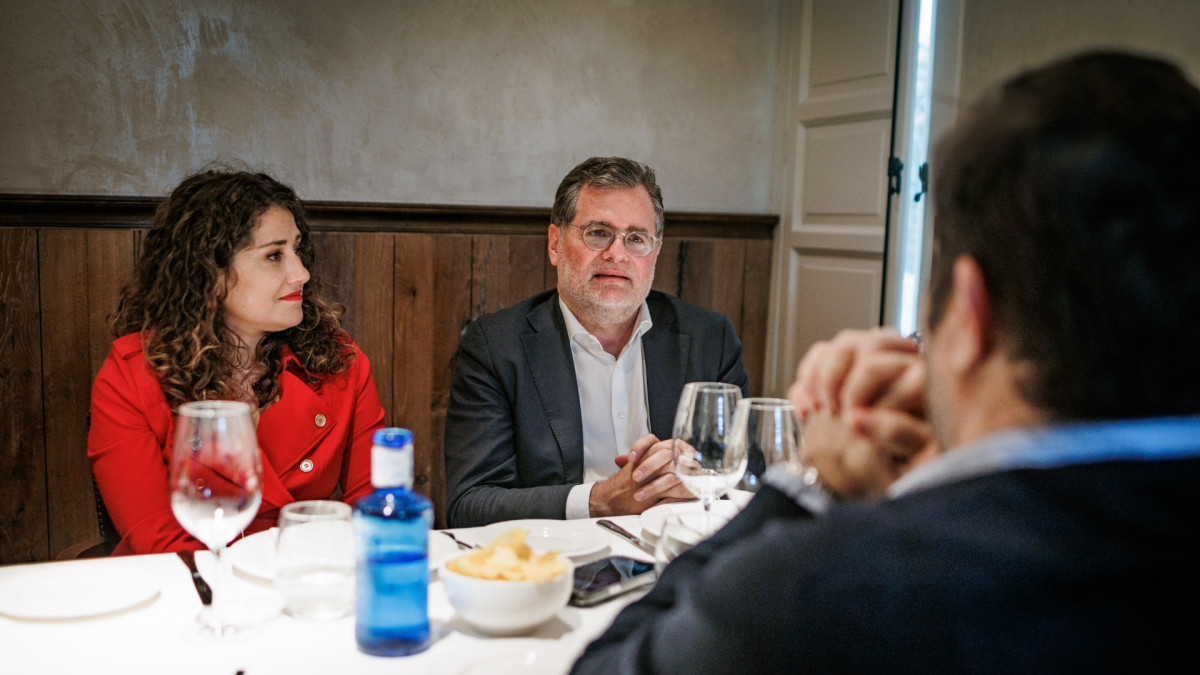
The future of the European project requires a strategic alignment between German pragmatism and Spanish impetus. The office of the Friedrich Ebert Foundation in Madrid has brought together the Social Democrats Wolfgang Schmidt and Enma López in this conversation, in which they explore the main topics on the European agenda in Agenda Pública.With Donald Trump as the major disruptor of the Atlantic alliance, Schmidt notes that “under normal circumstances, a European leader would have to stand up and respond firmly“, but he is aware that “that then has costs in other areas”.
For her part, López reiterates that “what he wants is to divide us” and therefore the path must be one of “European unity”, just as in Ukraine or in European economic challenges. On this point, the Galician is clear: “We have to decide whether we prioritise social cohesion, pensions and social spending, or whether we simply accept a Washington-imposed agenda”, she explains.
In their analysis, they shed light on other particularly divisive points, such as the war in Iran, the role of the radical right in Europe, or the role of European leaders in the present. Although they had previously been interviewed in Agenda Pública in the past, this is the first time they do so facing each other.
Enma López and Wolfgang Schmidt in Madrid. Photo: Agenda Pública / Tania Sieira.
The first question concerns Chancellor Merz in the Oval Office and his reaction when another European country is criticized. What reading do you make of this?
Wolfgang Schmidt (W. S.): The scene well captures how difficult the situation is when you have an American president in front of you whose main characteristic in foreign policy is unpredictability.
For a German leader, moreover, several issues intersect in such a situation. First, the European Union as a whole and European solidarity. Then, the interests of his own country, heavily dependent on exports to the United States and, therefore, on the American market. And finally, support for Ukraine.
European leaders try to keep Trump as close as possible to a European position. Ukraine continues to depend in part on U.S. backing, especially in intelligence and certain resources that Europe cannot immediately replace. Moreover, Washington still directs the negotiations. The calculation, so far, has been clear: it is preferable to act with the U.S. within the process than to push it off the table.
We have also seen how Trump has transformed what used to be little more than a protocol photo in the Oval Office into a kind of boundless press conference. And there he can say things that, under normal circumstances, a European leader would have to stand up to and respond to firmly. The problem is that this later has costs in other areas.
“[Trump] has an evident preference for the far right, but he also maintains good relations with leaders from other political spaces”
Trump also acts greatly based on personal relationships. He is not always guided by a cold strategic logic, but by affinities or aversions. He has a clear preference for the far right, but he also maintains good relations with leaders from other political spaces. That helps explain why the German chancellor reacted the way he did. And I understand that, from Spain, that raises questions.
What questions does this raise from Spain?
Enma López (E. L.): In my view, the questions should not be directed at Germany, because precisely what he wants is to divide us. The response to Trump has to be more Europe.
Each country has its own constraints and that must be respected. But I do think a path is opening, and Pedro Sánchez has opened it with courage and consistency. He has maintained the same position he had with Ukraine and with Gaza and Palestine: respect for international law and rejection of unilateral actions, regardless of whether we like the regime affected more or less. We have done the same with Venezuela.
Now we are seeing how other countries begin to join that path. It has happened with the United Kingdom and with France. And that is the way: European unity. Otherwise, we will remain at the mercy of the will of a single person on the other side of the Atlantic, and that puts us in a position of weakness.
For mid-sized countries like Spain, multilateralism is an opportunity. Anything that departs from it returns us to the rule of the strongest, and in that scenario everyone loses. I am convinced that António Costa and the rest of the European leaders will share this stance as well.
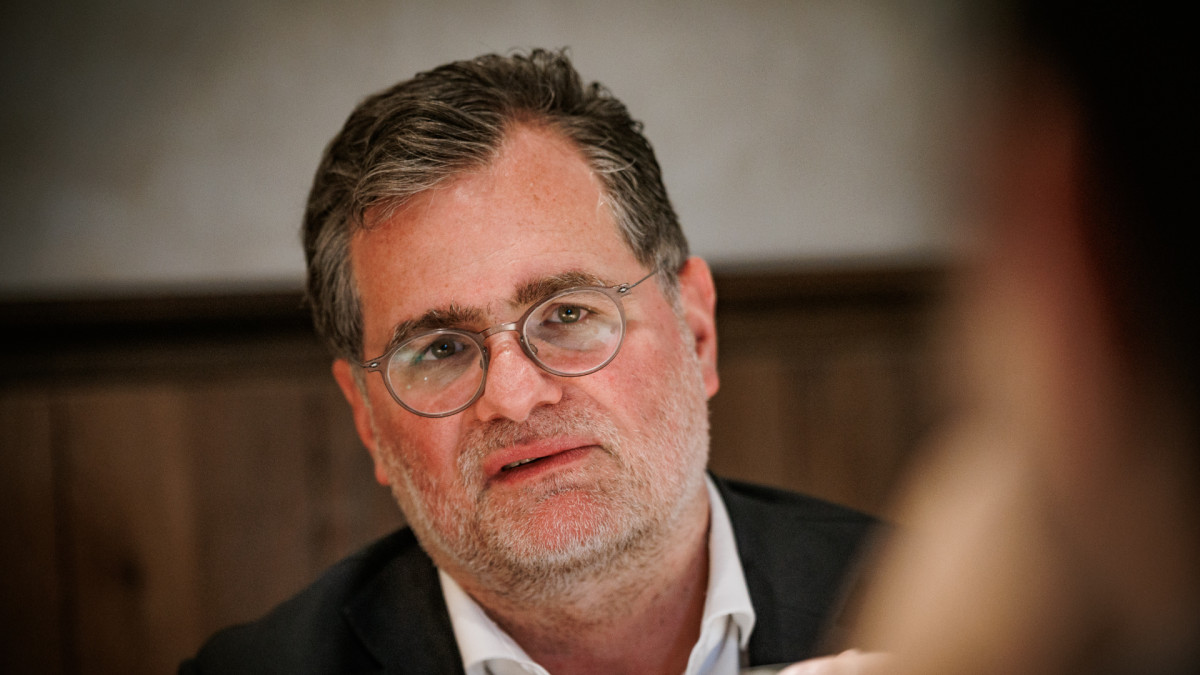
Schmidt, very close to Spain, received the Grand Cross of the Civil Merit Order in 2022. Photo: Agenda Pública / Tania Sieira.
Do you not get the sense that a portion of the public actually buys into the logic of the law of the strongest? In other words, when international or multilateral law fails to resolve certain problems, there are those who prefer immediate, even harsher solutions. This has been seen in debates about Venezuela or Iran. The question for both of you is this: how should the left, or European social democracy, respond to a portion of the public that believes that path is more effective?
E. L.: In Spain I do not think that is the majority position. There may be people who see it that way, especially among those who oppose Pedro Sánchez and reject any decision by the Government, but the majority sentiment in Spanish society remains opposed to war.
Here the memory of the consequences of unilateral actions remains very vivid. In Madrid, and not only in Madrid, that wound remains present. That is why the “No to war” has such symbolic strength. Not because one preferred the regime of Iraq or Iran, but because the debate is not about choosing between tyrannies. It is about respecting common norms, defending human rights, and protecting the sovereignty of states.
“In Spain I do not see a false dilemma: I see a society fairly clear in its rejection of war”
Another question is whether this multilateral approach needs to be revised to be more effective. Probably yes. Hence talk of a political conference or a peace convention to review mechanisms that today are not functioning as they should.
That is a debate that progressives must address, though not only progressives. All democrats should be united in this, because in the end we are talking about democracy. And in Spain I do not see a false dilemma: I see a society fairly clear in its rejection of war.
W. S.: The law of the strongest depends a lot on the point of view. If you are the victim of that force, you perceive it very differently from someone on the side that exerts it.
It is also worth distinguishing between Venezuela and Iran. In the Iranian case another element comes into play: not only internal regime repression but also the threat it projects on Israel and other neighbors. And that leads to an uncomfortable question: why act against Iran and not against other Gulf countries that are not democratic and also commit grave abuses? Why not act the same against other authoritarian regimes?
Part of the answer has to do with the nuclear threat and with the deterrence capacity granted by those weapons, as with North Korea or Russia. Another part with Iran’s regional projection through actors such as Hamas, Hezbollah or the Houthis.
International law, based on the text of the United Nations Charter, is clear: Article 51 only activates when an attack has already occurred. At the same time, we have seen how a country that fears a threat can feel trapped by a real dilemma: taking action earlier means abandoning the legal framework; waiting can have irreversible consequences. But then the question arises: who decides when that risk justifies action?
Add to that another reality: when the Security Council is paralyzed by vetoes and power balances, who makes decisions to preserve international peace? The General Assembly can condemn, as happened with Russia’s invasion of Ukraine, but such condemnation is not enough to stop a war.
“In Germany it was different because Gerhard Schröder’s government opposed it, just like France with Jacques Chirac. Yet, within Germany there was also opposition to that stance”
For that reason, the situation is more complex than a purely abstract appeal to international law suggests. The position of the Spanish government, that of Pedro Sánchez, is clear, coherent and strongly grounded in the letter of international law. It has logic and legitimacy. At the same time, it is true that the international context has become much more difficult to manage.
In Spain, moreover, there is the memory of José María Aznar’s support for the Iraq War and of some tests that later proved false. In Germany it was different because the Schröder government opposed it, just like France with Chirac. Yet, inside Germany there was also opposition to that stance. Ultimately, the question of how to respond to the actions of a superpower like the United States when it projects its power beyond its borders remains extraordinarily complex.
RELATED ARTICLES
Enma López and Nacho Catalá discuss with ‘Agenda Pública’ in Granada.Agenda Pública / Álex Cámara
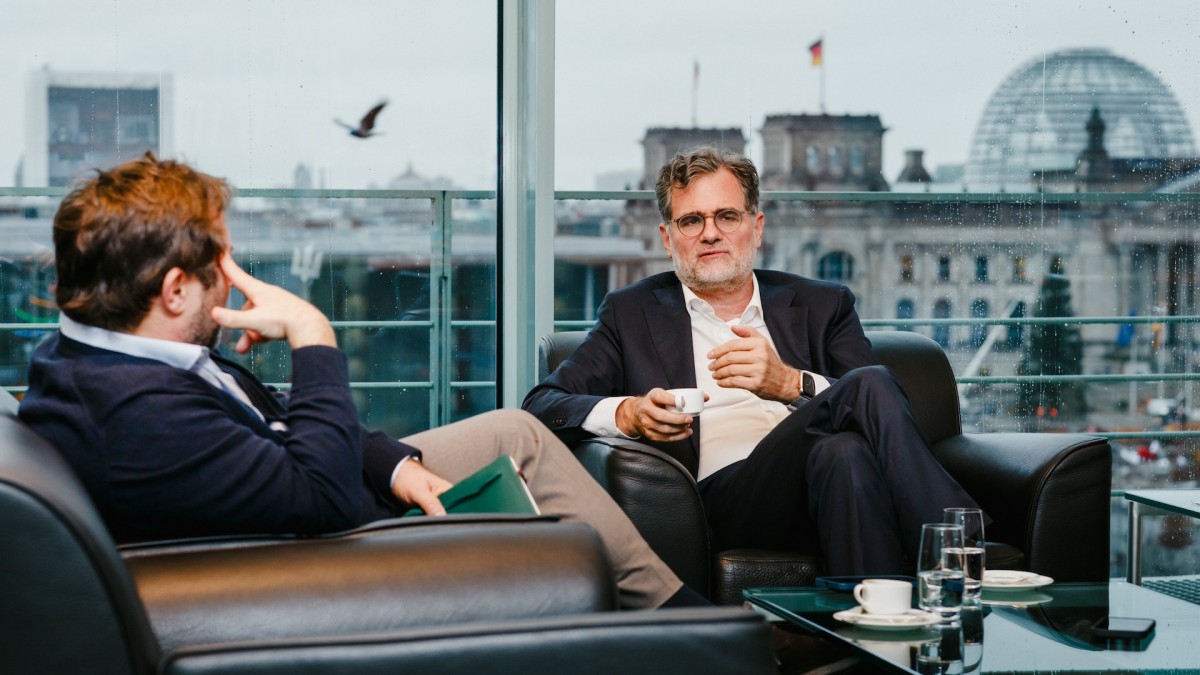
Wolfgang Schmidt receives Agenda Pública at his Berlin office, facing the Bundestag.Agenda Pública / Patricia Sevilla
Speaking of that projection of power, to what extent does Trump’s leadership style damage the radical right in Europe? AfD, Le Pen or Vox always speak in terms of national sovereignty. If the U.S. funds or at least promotes certain right-wing think tanks in Europe, can we speak of political interference? And, moreover, to what extent does Trump’s projection of power inside other countries weaken the European far right itself?
E. L: To the European far right, it places them before a huge contradiction. They are the ones most wrapped in flags and who most claim to be patriots, but when the time comes for truth, they appear aligned with an external power that directly threatens our sovereignty.
It was very clear with Greenland. We are no longer talking about distant cases. We are talking about a direct threat to European territory. And then the obvious question arises: where do those purported patriots stand? On the side of defending our independence and sovereignty or on the side of those who call it into question?
“When Trump punishes the Spanish countryside, are you with the farmers or with those who harm them? And the same happens with the debate about the 5% of NATO spending”
The contradiction also appears with tariffs. When Trump punishes the Spanish countryside, are you with the farmers or with those who harm them? And the same happens with the debate about 5% of NATO spending. The budget is one, and money is finite. We must decide whether to prioritise social cohesion, pensions and social spending, or simply accept a Washington-imposed agenda.
There you can clearly see it. They are not patriots: they use the flag to divide. Patriotism is demonstrated by defending the country against external interference and sustaining the common good. And I see exactly the opposite.
W. S.: The case of Greenland was very revealing. Europe’s far-right had a hard time fitting Trump’s words about Denmark and a European territory. Because, indeed, there clash two things: his sovereignty discourse and the fact that Trump threatens a member state of the European Union.
That put Farage, Le Pen, AfD, and even allied leaders like Orbán in an awkward position. They were forced to distance themselves. There you clearly perceive the contradictions of a far-right that pretends to be international without ceasing to present itself as ultranationalist.
About think tanks, one should be a bit more cautious. Not every international work carried out by foundations or think tanks can be equated with interference. German foundations also operate in other countries. There is a legitimate ground for exchange, training and political relations. The problem arises when that work is combined with a capacity for massive and opaque influence.
And there the big change is not so much in the think tanks as in platforms controlled by tech oligarchs aligned with Trump, or with the part of Trump closest to J. D. Vance. That does alter the democratic balance: they control algorithms, data and visibility flows. Their influence capacity is incomparably greater than that of a traditional think tank. Against that, a response is indeed required.
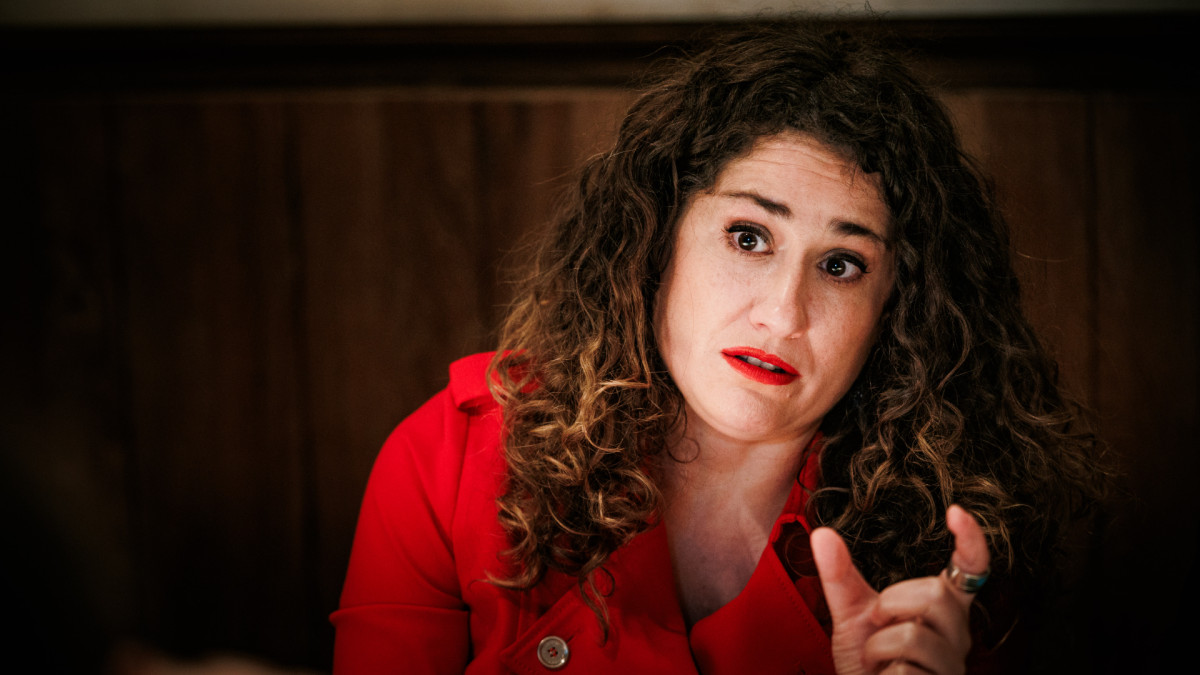
The Madrid PSOE spokesperson for the Madrid region detects contradictions within the European radical right. Photo: Agenda Pública / Tania Sieira.
There is another matter that social democracy must face: leadership. I used to like Scholz a lot, but it is evident that he was not a leader who connected massively. Pedro Sánchez, however, does seem capable of changing political narratives in a profound way. How much weight do leaders have today in the ability to build a winning narrative? To what extent is the problem not just what is done, but how it is embodied?
W. S.: There are several layers to that question. The first is that having a leader is not enough: you need an idea. Not only a narrative, in the superficial sense of the term, but a substantive idea that is attractive in such a complex time. And then, someone capable of representing it.
There is a growing demand for strong figures, for leaders who break rules and convey authority. But in Germany we have a political system designed, precisely due to its historical experience, to avoid excessive concentration of power. There are checks and balances, sixteen Länder, a Parliament that elects the chancellor and a political culture based on coalitions.
That clashes with the widespread expectation of personal leadership, partly nourished by the presidential image of the United States. People expect someone who bangs the table and decides. But Germany does not operate that way.
In the case of Olaf Scholz, it is worth remembering that in 2021 he was one of the most valued politicians in the country. He had been very popular as mayor of Hamburg and as finance minister; he came to the chancellorship with solid legitimacy. What happened is that governing a three-party coalition with very different parties wore down that popularity.
“From the outside it may seem like a lack of leadership, but often it is the result of a system deliberately built to avoid unilateral decisions”
In a coalition, it is not enough for the chancellor to want something. There are other leaders with autonomy, other ministries with their own competencies and deputies who answer, ultimately, to their own conscience. That is the logic of the German system. From the outside it may seem like a lack of leadership, but often it is the result of a system deliberately built to avoid unilateral decisions.
That does not mean leadership does not matter. It matters a lot. But its strength also depends on the institutional system in which it operates and the social expectation surrounding it.
E. L.: I do not see a contradiction between the separation of powers and the importance of leadership. Each institution has its role, but the leadership of a president is decisive, especially in a moment like this.
And I am not necessarily talking about authoritarian leadership. There are other forms of leadership. I recently read a reflection on “leadership of doubt,” and I find it suggestive. What matters today is to have a voice and to be able to make decisions when it is time.
There comes a moment when it is no longer enough to rely on advisers, teams or reports: a final call must be taken, and the one who picks up the phone is the president. That is why it matters so much who bears that responsibility.
“Today we need leaders who are brave, with firm convictions and capable of standing up not only to other elected leaders but also to the tech oligarchs”
The response to what is happening with Trump is being provided by state leaders: Macron, Steinmeier or Pedro Sánchez. There you can see courage, consistency and the capacity to accept costs. Because defending a position has consequences, and sometimes those consequences translate into tariff threats or diplomatic tensions. The European Union also demonstrates its usefulness in this area. We are stronger because we share a common market and a common political architecture. That protects Member States and widens their room for maneuver.
That is why I believe today we need brave leaders, with firm convictions and capable of confronting not only other elected leaders but also the tech oligarchs. We have already seen clashes between Pedro Sánchez and Elon Musk. Musk may have more influence than many heads of state. It is a different kind of power, but very real. Democratic leadership must be prepared to challenge it.
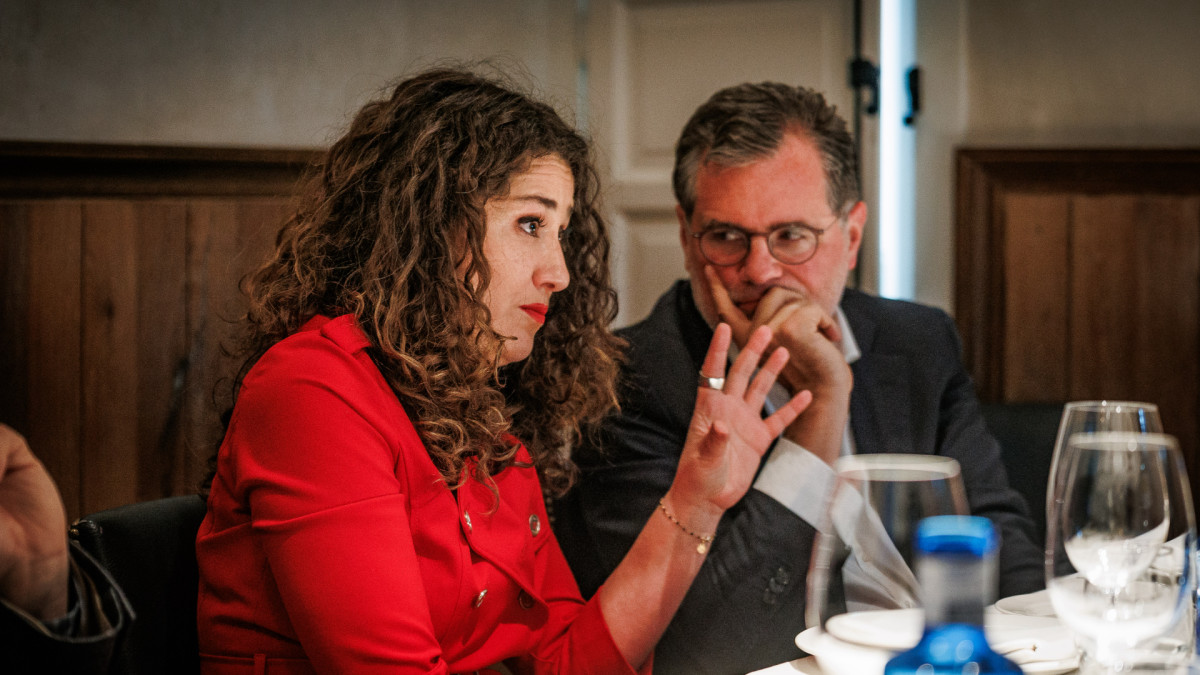
Schmidt and López closely observe the leadership of Pedro Sánchez and former Chancellor Olaf Scholz. Photo: Agenda Pública / Tania Sieira.
One last, more concrete question for Wolfgang Schmidt. I want to propose a hypothesis: I get the impression that one of the great external interferences suffered by a European country in recent years has been Russia on Germany through Ukraine. In other words, that Scholz lost the election because of Ukraine. Russia knew what it was doing, knew what it could provoke in Europe and, in particular, in Germany. Would the coalition have fared better without the pressure stemming from the invasion?
W. S.: Yes, without a doubt. And not only for the more evident geopolitical reasons, but because the war ended up having a direct effect on the coalition’s finances and political stability.
Germany has supported Ukraine with enormous military, economic and social aid. Added to that were the costs of hosting refugees. On the other side, there was the so-called debt brake, which drastically reduced the margin to finance other priorities, such as economic and energy transformation.
At the same time, cheap gas disappeared, inflation rose, real wages fell and social discontent grew. This happened not only in Germany: in many countries incumbent governments paid a high electoral price for that accumulation of crises.
“Once the war began, it became evident that [Russia] took advantage of the context to intensify political pressure, support extremist forces and hinder governance”
I do not think Moscow planned exactly that from the start. Probably Moscow expected a quicker victory, fewer sanctions and a smaller impact on the European economy. But, once the war started, it is evident that it also took advantage of the context to intensify political pressure, support extremist forces and hinder governance in several European countries. That is part of its playbook.
It is also worth recalling that the coalition’s start was very different. After the September 2021 elections and during the negotiation of the agreement, the climate was one of enthusiasm. By December, the three parties entered government with strength and there was a very high expectation of change after sixteen years of governments led by Angela Merkel.
Then came, in sequence, a new wave of COVID, the energy crisis, inflation and the war, also with its economic impact on Germany. All of that completely altered the political horizon. It also reopened the leadership debate, because in times of uncertainty the social demand for direction intensifies.
But, as I said, the German system obliges us to move cautiously, to bargain, to deliberate and not to concentrate power in a single person. That, in crisis contexts, can translate into a perception of slowness or weakness, even though it responds to a very different institutional logic.
In any case, yes: without the war and its economic consequences, I am convinced that that coalition would have had many more chances to function well.
Thank you both very much.
