
The unilateral and unprovoked decision by the United States and Israel to launch a war of choice against Iran places the European Union at a historic crossroads that transcends the regional stage. This is not simply a new escalation in the Middle East, a region that is structurally unstable and crossed by overlapping conflicts. We are at a turning point that directly challenges the normative core of the European project. The EU was born as a community of law, as a political response to the devastation of the twentieth-century wars, anchored on the premise that force should be subordinated to the rule of law. Today, that principle appears eroded by the majority European stance, with the exception of Spain, faced with a military intervention that has no Security Council mandate and has overwhelmed diplomatic channels.
“The President of the Commission, Ursula von der Leyen, has appealed for de-escalation and regional stability, while reiterating Israel’s right to defend itself”
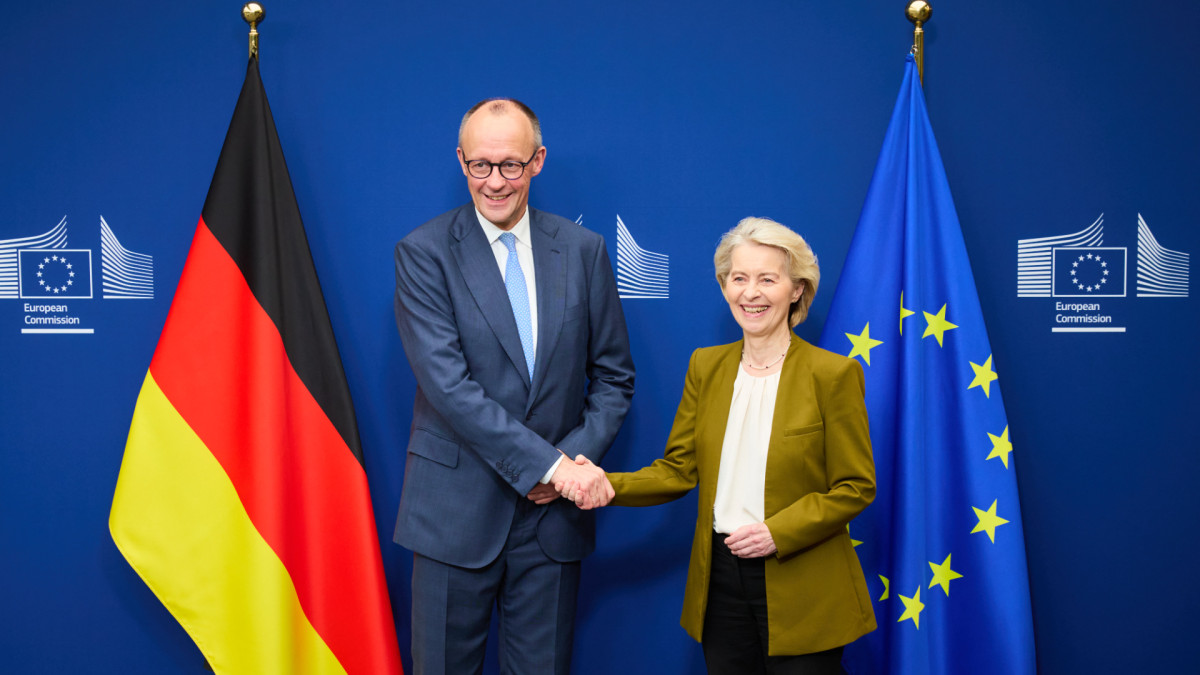
The reaction of the community institutions has been revealing. The President of the Commission, Ursula von der Leyen, has called for de-escalation and regional stability, while reiterating Israel’s right to defend itself. This approach, which in other contexts could be interpreted as diplomatic balance, takes on another meaning here. It avoids making a clear judgment on the legality of the action and shifts the debate toward security understood in strategic terms. The High Representative, Kaja Kallas, has insisted on the need to avoid a regional conflagration that would directly affect the European framework. Yet, neither from the European External Action Service has there been an autonomous initiative to claim the role of the United Nations or to openly challenge the breach of the international legal framework. The silence on illegality is not neutral; it contributes to normalizing it.
The German turn under Chancellor Friedrich Merz is particularly significant. Germany was a key player in negotiating the Joint Comprehensive Plan of Action (JCPOA), an agreement that demonstrated that multilateral diplomacy could contain nuclear risks without resorting to force. Berlin then defended the negotiated path and the centrality of international law. Today, the Chancellor’s statements, which appear to be sympathetic to intervention and lack a clear condemnation, do not merely consign that diplomatic achievement to oblivion in which Germany played a laudable role, but send a troubling message in terms of normative coherence. If it is accepted that a power may resort to force without international mandate when it deems it opportune, by what authority can one condemn Russia’s aggression in Ukraine?
The erosion of the norm is always bidirectional and opens space for other revisionisms. The rhetorical message from Merz, beyond its implications for the Middle East, offers a dangerous green light to those who question the European legal order and even legitimizes other expansionist temptations under the logic of power.
“We are faced with a Europe that seems to have assumed its place is to accompany decisions taken in Washington, even when they amount to a breach of international law”
The joint statement of the E3 (Germany, France, and the United Kingdom) confirms this drift. The three countries that pushed the nuclear deal with Iran and that for years championed European strategic autonomy now align with the American position. We are not facing a Europe that is dispersed or fragmented. We are facing a Europe that seems to have assumed that its place is to accompany decisions taken in Washington, even when they entail a breach of international law. We have moved from rhetorical subservience and prudent appeasement to a deeper step, the political backing of an intervention that erodes the liberal multilateral regime.
The paradox is profound. Two liberal democracies (though in crisis and evident decline) are driving a war of choice that is not forced, transcending diplomatic channels. And other European democracies join, directly or indirectly, that initiative. If the liberal order was defined by the voluntary submission of democracies to common rules, what we observe is the gradual disengagement from those rules when they prove inconvenient. The multilateral regime does not collapse solely due to the actions of authoritarian powers; it also drains from within when those who uphold it stop respecting it.
The European alignment also opens a much broader stage for strategic ambiguity. President Emmanuel Macron has explicitly raised for the first time the possibility of an expanded nuclear deterrent in cooperation with partners such as Poland, the Netherlands, Denmark, Belgium, or Sweden. In parallel, Gabriel Attal has stated that the United Nations has become a mere humanitarian and climate actor, incapable of preventing conflicts, meaning that new forms of governance must be imagined. These statements, far from being incidental, anticipate a Europe that adopts the language of power and deterrence as the central axis of its foreign policy. The war against Iran, rather than halting proliferation, opens a window of opportunity that accelerates an arms race that is no longer limited to the conventional plane.
“The involvement of France and the United Kingdom, with military presence in the area, places all Europeans on the edge of a war”
Economic dimensions cannot be ignored either. In a region strategic for energy supply, the interests of companies like TotalEnergies or BP are at stake, as well as the international projection of the European defense industry with systems such as the Rafale. When the defense of these interests overlaps with the defense of international law, the EU drifts away from its founding narrative. Prioritizing energy security or industrial competitiveness may be understandable from a realist logic. The problem is that this logic ends up replacing the norm entirely.
Meanwhile, the Middle East dynamics proceed in a reckless manner in a highly inflammable region, whose migratory, energy, and security derivatives will inevitably affect European territory; we have already seen this with the attack on the British base at Akrotiri in Cypriot soil, the rotating presidency of the EU Council. The involvement of France and the United Kingdom, with military presence in the zone, places all Europeans on the brink of a war that is not only illegal and unprovoked, but that serves concrete strategic objectives aimed at reconfiguring regional balances and controlling key resources.
Ultimately, it is not a question of whether Europe has enough military capability or whether it can adapt to a more competitive world. The question is whether it is willing to renounce what defined it as a political project—the conviction that international law and the human rights regime are not accessories but the very foundation of its existence. If the European Union accepts that force prevails over the norm when it suits its allies, it will have ceased to be a normative actor and will have become merely another player in the stark logic of power. And that would be, more than a temporary crisis, a structural abandonment of its founding essence
