
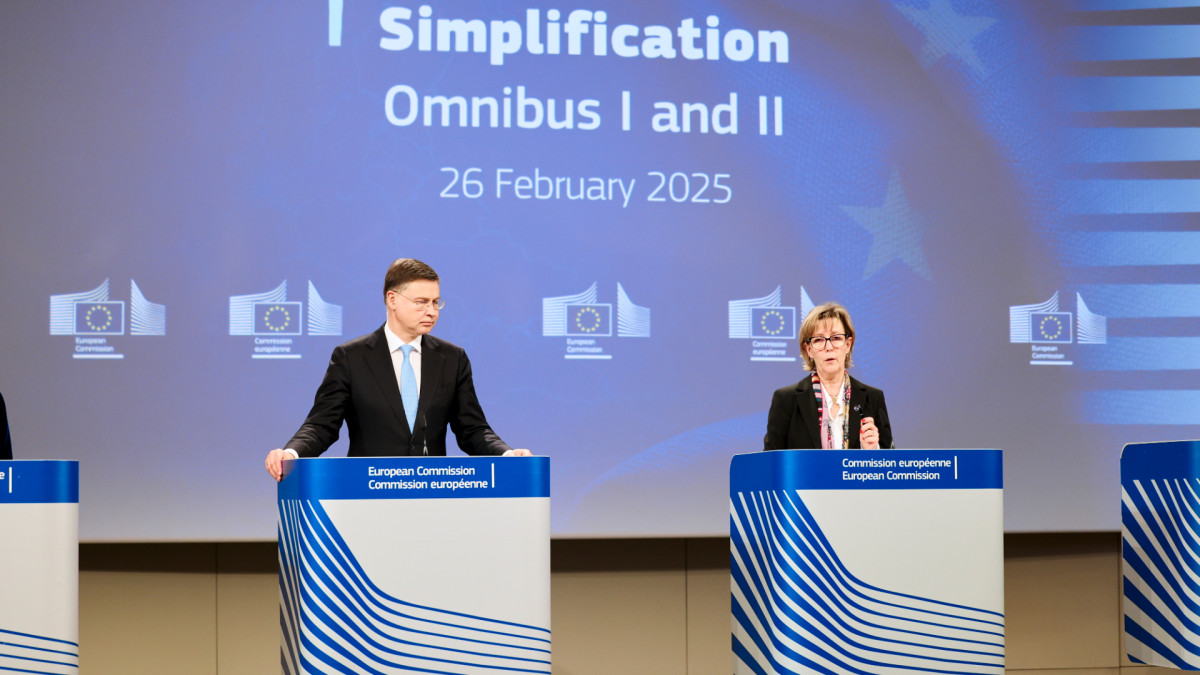
In her interview on Agenda Pública, Ana Gallego argues that the European Commission is not deregulating, but “learning to regulate better”. The core of rights, she says, remains intact. What is being reviewed are procedures, administrative burdens, and formalities that can be simplified.
The argument may seem reassuring, but that is only an appearance, because the context in which this review takes place matters. We are not facing an isolated reform. The Digital Omnibus is part of a series of packages that, under the banner of competitiveness, are revising rules in various areas, from corporate responsibility to the environment. When that logic becomes transversal, it ceases to be technical and becomes political.
In the digital sphere, moreover, the moment is not neutral. The push to “not fall behind” in artificial intelligence (AI) has generated a climate of urgency. A certain European AI FOMO (fear of missing out on AI). The implicit message is that any regulatory restraint could cost us the race against the United States or China.
“The lack of European competitiveness is not mainly explained by the existence of data protection rules or by transparency obligations.”
But this narrative oversimplifies the problem. The lack of European competitiveness is not primarily explained by data protection rules or transparency obligations. It responds to structural factors such as market fragmentation, the difficulties of financing to scale, technological dependence, investment gaps, and the absence of domestic industrial champions in digital infrastructures. Added to this is a track record of public investment policies that, at times, have prioritized reducing risks for private actors over developing own digital capabilities and infrastructures oriented to the public interest.
Thinking that easing obligations on fundamental rights, and doing so without respecting the rules of the game, will resolve that deficit is a weak hypothesis.
Moreover, it is worth asking who truly benefits from regulatory flexibilization. In the current digital ecosystem, those who already control large volumes of data and computational capacity, not to mention massive legal teams and lobbying power, are not European small and medium-sized enterprises. They are platforms and global conglomerates with infrastructures, capital, and legal teams capable of navigating any regulatory ambiguity.
When the demand for traceability, documentation, or transparency is reduced, those best able to adapt are precisely those dominant actors. Not the startups trying to enter the market. Not the SMEs seeking to compete on level playing fields. The Commission argues that simplification favors small businesses. The objective is understandable. But there is an evident risk: that, in practice, competitive advantages are consolidated for those who already control data flows and AI infrastructures.
Rules not only impose limits. They also structure the market. They define how information is distributed, who bears risks, and who is accountable. Reducing obligations under the promise of greater agility may seem pragmatic. However, if those obligations were precisely what allowed visibility and control, the balance shifts.
“The European Union has built over the years a regulatory identity based on the idea that protecting rights is not an obstacle to innovation, but its condition of legitimacy.”
The European Union has built over the years a regulatory identity based on the idea that protecting rights is not an obstacle to innovation, but its condition of legitimacy. That stance generated social trust and legal predictability. A trust that should be seen as an economic asset. If the framework is reconfigured under the pressure of the AI race, the risk becomes juridical and also strategic. Europe could end up competing on the turf of others, rather than strengthening what differentiated it.
Here it is important to acknowledge something: the member states are not immune to these risks. The Spanish state itself has promoted initiatives in algorithmic supervision and digital governance recognizing that digital technologies have deep social impacts. There is awareness that the problem is not only about accelerating adoption, but about managing its consequences.
In that context, presenting the Digital Omnibus as merely a procedural adjustment is insufficient. It is not about sanctifying bureaucracy or denying that certain burdens can be revised. It is about understanding that, in the digital realm, mechanisms of transparency and accountability are not mere formalities. They are the tools that enable people, authorities, and competitors to know what is happening.
The real debate is not simplification versus regulation. It is what digital development model the EU wants in a moment of geopolitical pressure. It can choose to strengthen its commitment to high standards that build trust and long-term markets. Or it can allow the fear of falling behind to reorder its priorities and gradually shift the balance between rights and the market.
That shift does not occur overnight. It accumulates, through adjustments that, taken in isolation, appear minor. That is why the debate deserves more than rhetorical calm. It deserves an honest discussion about what Europe we want to build in the era (or rather the bubble) of artificial intelligence.
