
Rumors had been swirling for several weeks, but finally last Monday Brussels announced that it would prohibit public funding for renewable projects that include solar inverters manufactured in high-risk countries. Essentially, in China.
An inverter is a device that converts the direct current produced by renewable installations into alternating current that can be fed into the grid. In essence, it is the “brain” of the solar installation. They are highly sophisticated, monitorable remotely, and operable from afar. When you see on your phone what your own self-consumption installation is generating, it is thanks to the inverter.
This restriction on financing solar inverters and, apparently, also on BMS—battery management systems—used in storage systems (which serve a similar function) fits into two distinct yet intertwined issues. The first, and the one that the measure aims to justify, is cybersecurity. Solar inverters can be operated remotely by their manufacturers and collect a vast amount of data. Potentially, they pose a risk of cyberattacks and even a direct assault on the European electricity system through a general paralysis of all inverters from a given brand or produced in a particular country.
In fact, it has always struck me as curious that during the first days after the Iberian blackout, when all sorts of conspiratorial theories circulated, it was not claimed that the blackout occurred because the Chinese had stopped all the inverters. Probably those spreading the misinformation did not realize that such a thing was possible. It would have been false, but it would have been even more plausible than some of the other theories that circulated.
“It is important to note how extremely unlikely it would be for China to decide one day to disconnect all the inverters in Europe and cause a blackout”
The risk exists, but I think it is important to stress how extremely unlikely it would be for China to decide one day to disconnect all the inverters in Europe and cause a blackout. It would basically be a declaration of war, with indelible diplomatic and commercial consequences. Only in a warlike or pre-warlike scenario would something like that be plausible.
Distrust of Chinese suppliers and, specifically, of the company Huawei, is neither new nor specifically European. In the United States, restrictions on Huawei began in 2019, first prohibiting its use in government equipment, then limiting its access to federal subsidies, and finally culminating in a de facto veto that spread to a large part of the U.S. economy. Similarly, many in Europe have chosen to follow suit, and national restrictions have been established (in Lithuania, for example) or we have witnessed certain controversies, such as the contract that the Spanish Ministry of Defense had to cancel with Huawei a year ago after winning a tender.
Nevertheless, there are serious suspicions that a protective objective may be hidden behind the cybersecurity restrictions. Last January, the European Union Institute for Security Studies published this report that argued for limiting Chinese influence in critical infrastructure, understanding influence not only as access to information and the interoperability of critical infrastructure, but also as influence through economic investment and control of supply chains.
Furthermore, Europe’s concern about the risk of deindustrialization on the continent is evident and can be seen in almost every statement from European leaders. Europe wants to relocate industrial production, wants to protect itself more commercially, but has not yet found a way to do so without triggering the problems and inefficiencies that would come with a coarse, broad-based protectionism that, in addition, would run counter to its values.
“Europe feels threatened by the potential of Chinese technology, but it needs it, at least in the short and medium term”
Europe, subjected to a new energy crisis and lacking significant fossil resources, needs to reduce its dependence on oil and gas, but to do so it must rely on Chinese technology. That is to say: panels, batteries, electric cars, but also components for these technologies are imported from China. In short, Europe feels threatened by Chinese technological potential, but it needs it, at least in the short and medium term.
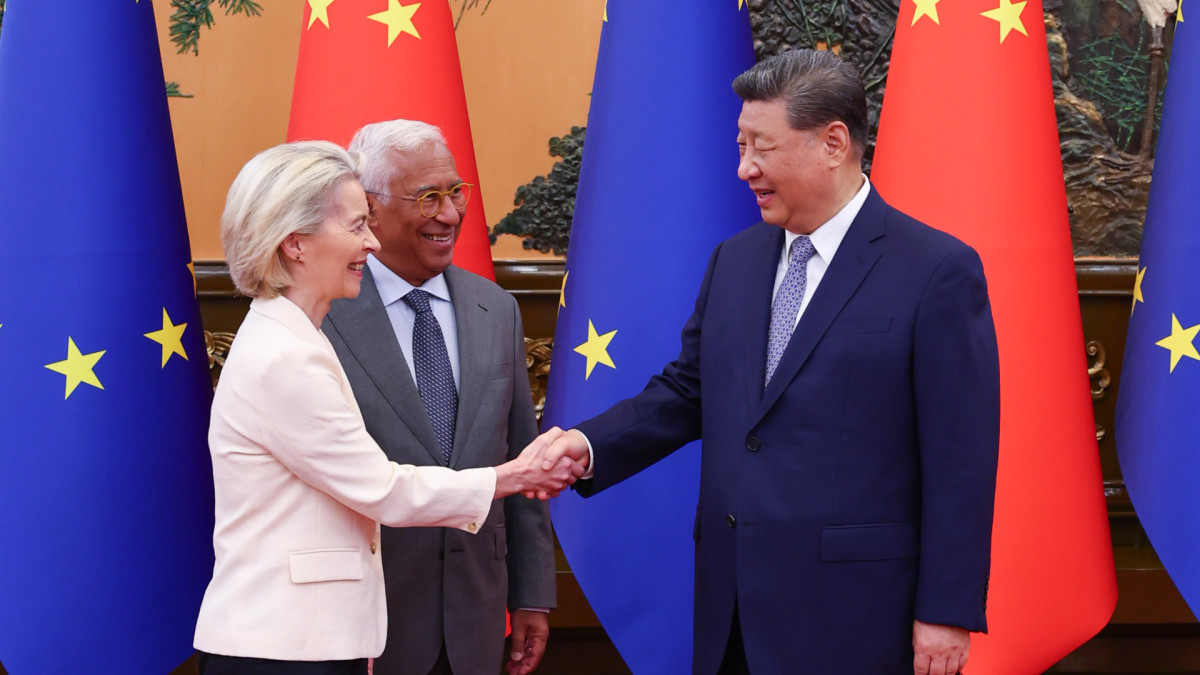
The move by the European Commission has not pleased China at all, which even before the measure was official complained that we were facing a protectionist and unjustified move and threatened with countermeasures. These countermeasures, depending on how strong they are, could jeopardize many European industries. More than once, China has used, for example, restrictions on the export of rare earths; the most recent example being a response to U.S. tariffs.
Beyond the economic consequences, we cannot ignore the geopolitical conflict that Europe faces at its borders. In addition to the direct conflict with Russia, this past year has brought a relationship with the United States that is increasingly problematic, with no sign of improvement; quite the opposite. The next two and a half years could be very hard in this regard, because the American president is not someone to be pacified with concessions. It has been shown that the only way to restrain him is to show firmness and strength. Let us not forget that, before getting involved in the Iranian hornet’s nest, he intended to annex territory from an EU country, not to mention his brazen policy of dividing the EU by supporting anti-European parties.
As if that were not enough, Middle East problems have opened a new geopolitical front. In this context, can the EU afford to start hostilities with China? In principle, there seem to be too many fronts for a divided continent with weak governance.
In broad terms, it seems reasonable that Europe would want to keep control over critical issues. In the case of inverters, it could even dispense with Chinese manufacturers, since, although the two leading inverter manufacturers in the world are Chinese (Huawei and Sungrow), Europe is home to three of the world’s main inverter manufacturers: the German SMA, the Austrian Fronius, and the Spanish Power Electronics.
The case of Power Electronics is paradigmatic. Seventy percent of its turnover comes from sales to the United States, where, as a reminder, Huawei is banned, and another significant portion of its business is in Australia and the United Kingdom, with similar concerns. However, its share of business in Europe is modest. We therefore have enough productive capacity to satisfy European needs, but we do not leverage it because European-made products tend to be somewhat more expensive. Yet the difference is not so significant: for a utility-scale solar park, the difference between using a Chinese inverter or a European one could be a price increase of barely about 1%. Not something insurmountable.
“We cannot risk an energy transition that we urgently need and maintain a dependence on fossil fuels”
Nevertheless, Europe needs Chinese solar panels and batteries or, at least, their basic components: solar cells and battery cells. In Europe we no longer have (or have not yet developed) these production capabilities. It is legitimate that we want to use European products, especially in critical matters, but we cannot risk an energy transition that we urgently need and maintain a dependence on fossil fuels that is worse and more intractable than the dependence on foreign technology.
We will see what becomes of the review of the European cybersecurity law and to what extent European protectionist pressure from industry ends up conditioning or joining other legitimate concerns. In any case, it would be prudent to handle these issues with a cool head and prioritize frank dialogue over conflict. China must understand that Europe has a legitimate aspiration to remain an industrial power and to retain control over sensitive issues. Just as China imposed the joint-venture and technology transfer model to attract investments since Deng Xiaoping, Europe today aspires to an industrial model with European guarantees and it is possible to seek collaboration models between China and Europe that can work with a reasonable level of comfort for both parties. However, Europe must be careful not to open a new geopolitical conflict that would increase dependence on those who today are either subtly or openly hostile.
