
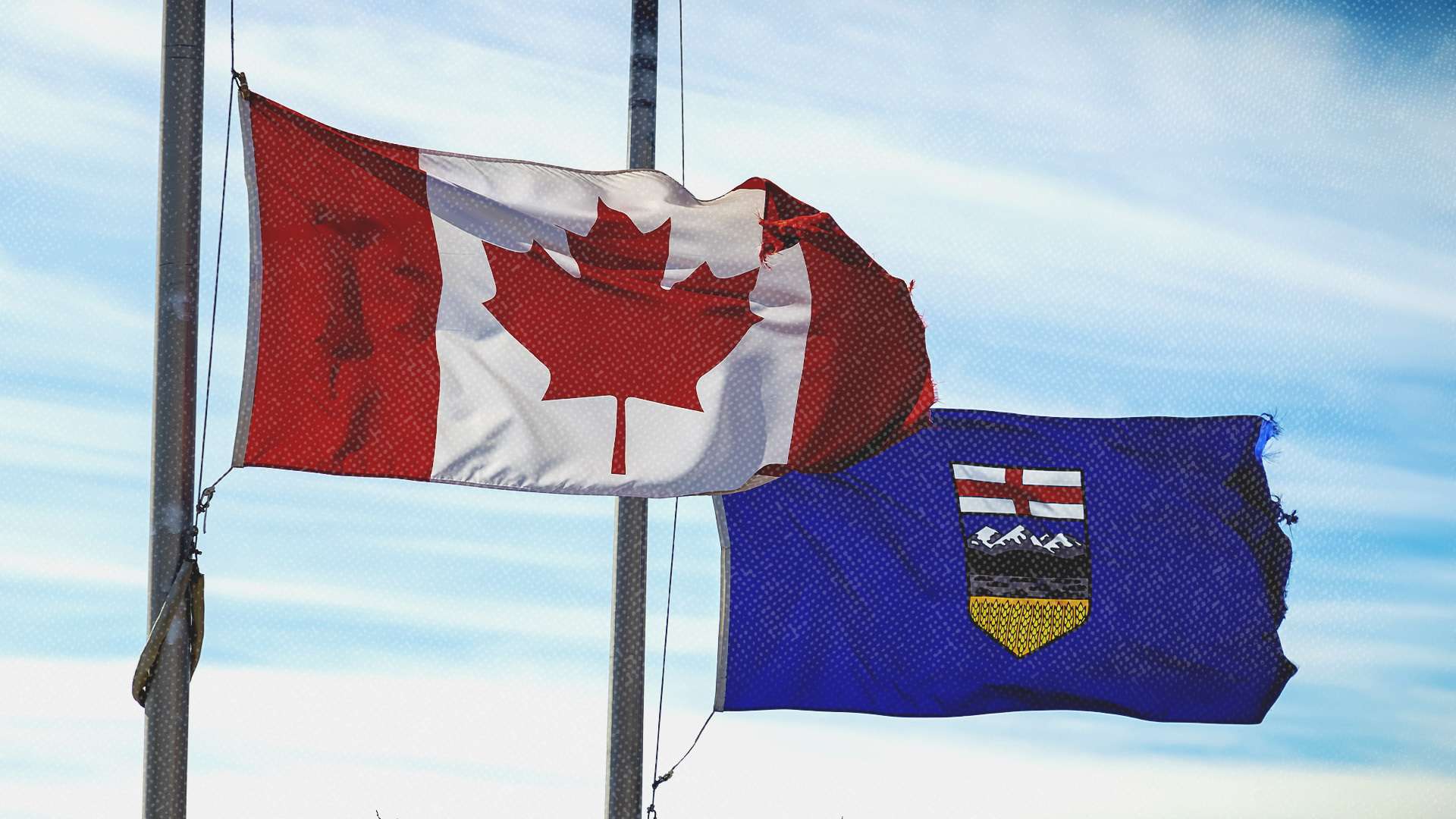
Economic grievances and political alienation are fueling a separatist movement in the Canadian province just north of Montana.
This Monday, a separatist faction in the oil-rich province of Alberta, located immediately north of Montana, delivered more than 300,000 signatures in support of a referendum on exiting Canada. The total surpasses the legal threshold needed to trigger a vote by a wide margin. Recent assessments indicate that a sizable portion of Alberta’s population—roughly a quarter—would back secession. While the organizers still face a long road before a referendum is held, the movement’s rising popularity highlights growing fault lines within Canada’s constitutional order—especially cultural divergences, economic grievances, and persistent political underrepresentation of western provinces.
Alberta has never before seriously launched a path toward independence, whereas the Francophone province of Quebec has staged referendums on leaving Canada. The second referendum, in 1995, produced a razor-thin “remain” result—50.58 percent—leading the Supreme Court of Canada to issue an advisory ruling defining the conditions under which Quebec could pursue secession. The court stated: “The other provinces and the federal government would have no basis to deny the right of the government of Quebec to pursue secession should a clear majority of the people of Quebec choose that goal, so long as in doing so, Quebec respects the rights of others.”
That Quebec ruling could, in theory, supply a legal pathway for Alberta. Yet the current demand to “respect the rights of others” is now being used to challenge Alberta’s capacity to separate. In the view of some Indigenous groups, secession would threaten collective Indigenous rights protected by treaties and enshrined in the Canadian Charter of Rights and Freedoms.
Nevertheless, an unfavorable judgment would likely intensify the sense that Alberta is being treated unfairly. At its core, the Alberta Sovereignty movement stems from a feeling that values and ambitions in the country’s conservative, economically productive prairie heartland diverge from those of the more prosperous yet politically influential eastern provinces, notably Quebec.
The roots of Alberta’s early settlement are instructive. Albertans developed a distinct culture and set of ideals that diverged from the Francophone and monarchist sensibilities in the east. Early settlers included Mormons, Germans, Ukrainians, and other Eastern Europeans who primarily moved north from the United States rather than coming from more settled regions of Canada. They were aspirational Americans who, after crossing the frontier from Ellis Island toward the Rocky Mountains, pursued opportunities in a land where land was cheaper and easier to obtain.
These cultural differences persist, particularly in the province’s conservative political leanings. For instance, in 2024, Tucker Carlson conducted a sold-out tour in Alberta, charging about 200 CAD ($147) per seat for appearances with the province’s premier (the equivalent of a governor). Alberta also cherishes a Wild West ethos, being the home of the Calgary Stampede, recognized as the world’s largest outdoor rodeo event.
Adding to the complexity is Alberta’s unique economic position within Canada. Beneath the province’s surface lie roughly 167 billion barrels of oil reserves—nearly four times the volume found in the United States. Yet Alberta is one of only two landlocked provinces, meaning it cannot transport this oil to international markets without the collaboration of other provinces.
Complicating matters further are extensive interprovincial trade barriers that Canadian provinces erect against one another. Unlike the United States, Canada does not prohibit discrimination against intranational commerce. The issue is so pronounced that a 2019 IMF report observed that international free trade agreements give foreign firms better access to Canada than Canadian ones enjoy. This lack of internal free trade creates perverse incentives: provinces that rely on cheap oil to keep their manufacturing sectors competitive are incentivized to block that oil from reaching global markets, even if such actions reduce national productivity.
Another factor is the equalization payments scheme—intended to redistribute revenues from wealthier provinces to those less affluent and calculated based on each province’s tax base. Since the program’s inception in 1957, Alberta has not received any equalization funds. By contrast, Quebec received about $129 billion between 2015 and 2025, a burden largely borne by Alberta. The gap is amplified by exemptions like Quebec’s hydropower revenue and restrictive policies, such as the province-wide ban on retail stores opening past 5 p.m. on weekends.
These economic frictions have fed into Canada’s broader economic stagnation over the past decade under liberal governance. The country now posts a GDP per capita that trails Alabama, one of the least productive U.S. states.
Finally, separatists have exploited a sense of political marginalization after years of liberal leadership, tapping into Albertans’ feeling of powerlessness when addressing these structural issues. Canada operates as a parliamentary system, in which voters elect one representative per riding, and the party with the most seats forms the government, the leader becoming prime minister. Given Alberta’s concentration of conservative voters, many ridings are won by margins well above 70 percent—even in a multiparty setting. In contrast, ridings in the eastern provinces often hover near or below 50 percent, especially where three or more parties compete. Taken together with the distribution of votes, Alberta’s influence over the ruling party and the prime minister is markedly smaller than that of voters in Eastern Canada.
This dynamic is compounded by districting rules that cushion provinces with shrinking populations from losing seats, while seats can be added based on Senate representation. Unlike the U.S. Senate, Canada’s Section 22 does not guarantee equal Senate seats for every province; instead, it groups Quebec, Ontario, the Western provinces (including Alberta) as a Western bloc, and the Atlantic provinces as another bloc. This arrangement is akin to California, New York, and Texas sharing two senators each while the Midwest collectively holds a smaller total. As a result, Albertans are not only underrepresented relative to the popular vote, but each Alberta riding contains more people than the national average, diminishing the weight of a vote.
It remains unclear how and when a separation referendum might unfold. Yet Alberta’s grievances illuminate real flaws in Canada’s federal structure, and neglecting to address them could deepen the rift between the country’s eastern and western regions.
