
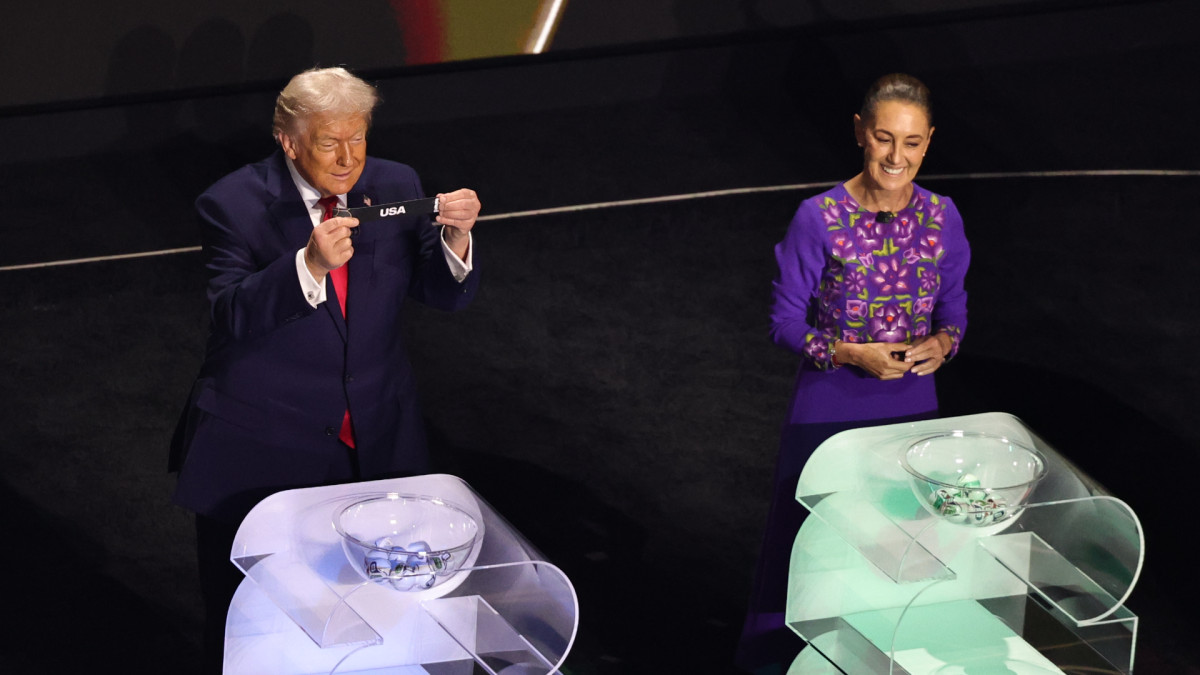
The relationship between Mexico and the United Stateshas once again tense on the eve of the FIFA World Cup, which both nations are hosting. Just over a month before the global tournament begins, bilateral ties are back under scrutiny: “narco-state,” “institutional corruption,” and “organized crime” are the terms that have led them into this murky terrain.
“This new diplomatic tension concerns an invisible border that separates what one country can decide from what another can (or cannot) impose”
The accusation leveled from Washington against Rubén Rocha Moya (former governor of Sinaloa and a steadfast ally of Andrés Manuel López Obrador) is not merely another legal file: it is, in broad terms, a narrative that overrides another narrative. The U.S. speaks of corruption and drug trafficking; Mexico “defends itself,” arguing that it is yet another intrusion into its domestic politics. And in the middle stands Claudia Sheinbaum, so calm, so focused on her internal economic affairs that she is forced to decide: either investigate and punish a governor faithful to her Fourth Transformation project —driven, of course, by the White House’s demands—, or, appealing to her inviolable shield, the sovereignty of the nation, turn a deaf ear to the judicial request from the Trump Administration and leave open suspicions about the links of a political ally with criminal networks. In short, this new diplomatic tension centers on an invisible border that separates what one country can decide from what another can (or cannot) impose.
Sheinbaum knows that the echo of every word she speaks resounds in the Oval Office. Each declaration issued from Mexico City is born with the legitimacy of its institutions. Yet, doubts and delays reach Washington, where patience wears thin in the face of what is seen there as complicity with organized crime. Therefore, the Mexican president insists that her government will neither shield nor cover for anyone, but will also not accept external pressure. The truth is that, beyond easy words and limited resolve, this situation is a very delicate balance: to show firmness without slipping into cover-up (to defend sovereignty without becoming a protector of suspects in grave crimes) or to yield to a case with a very difficult solution.
And the bilateral relationship? The U.S. demands immediate and forceful legal actions, and punishment for a politician who governed one of the hottest hotspots of global drug trafficking; Mexico responds with the benefits that (ironically) the slow-moving judicial bureaucracy always offers, namely rhetoric and delay. And in the face of that situation, a clash is inevitable, because urgencies do not align. Nor do the interests of both nations. The truth is that today, the Rocha Moya case has become a symbol of the mistrust that the U.S. still harbors toward its southern neighbor, a distrust that underpins the power structure between them, even as echoes of numerous cooperative discourses linger in the air.
“The case puts the spotlight on a narrative that refuses to expire: that, for Washington, Mexico remains land of bandits”
Rocha Moya is, to a certain extent, just a name, one of many suspects navigating the murky waters where borders between crime and politics blur. But this case casts a spotlight on a narrative that refuses to die: that, for Washington, Mexico remains land of bandits where criminals collude with politics. Yet, for Sheinbaum, it represents an opportunity to prove that her government will not bow to Trump’s demands. For her, defending the seemingly indefensible is a reason to uphold sovereignty, even when it seems impossible, unsustainable, or immoral.
For now, Rocha Moya no longer governs Sinaloa (he has taken a leave of absence), and Sheinbaum is investigating the case to decide. Meanwhile, in the United States, time keeps moving forward.
Who is Rocha Moya? The Key Points of His Case
Rubén Rocha Moya was born in Badiraguato, Sinaloa, in 1949, and since then his life has been shaped by the fate of that land: a cradle of rural teachers and bosses, of public universities and cartels. His political career began in the socialist left of the 1980s, when the Unified Socialist Party of Mexico brought him to the state Congress. Later, he became rector of the Autonomous University of Sinaloa; that position gave him academic prestige and brought him closer to local power networks. Yet his true leap came when Andrés Manuel López Obrador brought him into his movement, his system, his clan: Morena. And in 2018, López Obrador made him a senator; three years later, governor.
That relationship is at the heart of this matter: it is much more than politics; it is about trust. “Friend… comrade in the fight… my brother” is how the former Mexican president described the former governor. He presented him as the ideal candidate for Sinaloa, a state where his political movement needed a man aligned with its interests. Rocha Moya was, in the president’s words, “an honest man, committed to the people,” and that endorsement was enough for Morena to rally behind him. His political career cannot be understood without that backing: it was López Obrador who pushed him, legitimized him, and made him the representative of his project in the country’s most volatile territory.
“Governing Sinaloa means living with that shadow, managing a territory where the boundaries between legal and illegal are often nonexistent”
Sinaloa is not a place that goes unnoticed. Neither in popular culture nor in the courts. It is, simply, the epicenter of Mexican drug trafficking since the 1980s, when Joaquín “El Chapo” Guzmán and Ismael “El Mayo” Zambada rose to the top of the criminal hierarchy. There, the Sinaloa Cartel was founded: the most powerful organization in the hemisphere (and one of the most powerful in the world). There, undoubtedly, politics, economy, and organized crime mingle like nowhere else in Mexico. Governing Sinaloa means living with that shadow, administering a territory where the lines between legal and illegal tend to vanish, where state power competes with the dark power. A current clear example is that in Sinaloa’s ports, Chinese mafias operate within a drugs trafficking network, while they also haul (from those same ports) tons of totoaba, a fish endemic to the Mexican Pacific and highly valued, as investigations by the newspaper El País reveal.
That is why the figure of Rocha Moya is so significant: he is not only a governor accused by the United States, but the representative of López Obrador—the man who transformed a country and whose political movement became Mexico’s political system—precisely in the cradle of organized crime. His ties to the former president make him a barometer of the era: the strong bet by Morena to govern even in the most conflict-ridden territories. Therefore, every clash, every accusation that originates in Washington fuels the argument that the line dividing legitimate power from de facto power always blurs under the influence of the murkier interests.
El Chapo Guzmán and His Extradition Request
Sinaloa is known in Mexico for many things (culture, cuisine), but to the rest of the world there is a name that gave it global dimension: Joaquín Guzmán Loera, known as “El Chapo” Guzmán, and the cartel that bears the name of the place where he was born.
It turns out that a couple of days after the indictment by the Southern District of New York against Rocha Moya and Rocha Moya’s request to step aside, the infamous drug lord “El Chapo” Guzmán sent a letter to the Brooklyn Federal Court asking judge Brian Cogan to be extradited to Mexico after having been sentenced to life imprisonment in the United States.
According to the newspaper ABC, the Mexican boss makes that request arguing that the judicial process he underwent was not entirely clear and that, invoking the law, both administrations could arrange his return to his country. That outlet, without giving further details, suggests that those actions would be a kind of “trading” Rocha Moya for him.
Recall that, at least, El Chapo was involved in two historic escapes from high-security Mexican prisons. But not only that: the leader of the Sinaloa Cartel is also known for having bribed every authority who arrested him, as well as politicians who used him as a pivotal piece in the dark power structure.
What will become of the man once considered the most powerful criminal boss in the world during the first two decades of this century? What will become of Rocha Moya?
“Sheinbaum will have to mount a forceful response to the U.S. demand and complaint, regardless of what she decides”
For now, Sheinbaum will have to mount a forceful response to the U.S. demand and complaint, regardless of what she decides: to bet on sovereignty or to cooperate with the White House in its furious (and questionable) fight against global organized crime.
