
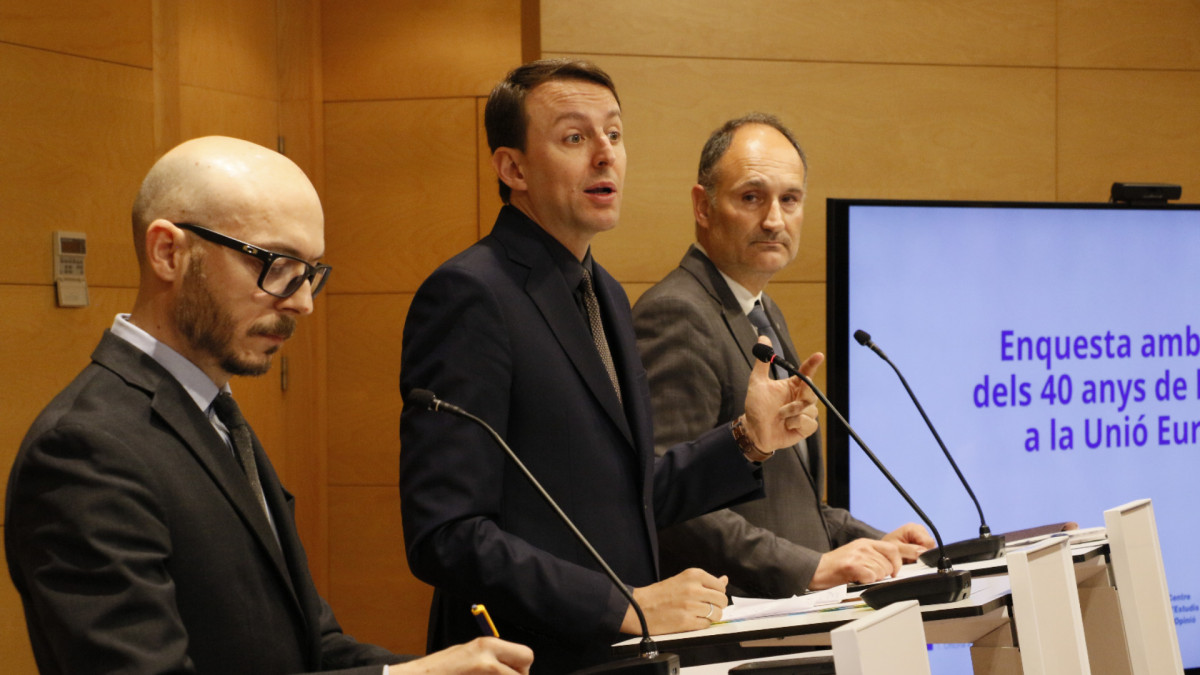
Four decades after accession, Catalan society offers a distinctive form of Europeanism. The survey from the Centre d’Estudis d’Opinió (CEO) commissioned by the European Parliament Office in Barcelona provides the clearest snapshot available to understand what Europe Catalonia wants as negotiations proceed on the 2028-2034 multiannual financial framework and three years ahead of European elections.
The barometer rightly emphasizes that the pro-European sentiment is rising and that 87% want Catalonia to continue actively participating in European Union programs. Yet there is a second layer: the one that emerges when party sympathy is cross-referenced and compared with the 2024 survey. In this case, the result is more nuanced and politically more useful: firm identity, eroding operative satisfaction, and an internal map of fractures.
Firm Identity, Waning Interest
European-leaning sentiment climbs three points in two years, from 55% to 58%, a modest rise that disrupts the narrative of identity withdrawal often seen over the past decade. But this datum has another face: disinterest in European politics reaches 59%, fifteen points above general disinterest. This reflects a form of attachment without real engagement as a widespread attitude among the Catalan population.
“Vox remains in an intermediate position that breaks the simple equivalence between radical right and Euroscepticism”
The cross‑section of data with party sympathy offers a map worth pausing on. The party with the most sympathizers who feel very or fairly European is not from the cosmopolitan left, but the PP (86%, with sample-size caveats), followed by PSC (74%) and Junts (73%). At the opposite end, Aliança Catalana (28%) and CUP (42%) mark the two poles of Catalan anti‑European sentiment: one on the identitarian right, the other on the alternative, anti‑globalist left. Vox sits in an intermediate position (48%) that breaks the simple equivalence between radical right and Euroscepticism.
Another little-noted finding: those born outside Spain are the most Europeanist (69%), compared with 56% of those born in Catalonia. Catalan Europeanism does not follow the classic pattern of cosmopolitan urban elites.
The Silent Disenchantment
Positive ratings of the EU’s functioning fall seven points in two years (from 44% to 37%), and the intermediate position rises from 23% to 29%. The decline is not captured by the openly critical pole —which remains stable around 31% negative— but by that growing intermediate zone. Catalan disenchantment with the EU is not a rupture: it is doubt and questioning. And doubt is more dangerous for European legitimacy than rejection, because it neither mobilizes nor argues in a moment of political and institutional disaffection.
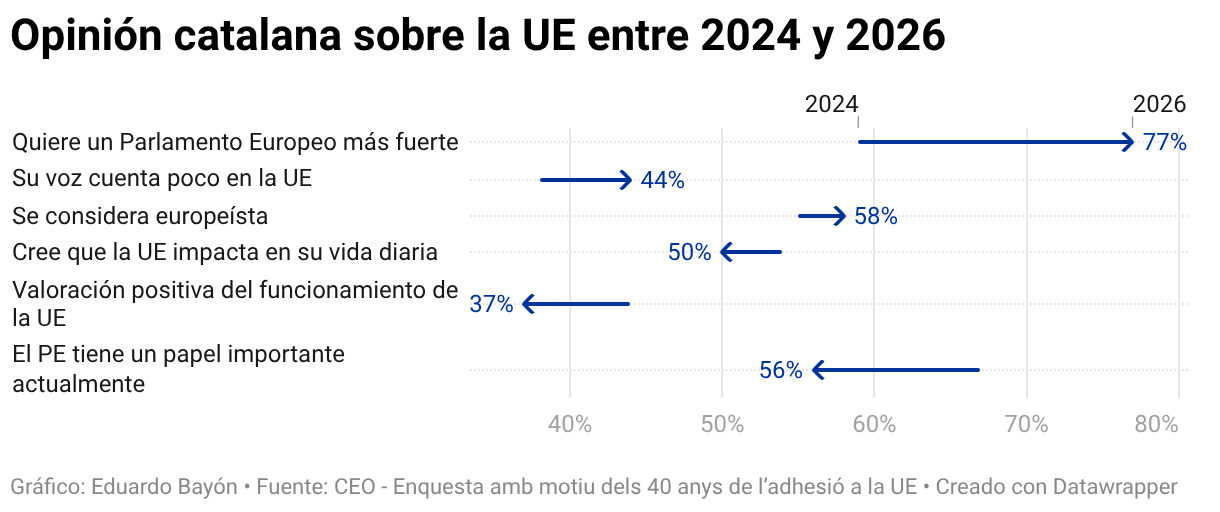
In this sense, 90% feel that their voice counts little or nothing in the EU, and within that block the category “little” gains six points. Leading the negative appraisal are Aliança Catalana (57%) and the Comuns (54%), who share a stance of rejection from opposite ends. Junts and CUP also feed the critical flank (35% and 40%). PP (59% positive) and PSC (55%) sustain the institutional-satisfaction bloc. ERC stands at 46% positive.
And yet, 69% still consider it positive to be part of the EU. European identity endures even as operative satisfaction erodes. Belonging feels right, even when performance has moments of inadequacy.
Unknown Institutions, Demand for More Europe
The distance from European institutions shows up in the very lack of knowledge. 54% cannot name a single European institution when asked spontaneously. The most well known is the European Parliament (33%). The Commission, the Council, the Court of Justice, and the European Central Bank do not exceed 11% each. It is a scandalously low awareness rate for a political architecture that should be part of democratic common sense. Even more so when budgets are allocated to give visibility to their activities.
“The latent federalist mandate is one of the great consensus points of this survey: PSC 88%, Junts 96%, ERC 81%, Comuns 93% and PP 89%”
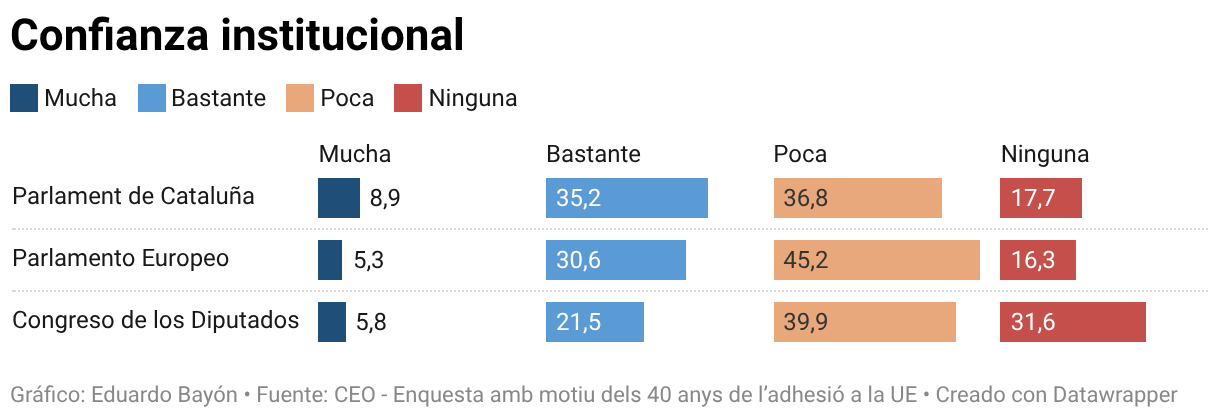
Pese a estas cifras, 77% want a stronger European Parliament: eighteen points more than in 2024. The latent federalist mandate is one of the great consensus points of this survey: PSC 88%, Junts 96%, ERC 81%, Comuns 93%, PP 89%. Only CUP (65%) and AC (61%) fall below. The hierarchy of institutional trust, moreover, reverses the actual competence: the Parliament of Catalonia commands more trust (44%) than the European Parliament (36%), and this one more than the Congress of Deputies (27%).
Defense: The Most Fragmented Block
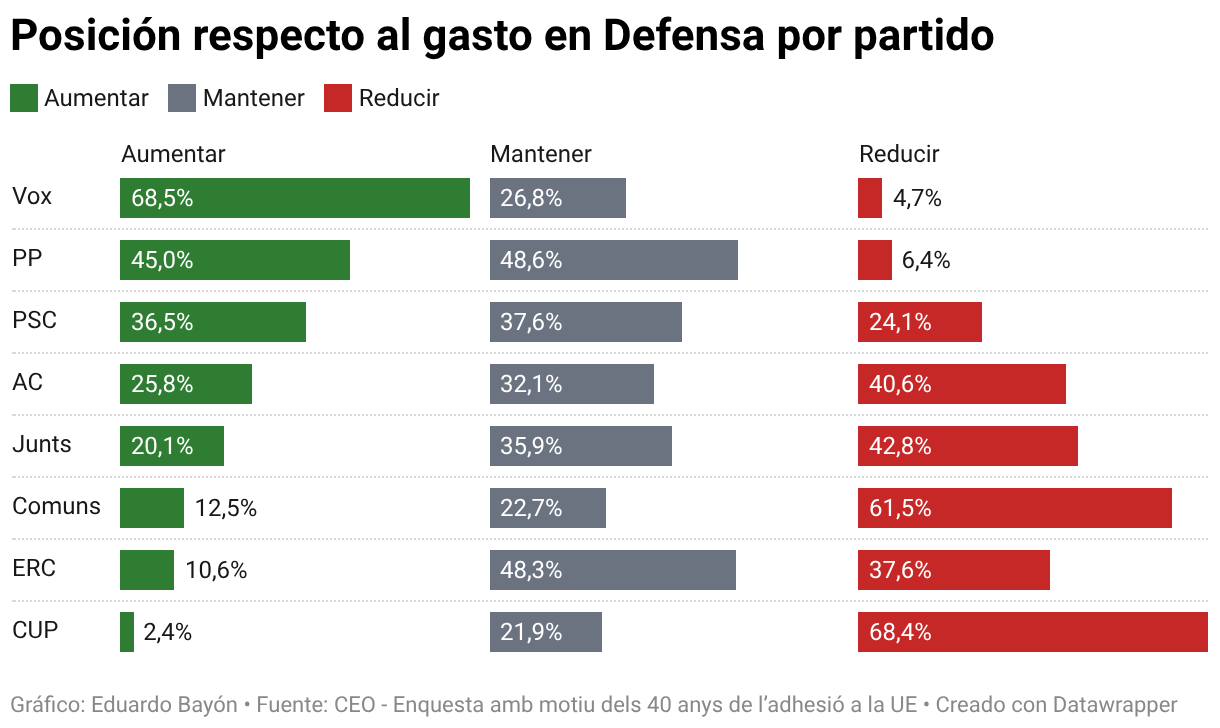
Military spending divides Catalan society into three almost equal thirds: 26% wish to increase it, 36% to maintain it, 34% to reduce it. The official report presents the result as “divided opinions” without further depth. The cross by party sympathy, accessible only from the microdata, offers a more precise map.
“Supporters of Catalonia’s PSC are closer to the PP than to ERC on defence-budget policy”
The party whose supporters most back increasing military spending is Vox (68%), followed by PP (45%) and the PSC with 36.5%, ahead of AC (26%), Junts (20%) and, far behind, Comuns (13%), ERC (11%), and CUP (2%). Catalan PSC supporters are nearer to PP than to ERC on defence budgeting, a sign of alignment with the defensive shift that the Sánchez government promotes in Brussels. On the opposite flank, CUP (68%) and Comuns (62%) lead the opposition to rearmament.
When the question shifts from “spend more” to “a common defense“, the consensus is reestablished across the board. 82% consider a common security and defense policy necessary, with cross-partisan support above 75% in all parties except CUP (47%). On a joint response to a territorial threat to a member state, yes reaches 89%, with the PP unanimous (100%) and PSC, ERC and Comuns above 93%.
The data analysis becomes clear: Catalan society wants a European defense architecture, but this does not necessarily imply militaristic budgeting. It highlights a clear distinction between integration and rearmament, between strategic sovereignty and military expenditure. This distinction should be at the center of any serious political debate, without merging both planes into a single rejection.
On Ukraine, 74% support maintaining sanctions on Russia and 67% consider the European package of 90 billion appropriate. The pro-Ukraine consensus reaches 90% in ERC and 86% in Junts, but falls in CUP (59%) and AC (58%), where there exists a minority yet detectable pro-Russian current.
The Dissonance Between Civic Agenda and Brussels Agenda
The most political datum of the entire survey is the hierarchy of priorities for the 2028-2034 budget. Adding first and second preferences: housing, 53%; agriculture and rural world, 46%; climate, 26%; research, 26%; migration, 25%; and, in last place, security and defense, with 15%.
“Defense, which dominates the European debate in recent months, is the last priority for Catalan society”
Defense, which dominates the European debate in recent months and consumes increasing volumes of the next multiannual financial framework, is the last priority for Catalan society. Only among Vox (44%) and PP (51%) does it figure among the high priorities. For the PSC, barely 19%; ERC, 10%; Junts, 9%; AC, 2%; Comuns, 2%; and CUP, 2%. Meanwhile, housing —a competence that is not even strictly EU— is the top citizens’ priority.
Overall, the survey does not depict a retreating Europhilia, but a consolidated Euroscepticism that is increasingly less automatic. Belonging to Europe remains a broad consensus framework, but it is no longer enough on its own to sustain political legitimacy or generate active adhesion. Catalan citizens do not seem to question their bond with the Union, but they are beginning to demand more than mere symbolic continuity. That shift compels European institutions and Catalan parties to respond not only in terms of narrative, but in terms of priorities, efficacy, and perceived usefulness. The risk is not a sudden collapse of Europeanism, but something slower and harder to detect: a settled allegiance turning into mere inertia.
