In a turning point moment for the European project, marked by the erosion of the liberal order and the reconfiguration of global alliances, the La Toja Forum, in its new edition in Lisbon, brought together policymakers and scholars around a central question: what role can and should Europe play in an international arena that is increasingly competitive, more uncertain, and less normative.
“The geopolitical framework that allowed the consolidation of the European Union has given way to an environment where the logic of power and competition among blocs prevails”
The day was permeated by a common idea around which participants began to dialogue: the geopolitical framework that allowed the consolidation of the European Union —based on rules, institutions, cooperation and consensus— has given way to an environment where the logic of power, bloc competition, and growing instrumentalization of interdependencies prevail. In the words of Paulo Rangel, former Portuguese foreign minister, “Europe has to become aware of its own responsibilities,” a statement that synthesizes the overall tone of the gathering.
Europe in the face of a new era
From the institutional opening, both Amancio López Seijas, president of the La Toja Foundation, and Juan Fernández Trigo, Spain’s ambassador to Portugal, framed the debate in historical terms. The 40th anniversary of Spain and Portugal joining the then European Economic Community served as a reminder of a political, economic, and social transformation process that today feels strained. The reference to the Carnation Revolution and the Spanish Transition was not merely commemorative, but used as an example that long, complex, and sustained processes can lead to stability and shared prosperity.
“Europe — and especially the Iberian Peninsula — would have completed a journey of democratization and openness that is now entering a new, less predictable phase”
Rangel revisited this idea with a metaphor also present in other interventions: the return to Ithaca. Europe — and in particular the Iberian peninsula — would have completed a journey of democratization and openness that now enters a new, less predictable phase. “We return to the embrace of Europe with all the wisdom that the journey gave us,” he noted, while underscoring that the current context no longer tolerates inertia or automatic responses.
Security, alliances and autonomy: an unstable balance
The deterioration of the transatlantic bond was one of the most recurrent themes. Rather than framing it as a rupture, the debate focused on redefining it. Mariano Rajoy, former Prime Minister of Spain, warned that Europe remains part of a bloc of democracies with a market economy and social rights, facing another set of actors characterized by authoritarian models and state capitalism. In that context, he argued that any tactical approach to the latter carries strategic risks and stressed that “only if Europe speaks with one voice can it assert itself as an international actor.”
“Europe runs the risk of becoming blurred if it does not advance in strategic autonomy”
The former Portuguese prime minister Paulo Portas agreed with the diagnosis, though he introduced an important nuance: the shift from a rules-based alliance system to one structured around powers. In this new board, dominated by the United States, China, and Russia, Europe risks being blurred if it does not advance strategic autonomy. “Europe should not need permission to defend its interests,” he stated, while warning about the uncertainty surrounding the American commitment to European security.
This debate moved more precisely into the security and Atlantic relations table. Javier Colomina, Deputy Secretary General of NATO and Special Representative for the Southern Neighborhood, argued that despite the political noise, NATO remains Europe’s primary strategic anchor. He urged strengthening European capabilities within the Alliance, avoiding approaches that could weaken it. The alternative, he warned, would be more costly and less effective. Similarly, Peter Rough, director of the Europe and Eurasia Center at the Hudson Institute, insisted that the United States has not abandoned Europe, even if it demands greater involvement from its allies.
Facing this view, Augusto Santos Silva, former president of the Portuguese Parliament, introduced a political and social dimension: increasing defense spending must be compatible with European welfare systems and have citizen legitimacy. Security, he noted, cannot be dissociated from the social contract that defines Europe.
The former Prime Minister of Spain, Mariano Rajoy, at the La Toja Forum. Photo: Foro La Toja
Economy, internal market and competitiveness
The economic bloc reinforced the idea that Europe possesses solid structural capacities, but faces operational deficits that limit its global projection. The former Portugal central banker Mário Centeno summarized this tension with the expression eppur si muove (and yet it moves). Despite the adverse context, the single market continues to function and the Union remains one of the world’s leading economic powers. However, risk aversion, regulatory fragmentation, and the slow pace of decision-making hinder more ambitious progress.
“The European problem does not lie in a lack of talent or innovation, but in the inability to scale projects and to consolidate globally sized companies”
Román Escolano, former Spanish Minister of Economy, expanded on this idea by pointing out that the European problem is not the lack of talent or innovation, but the inability to scale projects and to consolidate globally sized companies. The fragmentation of the internal market, together with overregulation and the deficit of financial integration, act as structural brakes. In this sense, he left one of the forum’s clearest quotes: “The solutions that have worked have always been European and those that have not worked are national.” They both agreed on the need to advance an integrated capital market, strengthen the international role of the euro, and reduce lingering internal barriers within the Union itself. They also highlighted the role of Spain and Portugal as drivers of trade openness, especially with regard to Latin America, praising the success of the Mercosur agreement.
A shifting international order
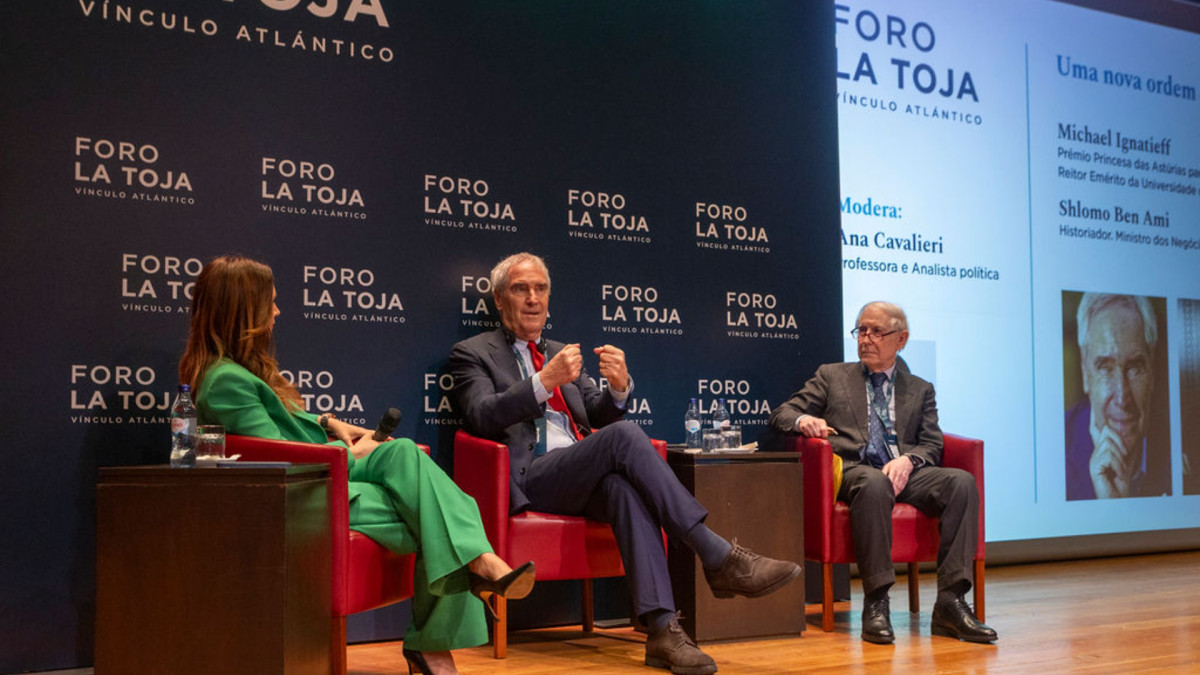
The most strategic reflection came in the dialogue between academic Michael Ignatieff and former Israeli Foreign Minister Shlomo Ben-Ami, who addressed the nature of the new global order. Ignatieff suggested that the liberal system that followed the Cold War has ended and that the United States, far from sustaining it, is contributing to its transformation into a more transactional model. In this context, he argued that Europe must take on greater responsibilities and develop its own capabilities: “Freedom is scary, but it is liberating,” he reiterated.
Ben-Ami, for his part, underscored the structural character of U.S. foreign policy, historically oriented toward preserving its hegemony. In his view, the current problem is not an anomaly, but an intensification of prior trends. He also warned about Europe’s technological weakness and the need to invest in its own capabilities, including those related to defense, as an indirect driver of innovation.
“The so-called ‘middle powers’, including the European Union, have significant economic weight, but lack the capacity to structure the global order”
Both found common ground in noting that the so-called “middle powers,” including the European Union, have substantial economic weight, but lack the capacity to structure the global order. Hence the importance of strengthening alliances, identifying vulnerabilities, and avoiding excessive dependencies in critical areas such as data or emerging technologies.
More Europe, with time and political will
The forum’s closing consolidated the main messages. The president of the organizing committee of the La Toja Forum, Carlos López Blanco, summarized the debate around several ideas: the need for “more Europe”, the structural nature of some of the current challenges, and the importance of not giving up the achievements reached. The reference to time was constant: many solutions have been identified, but they require sustained implementation and political consensus.
In the final intervention, António Costa, President of the European Council, pointed to two trends that will define the immediate future: the erosion of the liberal order and the consolidation of a multipolar world. “Principles, alliances and power,” he summed up, outlining the coordinates of the European debate.
Meanwhile, Margarita Robles, Spain’s Minister of Defense, and António José Seguro, President of the Portuguese Republic, stressed the Iberian dimension of the Atlantic bond. Far from simply adding national interests, they proposed a shared agenda between Spain and Portugal as a platform to reinforce Europe’s position in the world.
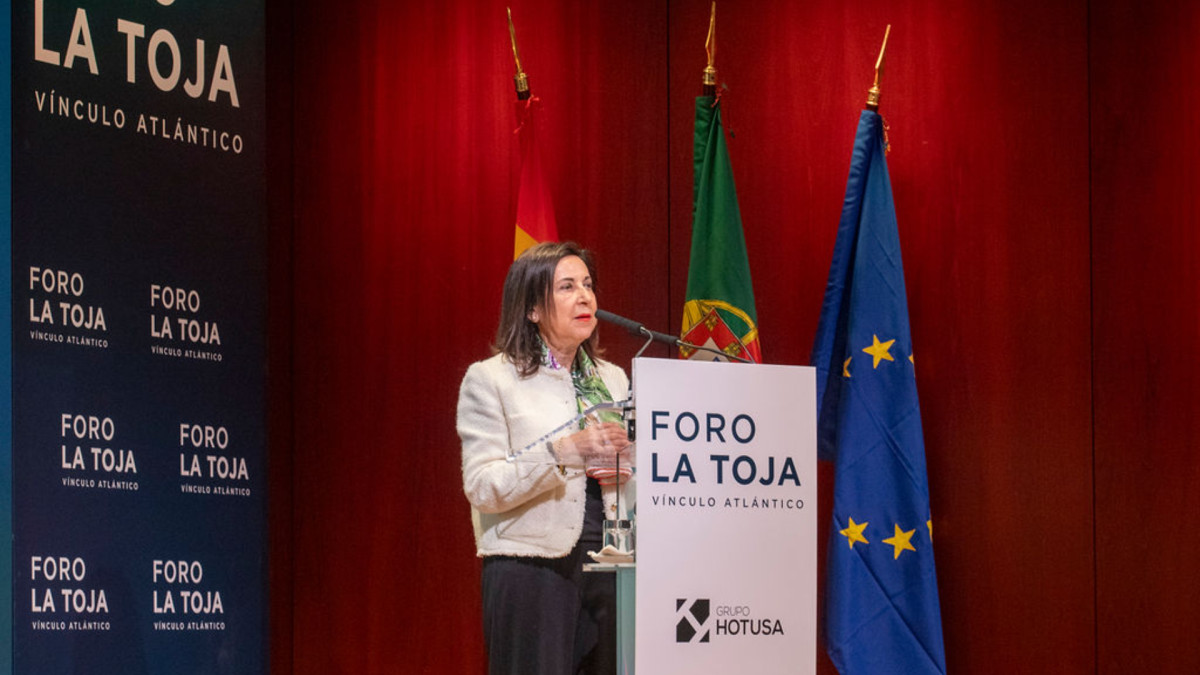
The Defense Minister, Margarita Robles, closes the meeting. Photo: Foro La Toja
Between a critical diagnosis and confidence
Throughout the day, pessimism about the international context coexisted with a more affirmative reading of Europe’s capabilities. Significant weaknesses in security, innovation, productivity, or governance were acknowledged, but it was also stressed that Europe has enough assets to play a leading role: a large-scale market, a strong currency, commercial capacity, talent, an industrial fabric, democratic legitimacy, and a social model that remains a global reference. The question, as several speakers pointed out, is not so much whether Europe can respond to the new scenario, but whether it will be able to recognize itself as a power, act with greater political coherence, and overcome the obstacles that limit its projection.
In this balance between urgency and confidence, between autonomy and alliance, the current European debate is staged. A debate that, as noted in Lisbon, will probably define the future of the Union and, above all, its ability to translate its strengths into real influence in the international system.
En alianza con