
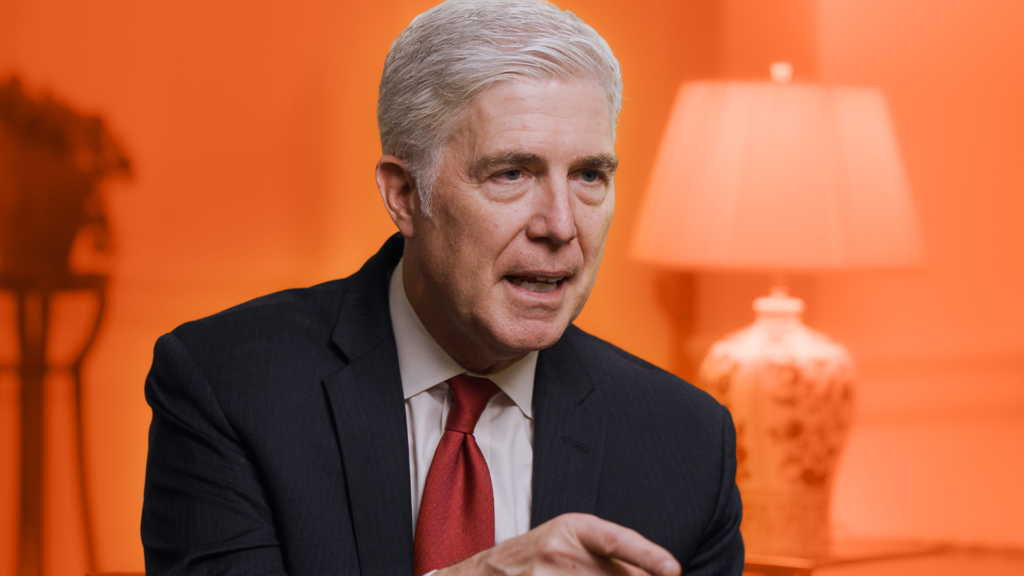
The Dissident Right seethes after Justice Neil Gorsuch described America as a creedal nation, a reaction that highlights how far removed its fixation has become from everyday concerns.
:15
:15
Download
The Best of Reason: In an AI-Driven Economy, Unemployment Will Be Nonexistent
The Dissident Right erupted in anger after Supreme Court Justice Neil Gorsuch told Reason and a number of other outlets that the United States is a “creedal nation.”
“The Declaration of Independence carried three foundational ideas,” Gorsuch explained in a recent interview with Nick Gillespie. “First, that all people are created equal; second, that each individual possesses certain inalienable rights granted by God, not by the government; and third, that we have the right to govern ourselves. Our country isn’t founded on a religion. It isn’t grounded in a shared culture or even a common heritage. It rests on those principles. We are a creedal nation.”
“Our nation is not founded on a religion. It’s not based on a common culture, even, or heritage. … We’re a creedal nation,” Justice Neil Gorsuch tells @nickgillespie on The Reason Interview podcast. pic.twitter.com/wfdkSbrVUX
— reason (@reason) May 6, 2026
For many observers, what looks like a standard civics lesson has been seized upon as an unforgivable offense by a wave of right-wing opinion leaders and their online sidekicks.
“I want all of the so called conservatives who believe things like this launched into the sun,” wrote the apparently anonymous user known as Tony Rigatoni.
“I simply refuse to accept the notion that every other people group on the planet is allowed to have a homeland except for native Americans,” added William Wolfe, a former Trump administration official, seemingly referring to Anglo-Protestants rather than Indigenous peoples.
Gorsuch’s remarks are described as emitting “cuck energy,” according to the blogger Curtis Yarvin.
A telling reaction came from Jeremy Carl, a commentator who had to step back from consideration for a State Department post after facing criticism for remarks about “white identity” earlier this year. “In all sincerity,” he wrote on X, “the fact that this nonsense is being paraded by ‘the best’ among Trump’s three Supreme Court picks signals a broad intellectual failure within the conservative legal camp.”
Carl’s revulsion with Gorsuch reflects a broader tendency. MAGA influencers have also labeled Supreme Court Justice Amy Coney Barrett a disappointment and a “diversity hire,” and President Donald Trump has expressed regret about heeding the Federalist Society’s originalist vetting when selecting his first-term judges.
The prevailing takeaway is that the conservative legal movement may have lost its bearings. Yet if Trump’s nominees and the nation’s leading center-right legal circle strike you as too liberal, it might be you who is out of step.
The belief in a “civic” nationalism—the notion that the United States is a “propositional nation,” as the Catholic thinker John Courtney Murray described it, rather than a country defined by blood and soil—has wide mainstream appeal across the political spectrum, including conservatives. Besides Gorsuch, others who have articulated this view recently include the anti-woke former presidential hopeful Vivek Ramaswamy, the renowned historian of the Revolutionary War era Gordon S. Wood, and at least one senior fellow at the Heritage Foundation (who has cited the Catholic writer G.K. Chesterton).
Last year, the polling firm YouGov asked respondents what qualifies a person as American. The leading responses highlighted legal and creedal elements: abiding by U.S. law, supporting the Constitution, and embracing the principles set forth in the Declaration of Independence. In the same period, Gallup found a strong consensus with the statement, “America is stronger when it includes people of diverse races, religions, and cultures.” In other words, the American public does not share the Dissident Right’s fixation.
I’m not certain it’s wise to exclude culture, as Gorsuch did, from the creedal concept of American nationhood. It’s true that the United States does not require a single ethno-religious culture to bind people together. We need not worship identically, eat identically, listen to identically, or dress identically. Cultural elements can evolve across regions and subgroups while still remaining authentically American. I suspect that this is roughly the sense in which Gorsuch used the term “culture.”
At the same time, there exist cultural aspects that must reflect a broad consensus if the republic entrusted to the Founders is to endure. Foremost among them is a culture of mutual forbearance, a genuine willingness to coexist peacefully with those who see things differently, and a shared pride in the ideals of human liberty and equal protection under the law—recognizing that America’s commitment to those ideals is a central source of its strength.
These values and loyalties are most effectively transmitted from one generation to the next through culture. But unlike cuisine, these are creedal in nature: tied not to a uniform way of life in a deep, intrinsic sense, but to a common political and philosophical project.
That project—and the values and attachments upon which it rests—faces challenges from voices across the political spectrum. They deserve robust defense, but the Dissident Right, which dismisses the idea of mutual forbearance in favor of a power-centered approach, does not offer a workable answer. You cannot salvage America’s cultural fabric by sacrificing its creed.
