
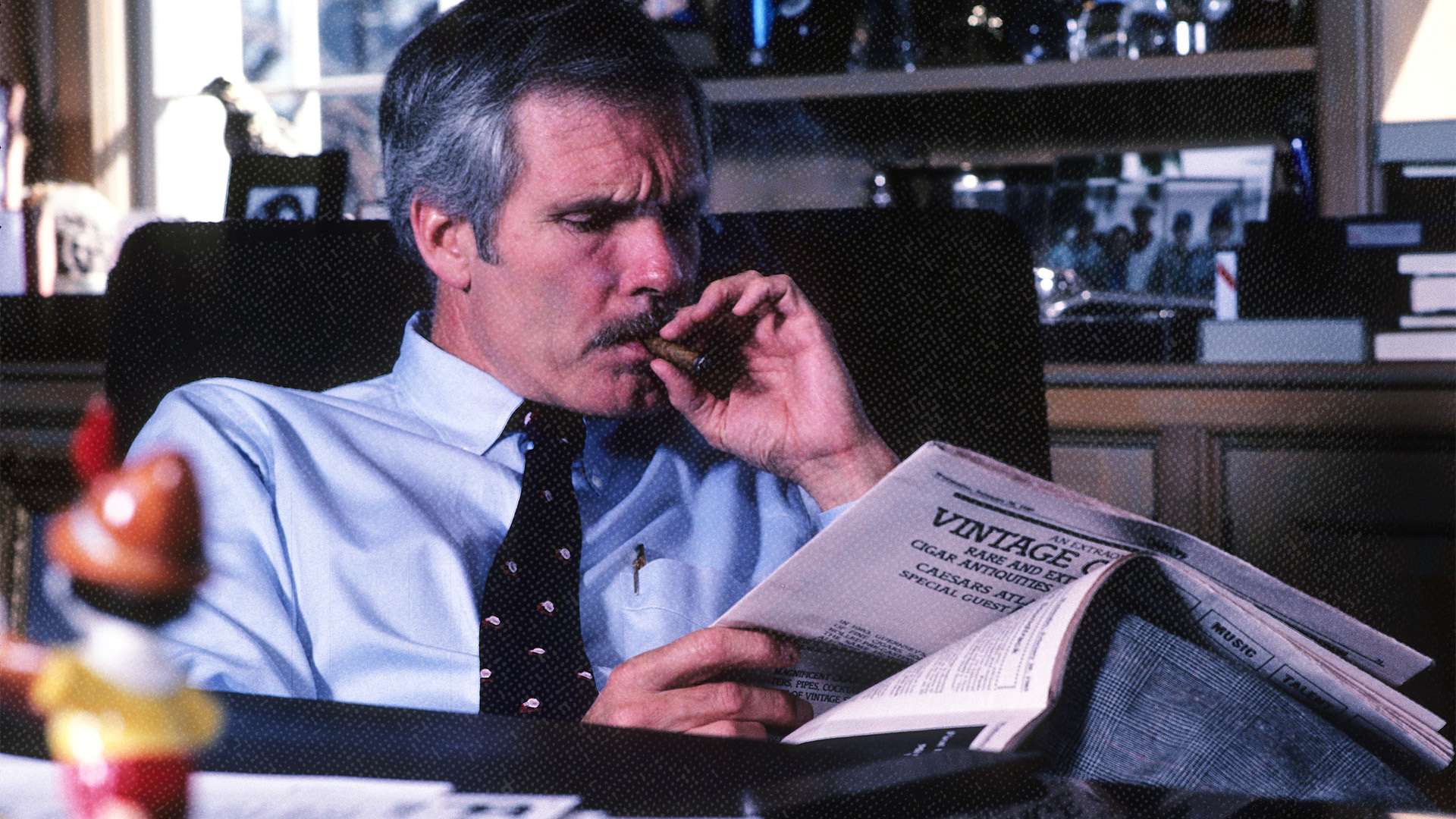
Ted Turner’s bold gambits lit a fuse that toppled the old order of licensed, bureaucratic television and left it in ruins.
Ted Turner, who has just left this mortal stage at eighty-seven, lived as a reveler, Playgirl’s man of the year, and a public embarrassment all at once. He brokered billion-dollar deals when a billion still looked astronomical. He charmed the seas as a yacht-racing icon, clinching the 1977 America’s Cup aboard the Courageous. He wed a striking actress, made her perform the politically incorrect Tomahawk chops to cheer his Atlanta Braves, and wandered across an ideological spectrum—from Randian rugged individualism to the Mouth of the South to a cosmopolitan United Nations patron and eventually to an environmentalist defending bison. Jane Fonda, his third wife, labeled him a “romantic swashbuckling pirate” and “my favorite ex-husband.”
The persona he cultivated was a playful mask designed to lighten the burden of enormous wealth. His true imprint, however, was as the Entrepreneur of His Era. Turner stood at the forefront as the Late 20th Century barbarians battered the gates of the old American media order. He arrived precisely when a wave of deregulation began to pry open long-closed doors, and he rewrote the script on what “public interest” regulation could be. Intellectuals largely lamented the end of an administrative state—and the Cronkite-era audience it sustained, the so‑called “news from nowhere” that a CBS executive once boasted about. Yet the old, closed loop that fed audiences and scholars alike was incompatible with freedom, open inquiry, and candid discussion.
Even before the dust settled, the creative upheaval sparked by Turner’s audacious moves had left the tyranny of licensed, bureaucratic television in tatters. The aftermath may sometimes look uneven, but the revival of free expression gained new momentum—an ascent that even the most sophisticated chatbots would eventually sense.
Born in 1938 to a well-to-do family, Turner inherited the good looks of Rhett Butler, a place at Brown University, a multi‑million‑dollar billboard empire, and a tragedy beyond words. His father, Ed Turner, a successful businessman, told the Ivy League youth that he was frittering away the family legacy on scholarly pursuits promoted by pompous professors. When the elder Turner finally invited his son into the family business, their relationship took on a fierce, competitive edge. Ed leveraged assets to swallow a far larger rival, a maneuver Ted believed would teach him about risk-taking.
After a breakfast quarrel at the family home in Atlanta, Ed Turner went upstairs and took his own life. Ted, downstairs, was 24 years old at the time.
That terrible beginning became an unlikely catalyst for entrepreneurial achievement. Turner salvaged what remained of the family holdings, acquiring a handful of minor radio stations and then purchasing WJRJ-TV in Atlanta in 1970—an arrangement nearly worthless because it bled $50,000 a month. In 1972, he grabbed another UHF bargain, WRET-TV in Charlotte.
The Atlanta station, rebranded WTBS (for Turner Broadcasting System), began to soar. By 1976 it had evolved into the first nationwide channel, a “superstation” carried by satellite to thousands of cable systems from coast to coast. Once a nearly worthless UHF license, it became the cornerstone of a sprawling cable‑programming empire.
The Charlotte outlet had been an even bigger wreck than the Atlanta money-loser. The company’s board had resisted his planned purchase, so Turner mortgaged his own home and bought the station himself. The asset subsequently appreciated dramatically. In 1979 he sold it to Westinghouse for $20 million—the highest price ever paid for a UHF station.
That sale furnished Turner with the capital to create CNN—America’s first truly 24/7 cable news venture—in 1980. What followed went far beyond the making of a mogul; it redefined how information moved around the planet.
Before CNN, American broadcasting was trapped in a pre-constitutional framework. Rather than open competition and robust debate, licensed media held sway. Radio and television were shackled not only by rules such as equal time and the fairness doctrine, but also by artificial scarcity imposed through licenses renewed under the scrutiny of powerful lawmakers and commissioners. Turner appeared at a moment when a glimmer of light was about to break through; he seized the opportunity at a time when conventional wisdom had missed it.
Ted Turner turned past constraints into future openings. He bought low (Lifeless UHF licenses regulated into oblivion) and sold high (satellite beams forming the new mass medium). The regulated wasteland blossomed into a competitive cornucopia.
A young Malcolm Gladwell once mocked the upstart Turner in “Ted Turner’s Cable Scam,” a 1987 essay in The American Spectator. In Gladwell’s telling, “Turner went to Congress in 1976, asking for special favors for his fledgling industry.” Gladwell called Turner a Svengali, selling naïve policymakers a bill of goods. “Time and again,” he argued, “the regulatory and legislative bodies steering cable TV have welcomed Turner’s vision of cable as television’s salvation.” Gladwell believed, looking back, that it was remarkable Turner could pull it off, given that the only thing he brought to the table was a technological breakthrough and little else.
Far from it. The technologies he freed had long been boxed in by regulation, and releasing them unleashed a new era. It began with satellite, which in 1962 had been monopolized by COMSAT—a joint venture of private AT&T and the U.S. government with legal control over all space communications. Prices were steep and innovation was stifled until Open Skies arrived in 1975. Competition was legalized, and the notion of a natural monopoly faded. Hughes, GTE, RCA, Western Union, and other stand-ins for AT&T entered the arena. Transmission costs to distribute nationwide programming collapsed by roughly 95 percent, making a national cable-TV market feasible.
As rivalry intensified, fresh questions emerged. Why should the 81 channels reserved for broadcast TV in 1952 not yield a plethora of programming choices in every market? Because the FCC adopted CBS’s plan to nurture precisely three national networks, killing off the fourth network, Dumont, in 1955. In the 1960s, the commission railed against TV’s “vast wasteland” while aiding those who produced it, and it thwarted eager cable competitors. Cable TV was deemed a threat to the “public interest” because it might siphon audiences from established broadcasters, and regulators throttled it accordingly.
By 1970, cable service was effectively illegal in about 90 percent of American homes. The dominant VHF stations—NBC, CBS, and ABC—held sway, while weak UHF stations were nearly worthless under FCC rules, despite cable operators’ desire to retransmit their signals with clarity.
Turner’s plainspoken aim was to imagine a world where such clumsy rules no longer mattered. A marginal Charlotte outlet could be delivered by cable, ending its “UHF discount.” A failing station like WTBS could beam its product to roughly 30,000 communities via satellites, produce popular original programs, and compete directly—with the choices once limited to My Mother the Car, Hello Larry, or SuperTrain—in households everywhere.
Turner arrived at the moment precisely right. What TV insiders (and Malcolm Gladwell) denounced as a concession to Turner was officially labeled the deregulation of cable TV by the Carter-era FCC. The New York Times, in its understated fashion, noted that these 1980 decisions reversed fifteen years of FCC emphasis on shielding broadcast stations from cable competition and opened the door for broadcasters and cable outlets to contend more equitably for viewers and advertisers.
Gladwell’s exposé concluded by branding Ted Turner a business dunce. “Turner has played the beleaguered entrepreneur, the television savior, the right‑wing point man, and—as his own whims dictated—the communications peacemaker. What he really desires is to accumulate wealth.”
Yes. That is the elegance of the system. Turner wasn’t a saint, but sainthood was never a prerequisite. He wasn’t a genius, yet his audacious bets did more than elevate his fortune—his holdings climbed to about $11 billion when TBS was acquired by Time Warner in 1996 and later by AOL in 2000, a resilience that survived the dot-com collapse when his wealth dipped to around $2 billion.
Turner believed in a future others failed to picture and took a string of extraordinary risks. He saw possibilities invisible to his peers, and with that insight he punctured the 1952 TV Allocation Table, steering American media onto a new, less regulated course that eventually merged with today’s Internet: unregulated, unlicensed, and unleashed. It isn’t utopia, but it does give the First Amendment a fighting chance and dispels the notion of News from Nowhere. Hats off to Ted. You were a wild, brilliant catalyst.
