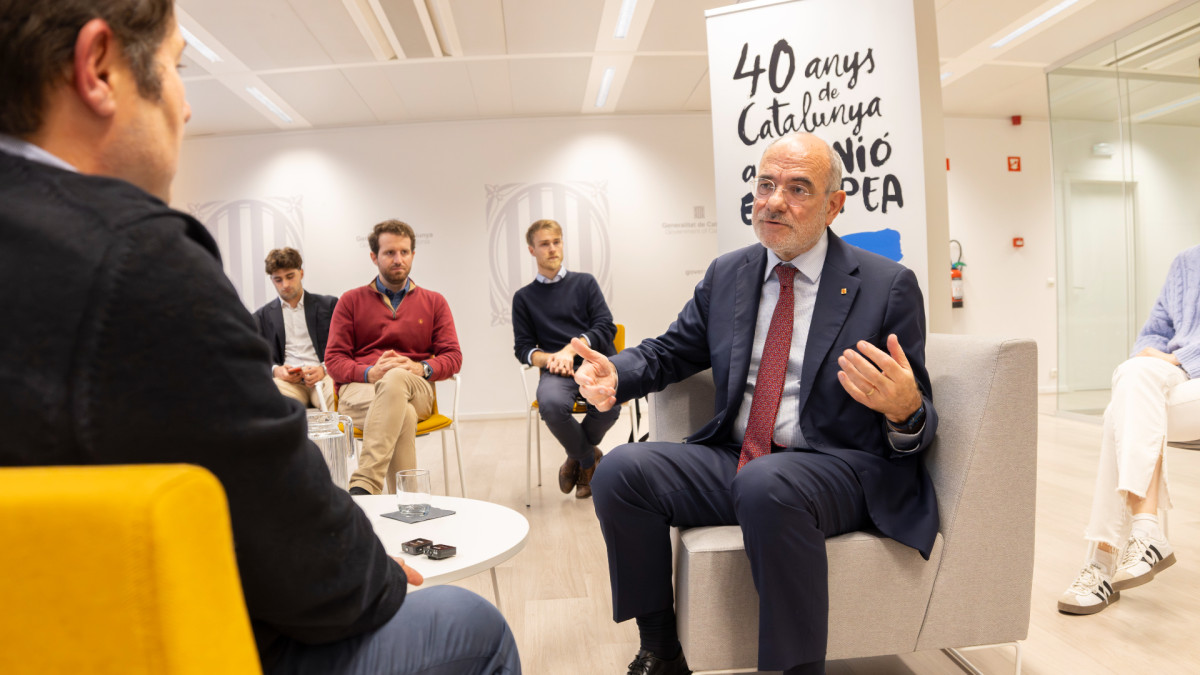
Brussels is not viewed in the same way from a centralized state as from a territory with its own competences and an outward-facing vocation. For this reason, Jaume Duch positions Catalonia as a player with a will to influence in the European Union: he argues that the country has built an image of a “serious country, deeply European” and warns that the upcoming EU budget could reopen a matter of particular importance: what role will regions have in a Union that tends to organize some instruments “in a more centralized way than before.”
The conversation, framed by the 40th anniversary of Spain’s accession to the European Union and the celebration of May 9, Europe Day, also addresses the new geopolitical scenario, the relationship with China, the acceleration of technology, and the need to complete European construction. The conseller for European Union and External Action of the Generalitat argues that the EU must adapt to a harsher context “without renouncing its basic values” and accelerate decision-making, because “if the world is accelerating, we should also be able to accelerate.”
The Catalan delegation in Brussels welcomes the director and editor of ‘Agenda Pública’, Marc López Plana Photo: Bru Agency
How do you assess Catalonia’s and Spain’s contribution to building Europe over these forty years?
Catalonia, in general, has made a significant and positive contribution over these forty years. We could probably say the same of the rest of Spain, but focusing on Catalonia, we are a community, a country, a region from the European vocabulary’s point of view, particularly active in various institutions, starting with the Committee of the Regions.
Catalonia has led and continues to lead many initiatives. It is a region that is always called upon when other regions in different countries want to launch initiatives to represent concrete interests in Brussels, whether on environmental issues, digitalization, or when the future of the European Union’s budgets is discussed. The question always arises: where is Catalonia, what can it do, or how can it help?
Recently, we have been asked to take on a certain leadership role when discussing a very important regulation, such as the one related to accelerating the European Union’s industrial policy.
“Catalonia has an image of a serious country, deeply European, that knows how to move and that now knows how to seek alliances at different levels”
This means that Catalonia has the image of a serious, deeply European country that knows how to maneuver and which, at least in the period I can talk about—the current government’s era—knows how to seek alliances at different levels: horizontally and, when appropriate, vertically as well. It also knows to first use its own tools and then those that European institutions or, for example, the Spanish diplomatic services can provide, which, logically, also have to help us in many matters.
How is Europe built over forty years with a composite state?
It is more complex than if it were a centralized state, but at the same time it is much richer and, above all, far more effective, because it brings us much closer to the real needs of people.
If we talk about the two typical phases of influence in European policy, in Community policy, we have the upward phase and the downward phase.
In the upward phase, the important thing is what tools you can obtain from your own State to influence the position that State will defend before European institutions, fundamentally before the Council of Ministers of the European Union.
That is fairly well regulated and allows, for example, that consellers of the Generalitat participate at certain moments in meetings of the Council of Ministers of the European Union representing the position of the autonomous communities and, therefore, also Catalonia’s specific position.
It is something that can be improved, and indeed one of the objectives we have since the beginning of this legislature is to increase Catalonia’s presence in those delegations of the Council of Ministers, in parallel with other measures we have already promoted, such as recovering a more dynamic presence in the Committee of the Regions, the institution that precisely channels those sub-state or, in some countries, subnational sensitivities.
Then there is the downward phase, that is, the moment of applying Community law or implementing EU programs.
During these forty years, the European Union has operated in a way that has allowed all this to be carried out in a highly decentralized manner. The execution of regional funds, in a significant part, is performed directly between Brussels and the Generalitat’s Department of Economy in Barcelona, without going through Madrid or other places.
In many projects and programs related to research, education, environmental protection, and other areas, management is also carried out directly between the European Commission and the Government of the Generalitat.
“The Generalitat is the one that holds the competences. Spain is, indeed, a nearly federal country”
The reason is simple: the Generalitat is the one that holds the competences. Spain is, indeed, a nearly federal country and, therefore, a very important part of the competences managed here by the European Commission are also held there. That is why it is logical that there is a constructive dialogue and a relationship that I hope we can maintain and deepen in the coming years between European institutions such as the Commission and Catalonia.
In short, it is a more complex system, but also much closer to the territory and, therefore, much more effective.
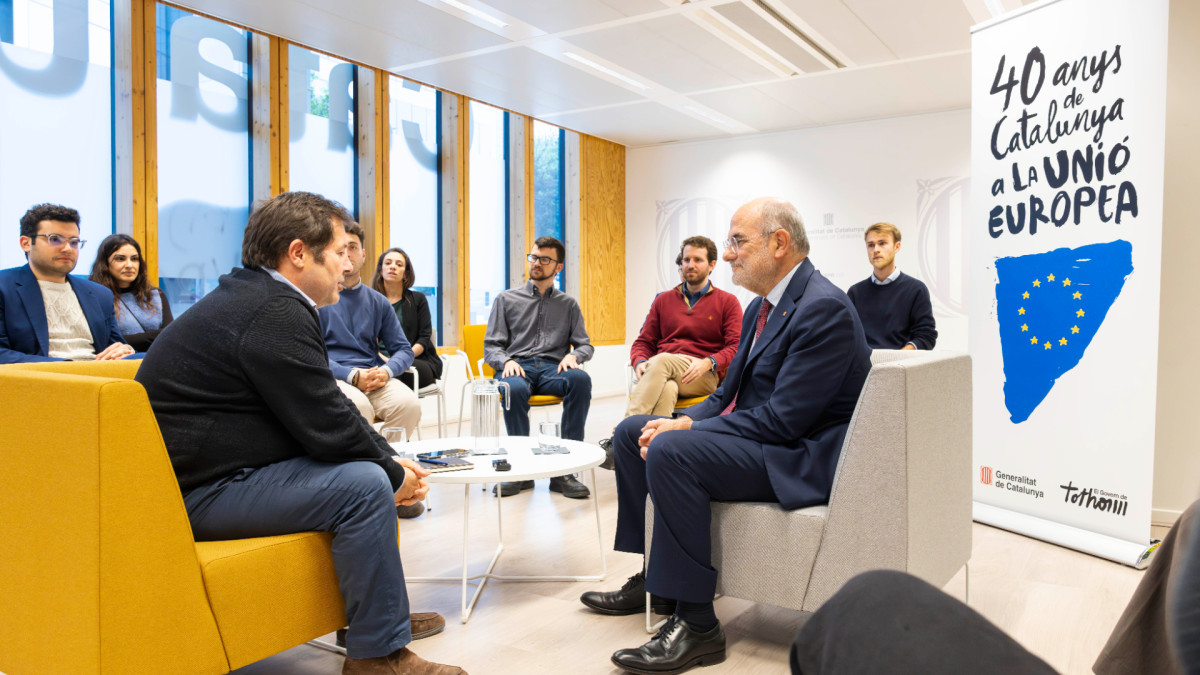
Jaume Duch delves into Catalonia’s role within a composite state and its relationship with European institutions. Photo: Bru Agency
There is one topic that worries him in particular: the role that the European Commission gives to regions in its budget proposal for the European Union for the period 2028-2034. What assessment do you have of this?
It is a topic that concerns us a great deal and in which we must be very attentive and proactive. And that is precisely what we have been doing since day one, since the first document was published.
The European Commission is organizing the multiannual budget execution and, therefore, also the EU’s annual budgets in a more centralized way than before, through a system of national and regional plans.
At first there were only national plans. Then, thanks to regional pressure, we managed to include the need to develop regional plans linked to those national plans.
Even so, there is now a discussion, mainly in the European Parliament, about all the implementation projects of the different programs used to mobilize EU spending. And there we have to ensure that the fine print does not end up triggering a recentralization in decision-making.
I think the political message has come through loudly and clearly, and by many channels. States with federal or autonomous structures, such as Germany, Austria, Spain, or, to some extent, Italy, are very clear that recentralization would cause internal political problems.
The European Commission itself also believes that some solutions should not be decided from Brussels, but at the level of each member state. That is, it will be up to each state to decide how to fit the national plan with the regional plans.
“We must be very present in both the Brussels debate and the discussions that may take place in the capitals of each country”
In any case, we must be very present in both the Brussels debate and the discussions that may take place in the capitals of each country; in our case, especially Madrid. The objective is to ensure, first, that there is no concentration of competences and, above all, to avoid a change in how the European Commission operates that ends up altering the balance of competences of countries like ours, where the distribution of responsibilities is part of the internal state equilibria.
Yesterday, a poll from the Centre d’Estudis d’Opinió was presented on how Catalan citizens value their relationship with Europe, which leaves some interesting elements. What is your assessment of these results?
It is an important poll produced by the CEO, with the collaboration of the European Parliament Office in Barcelona, and we have also participated by contributing some reflections on what elements could be drawn from it.
In general, the data are positive, though of course not all are, nor do all correspond to the ideal scenario we would like to see.
The first conclusion, in any case, is clear: Catalonia is today more pro-European than a few years ago.
The second, and very important, is that younger generations are the most pro-European or feel the most European. And that is surely one of the most positive elements of the poll, because we all see how the youth vote is evolving in many countries, including Spain. However, when asked whether young people feel European or are European-minded, those under thirty place themselves above the Catalan average in European sentiment.
It is also true that there are still gaps. People do not know very well how the European Union works or its institutions, and many citizens feel they do not have a voice in Europe.
It is a perception that changes a lot depending on when the question is asked. Three months before European elections, the answers tend to be more positive; two years later, they worsen because citizens disconnect from the moment when they decided who would be the European deputy.
All this shows that there is still much work to do: more education, more Europe-related initiatives, more work with the media, and above all, a better connection between European institutions and citizens.
Governments like Catalonia’s have a very important responsibility and function. They are governments closer to the territory and to the citizens and, therefore, they can do a much more direct job connecting the European Union and people than a larger state can.
Besides, I believe we also need greater involvement from local bodies, municipalities, cities, and towns.
There is a third element of the poll that is also fundamental for us: citizens want answers.
People may feel very pro-European, but at the same time they expect the European Union to help solve their problems. If that does not happen, that more emotional Europeanism ends up weakening.
This means that citizens want Europe to help resolve problems such as housing shortages — in Catalonia, though a reality repeated in many parts of Europe —; to guarantee security and defense; or to act on issues such as climate change, immigration management, social policies, or the fight against poverty.
Several years ago, for example, security and defense would hardly have appeared among citizens’ top priorities. Today they do.
“Citizens continue to back the European Union and Europeanism, but they demand concrete results”
In short, citizens continue to back the European Union and Europeanism, but they demand concrete results. They want to see that Europe is useful and contributes to improving the society in which they live and their life as European citizens
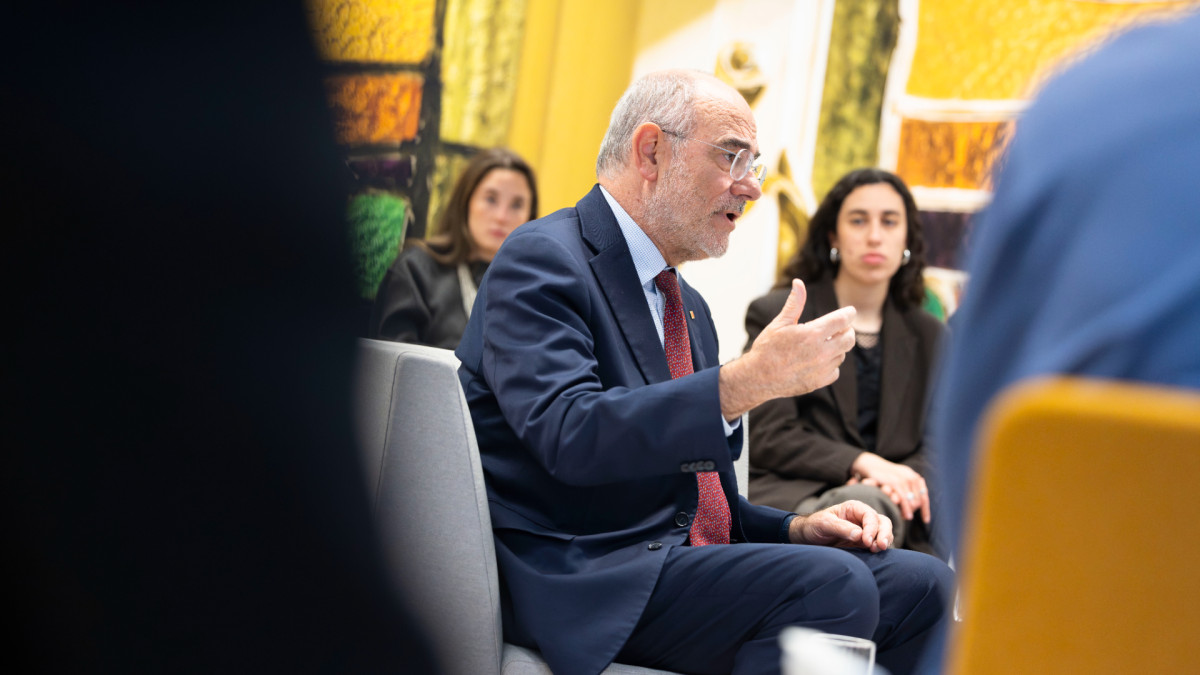
Marc López Plana asks the Catalan conseller about Europeanism among Catalan citizens and the challenges facing the European Union. Photo: Bru Agency
How do you see the next forty years?
I would be satisfied simply to know what the next four or five years will be like. Talking about the next forty already enters the realm of futurology.
But if we compare the forty years that have passed with the forty that lie ahead, I think the last forty have been the best of our history. There are many reasons to say so, and the data also demonstrate this indisputably. The big question is whether the coming forty years will continue to be the best years of our lives and, in that case, of Europe. And there, a big uncertainty appears, depending on many factors.
The first is what will happen in the world. And we do not know, because in less than two years we have seen changes that used to take decades to occur.
The world is accelerating and so are changes: politically, with a new U.S. administration; geopolitically, with a much more powerful People’s Republic of China; and also with a Russia that has completely broken with respect for the most basic rights and has provoked a war of territorial annexation in Europe, something we had not seen in a long time.
We are also seeing shifts in balances between countries and regions of the world and a weakening of multilateralism, that is, the role played by the United Nations, the World Trade Organization, and other international bodies. All of this changes the rules of the game.
The European Union had adapted well to the world’s functioning over the last decades, but now it must be able to adapt to a completely different context without renouncing its basic values, the defense of rights, or what it means to feel European.
At the same time, those values must be defended more than ever, because we live in a world that is more complex and, to a large extent, more hostile. A world in which our way of organizing society—democratic, plural, and respectful of human rights—is being questioned and attacked, something that did not happen a few years ago.
The big question is whether we will know how to adapt to these new times, whether we will be able to strengthen the European Union and, in fact, complete it, because European construction remains an unfinished project.
There are still many things to do: a genuine common foreign and security policy, a European fiscal policy, or a banking union that would allow governing economic and financial policy differently. There are advances and political will, but the processes remain too slow. And if the world is accelerating, we should also be able to accelerate the way we take decisions.
That implies, for example, reducing the number of issues that require unanimity or speeding up the European Union’s legislative processes.
The case of artificial intelligence is very illustrative. The European Union approved, a couple of years ago, the first law in the world to regulate artificial intelligence. But between the moment you start drafting a rule and the moment it enters into force, the technology has already changed completely.
Now we are probably looking at legislation that would need updating. But if we delay another two years to review it, we will be exactly in the same situation again.
“The core question is whether we have the political will, whether we are able to equip ourselves with the necessary instruments”
That is why the core question is whether we have the political will, whether we are able to provide ourselves with the necessary instruments to turn that will into concrete actions and, ultimately, whether we have the economic resources to do everything that needs to be done.
Is there a strategy to promote that more Catalans reach important decision-making positions in the Commission, the Parliament, or European institutions?
It is one of our priorities, not only in relation to the European Union but also with international bodies such as the United Nations. We have launched a program to facilitate that young Catalans gain internships in European institutions and international organizations.
We have also promoted a program that allows Generalitat civil servants to work temporarily in services of the European Commission or other institutions for periods of four months to two years. The aim is for them to integrate into the European machinery and, when they return to Catalonia, do so with direct knowledge of how these institutions actually work.
In addition, we have the Francesc Vendrell scholarships, specifically aimed at letting young people undertake internships in different organizations and institutions.
“We are going to launch a system of fifty annual scholarships so that university students can collaborate with us within the framework of their studies”
We will soon launch a system of fifty annual scholarships so that university students can collaborate with us within the framework of their studies, whether in the department in Barcelona or at one of the Generalitat’s twenty-one offices currently in various countries around the world.
And finally, the scholarships promoted through Catalunya International to pursue postgraduate studies at prestigious European universities, such as Sciences Po in Paris, and especially the ten scholarships for the College of Europe in Bruges, which is, in a way, the great school where many future civil servants and professionals linked to European institutions are formed, albeit informally. We have almost tripled the number of scholarships available.
The sum of all these measures clearly shows one thing: we want more Catalans to be part of the European machinery and international organizations, to get involved, and to help us better understand how these structures work and to accompany the work we also must undertake as a government.
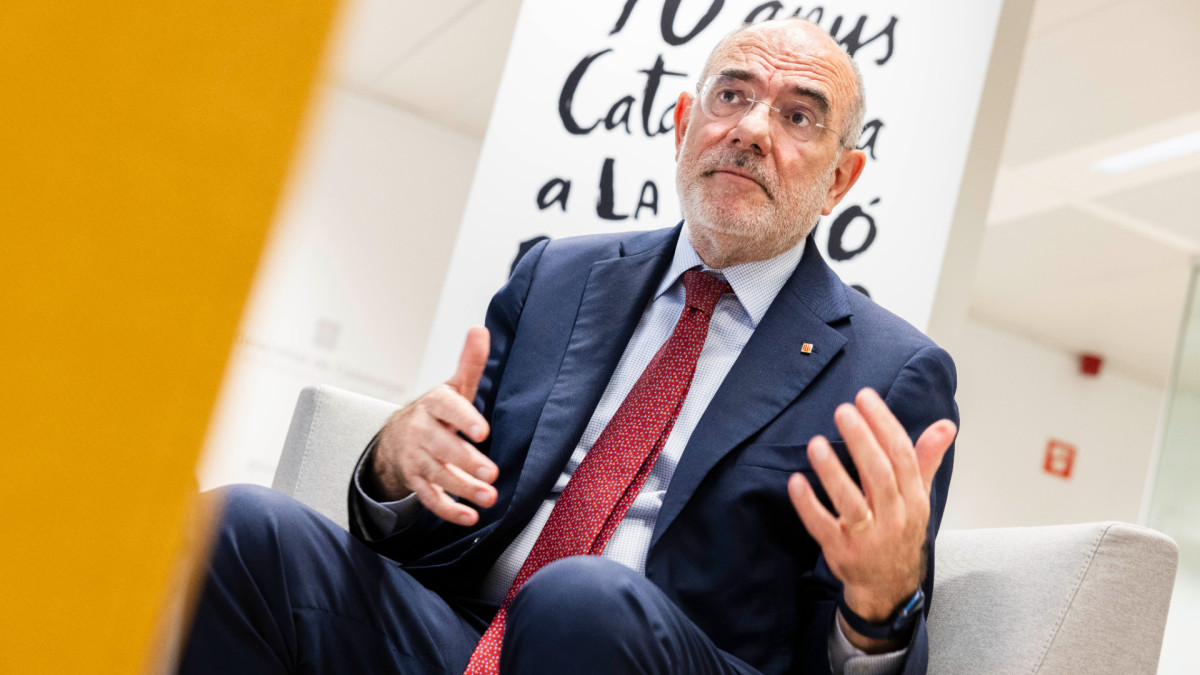
The Conseller Jaume Duch explains the mechanisms through which Catalonia seeks to influence European legislative debates. Photo: Bru Agency
Earlier you mentioned a particularly interesting topic: the leadership you have been asked to assume around the Industrial Accelerator Act, one of the most relevant initiatives at the moment and which has just entered the European Parliament. How can a regional government like Catalonia lead such a broad debate and use the mechanisms offered by European institutions to influence a parliamentary process of this kind?
When we talk about European legislation—or future legislation—the first step is to participate in the consultation processes opened by the European Commission, which allow you to provide opinions even before the first draft begins to be written.
And that matters because many laws go through green papers, white papers, and various studies in which the experience of actors tied to the professional or territorial spheres affected by that future regulation is sought.
In Catalonia, whenever there is a topic we consider especially relevant, we participate in that process.
Then, the Committee of the Regions also drafts an opinion on the legislative proposal, and there is the possibility to intervene, submit amendments, and ensure that the final text reflects your positions and interests. Often those interests coincide with those of other regions, though not always. In areas such as Mediterranean policy or fishing policy, for example, not all regions defend the same priorities.
In this specific case, we are already in a second phase of work before the Committee of the Regions and the European Commission, focusing not so much on the general concept as on the current specific text on the table.
And here we are working in two directions. On the one hand, contributing our position with the collaboration of the different Generalitat departments involved in the issue. On the other hand, coordinating with other regions that share similar approaches to build common positions.
Parallel, there is also essential work in the European Parliament, through the Members of Parliament you can access: Catalan, Spanish, or from other EU countries who share your vision and can help ensure amendments and the legislative process move in a direction aligned with your interests.
And the third major area of work is the State itself. It is essential to ensure that Spain’s Permanent Representation to the European Union accounts for your needs in preparing Coreper’s work and, subsequently, the Council of Ministers.
In the end, you have to be able to act simultaneously in three spaces: the regional and Committee of the Regions space; the Commission and European Parliament space; and the States and Council of Ministers space.
You recently traveled to China and have been very active in developing that institutional relationship. Earlier you spoke of a world that is increasingly complex, and China is, without a doubt, one of the great powers shaping this new international scenario. What impression did you take from that visit? What kind of relationship does the Government of Catalonia want to establish with China? How is a strategic relationship with a country as relevant and, at the same time, as complex as China managed?
China is a peculiar country, but just by going there—or even by observing it from outside—we realize we are dealing with one of the great world powers. In some areas it is likely already the leading power, or will be in a very short time. And that is a reality we must accept.
From there, one must also understand that, in today’s world, we need to maintain stable relations with different countries and regions around the world.
We feel much closer to the rest of Europe and also to the United States. But the transatlantic relationship is currently going through a complex phase. Every few days there are announcements about tariffs, about who will guarantee Europe’s defense, or about possible retaliations linked to certain political or military positions.
That means Europe also has to look toward other regions of the world. Toward Mercosur, for example, with which we have just approved a cooperation and association agreement; toward India, with whom a recent agreement has also been reached; or toward Australia, with which the European Union is about to close another deal. And, of course, toward China as well.
The relationship with China is more complex than with other countries, but that does not mean it should not exist. The important thing is to understand that it develops on different levels, and each requires a different approach: the economic and commercial plane, the cultural field, or social exchanges, for instance.
As Catalans, we must always act in line with the European Union’s overall strategy. Although it is also true that within Europe there are nuances in how to relate to China.
Historically, countries like Germany have maintained an especially intense relationship with China, closely linked to sectors such as automotive, although there is now also a sense of revising that strategy.
Other countries, such as Spain, have likewise developed a positive relationship, but always within the framework defined by the European Union in its relationship with China.
And we must be clear that there are areas where cooperation is straightforward, others where more prudence is required, and others where it might be better to maintain certain distances. That is, at heart, the task of governments. International relations are never easy, but it is always necessary to find spaces for contact and dialogue with the rest of the world.
Thank you very much.
With the support of