
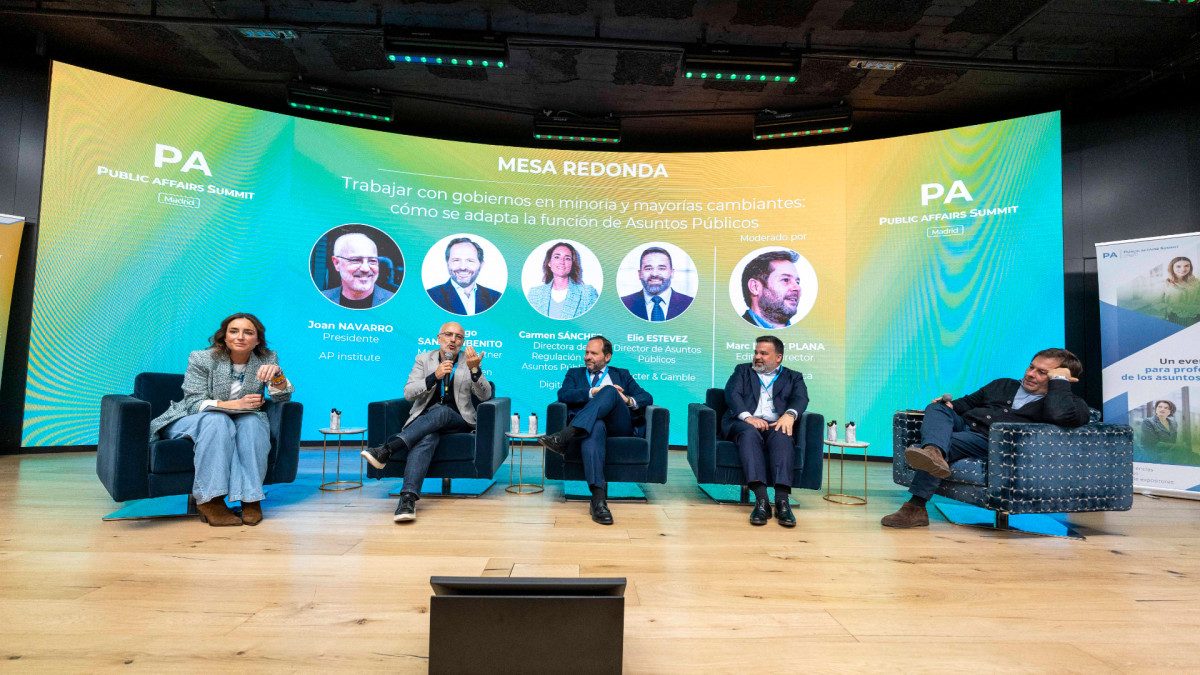
In a political context marked by parliamentary fragmentation, regulatory complexity, and a rising demand for dialogue between institutions and civil society, the first Public Affairs Summit held in Madrid brought together yesterday public affairs professionals, institutional representatives, companies, associations, and consultancies to debate the evolution of the sector in Spain. Madrid’s selection as the new European gathering’s venue was not accidental; although the profession has a long tradition in Brussels or other European capitals, in Spain the public affairs ecosystem continues to consolidate and gain institutional recognition.
Throughout the day, the diagnosis was shared: public affairs have ceased to be a peripheral activity or solely corporate, becoming a structural element of contemporary governance. The proliferation of political actors, regulatory pressure, the growing weight of Brussels, and the need to build consensus in increasingly polarized environments have expanded the space in which the profession operates, but also its responsibilities.
“The success of public affairs means the success of our political system, our democracy and the public interest”
The opening remarks by the Secretary of State for Relations with the Cortes and Constitutional Affairs, Rafael Simancas set much of the tone for the event. Simancas argued that “the success of public affairs means the success of our political system, our democracy and the public interest,” directly linking lobbying and interest representation activities with democratic quality. Although he defended Spain as a full democracy, he warned about the fragility of consensuses and called for shared responsibility among institutions and sector professionals to strengthen transparency, participation, and the quality of public policies.”Spanish democracy is valuable, but also fragile and reversible,” he noted, in a speech where he underscored the importance of public-private collaboration and of incorporating technical knowledge and policy evaluation into public decision-making.
Political fragmentation: more complexity alongside more spaces of influence
One of the main axes of the forum was the impact of political fragmentation on the practice of public affairs. The panel on minority governments and changing majorities reflected broad consensus: the current parliamentary scenario is not a temporary anomaly, we are facing a structural transformation of Spanish politics.
Joan Navarro, president of AP Institute, noted that single-color governments have been an anomaly in the European context and argued that the current political scenario, although more complex, has also introduced higher levels of plurality and transparency in negotiation processes. In his view, the growing social and political diversity has multiplied the interests and sensitivities present in public debate, making political management and consensus-building more difficult, but without it necessarily leading to institutional deadlock.
The idea that political plurality obliges rethinking engagement strategies was shared by Elio Estevez, Public Affairs Director at Procter & Gamble, and Carmen Sánchez Muñoz, Director of Regulation and Public Affairs at DigitalES, who described a much more volatile, multi-level and less linear environment. For companies, they explained, this means dedicating more resources, increasing strategic planning and maintaining constant dialogue with diverse actors, both in Madrid and in Brussels.
“Fragmentation complicates decision-making, slows down legislative processes and creates regulatory uncertainty, but it also multiplies negotiation spaces”
The colloquy left a recurring idea throughout the day: fragmentation complicates decision-making, slows legislative processes, and creates regulatory uncertainty, but at the same time multiplies negotiation spaces and forces broader consensus-building. In the words of Diego Sanjuanbenito, managing Partner at Rud Pedersen Spain, “public affairs professionals dedicate themselves to complexity”.
The roundtable ‘Working with minority governments and changing majorities: how the public function adapts to public affairs’. Photo: Public Affairs Summit
Transparency and regulation: the pending consensus
Another central debate centered on the regulation of lobbying activity in Spain. The general sentiment was clear: there is a growing consensus on the need to advance toward comprehensive regulation, but the process remains politically blocked.
The participants agreed that Spain lags behind other European countries and the European institutions. Dolores González Pastor, Director of IR and Public Affairs at Octopus Energy, summarized this view by asserting that “the question is no longer whether regulation is needed, but why it is taking so long”.
During the day, issues such as traceability of influence, the need for interoperable registers between administrations, the control of conflicts of interest and the role of political parties in accountability processes were discussed. Participants such as David Martínez García, Executive Director of Transparency International Spain, and Irene Matías Campano, Vice President of APRI, insisted on the need for an independent authority with supervisory and sanctioning power in Spain, as well as on the importance that regulation covers both the public sector and the interest groups themselves. Beyond the technical content, the debate also reflected a certain maturity of the sector, which is beginning to advocate regulation as a tool for professional legitimacy and institutional strengthening.
Influence is no longer played only in Madrid
The European dimension ran through much of the Summit’s discussions. The panel dedicated to the relationship between Madrid and Brussels demonstrated how much the European regulatory agenda already conditions national and business decisions.
One of the most repeated messages was the need to abandon a defensive view of Brussels. Omar Anguita, partner and Director of Institutional Relations and Strategy at Rud Pedersen Spain, noted that many companies still perceive European regulation as a constraint, when in reality the Community institutions are simply setting the rules of the game in an increasingly competitive global context.
“In public affairs, the winner is not the one who arrives last and shouts the loudest, but the one who has spent time building credibility and contributing data”
In that same vein, Alicia Martín Rodríguez, General Director of Plastics Europe Iberia Region, defended the importance of technical rigor and continuous work over strategies based solely on political or media pressure. “In public affairs you don’t win by arriving last and shouting the loudest,” she stated, “but by the one who has spent time building credibility and providing data.” The Europe discussion also carried an underlying tension that appeared at different times during the day: how to reconcile defending national or sector interests with the need to build a more coherent and strategic European position.
Carolina Gregorio, Public Affairs Director for Sustainability in Dow EMEA, argued for thinking in Europe rather than in the twenty-seven member states separately, advocating broader sectoral and industrial alliances against global competitors such as China or the United States. However, other participants and guests reminded that the growing internal political fragmentation of the member states makes constructing a single European voice even more difficult.
AI, sustainability and sectoral specialization
Although political fragmentation and regulation dominated much of the debate, the conference also reflected how public affairs are becoming increasingly specialized and technical.
Various parallel sessions and workshops tackled very specific fields — healthcare, sustainability, corporate communications, relations with business associations, NGOs or the onboarding of youth into the sector — showing to what extent institutional dialogue has integrated into almost all spheres of economic and social activity.
Artificial intelligence (AI) also occupied a prominent place. In the panel dedicated to its impact on the sector, featuring Enrique Marcos Collado, Senior Manager at Spaak; Tomás Burgaleta Alonso, cofounder of Reversa AI; Cecilia Álvarez Rigaudias, Director of Data and Privacy Policy Europe at Meta; and Ana Salazar Sánchez, President of ACOP, several speakers agreed that AI is already transforming internal processes, analytical capabilities, and regulatory monitoring, though it has not yet replaced the strategic and relational component of the profession.
The ability to identify patterns, anticipate public debates, or streamline technical tasks coexisted with cautions about confidentiality, technological dependency, or loss of judgment. The dominant conclusion was that AI can optimize processes, but not replace political judgment, contextual understanding, or the building of trust. Knowing how to pose the right questions, interpret political timings, and understand negotiation dynamics remains, according to participants, the sector’s main added value.”The new generations arrive with a much more natural relationship with technology and AI, combining digital capabilities with a broader transversal understanding of communication”” En parallèle, several interventions also pointed to a generational shift that may transform the profession from within. In the workshop on bringing young people into the public affairs market, participants argued that new generations come with a much more natural relationship with technology and AI, combining digital capabilities with a broader transversal understanding of communication, political analysis and information management. The automation of certain technical or bureaucratic tasks, they noted, will allow more time for strategic and relational value-generating functions.
This transformation is also accompanied by a growing professionalization of the sector. Throughout the forum it became evident how public affairs have begun to consolidate also in the academic and training sphere, with more specialized programs, institutions dedicated specifically to this activity, and a greater professional structuring of a sector relatively recent in Spain. The event itself reflected this evolution, with the participation of organizations such as AP Institute, ACOP or APRI, linked to the development, training, and representation of the profession.
A more visible and more structural profession
Beyond the concrete debates, the Public Affairs Summit left a shared impression: public affairs are gaining weight, sophistication, and legitimacy in Spain. The fact that Madrid hosted this European gathering for the first time signals the maturity of a sector that for years operated with less visibility than in other neighboring countries.
Throughout the day, a paradox repeatedly appeared: influence activity often occurs away from the public spotlight, yet its impact on political, regulatory, and economic decisions is increasingly significant. Precisely for this reason, many conversations focused on the need to professionalize, make more transparent, and better explain an activity that, as several participants argued, is essential in increasingly complex, fragmented, and regulated societies.
In a political setting where consensus is harder, institutions are more multi-level, and regulation is more technical, the forum projected a clear idea: public affairs are no longer merely a tool for representing business interests; they have become a mechanism for articulating between sectors, administrations, and civil society in an increasingly sophisticated political and regulatory context.
