
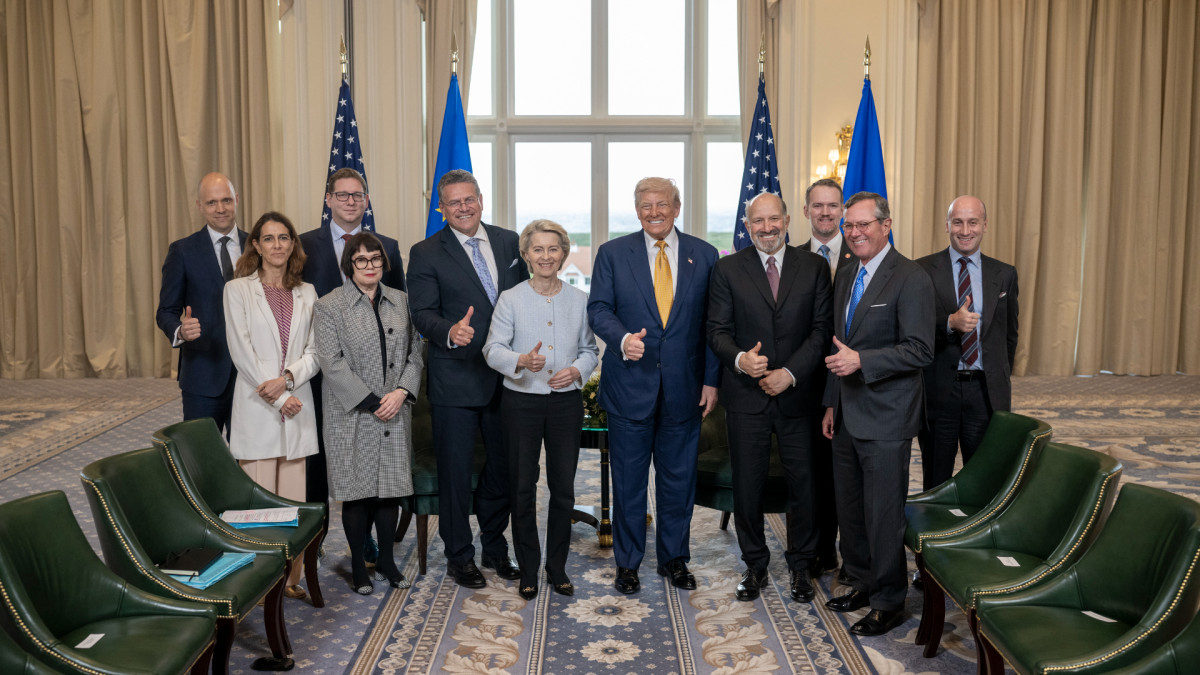
Although European institutions are prone to making certain moves in silence, the noise provoked by the departure of Sabine Weyand, Director-General for Trade and Economic Security, has been heard in all European capitals —and even on Florida’s golf courses. Everything indicates this has not been a mere reshuffle of chairs within the community bureaucracy. The fall of Weyand, the woman who dared to say that the “emperor” of European trade policy was naked, has an unavoidable political backdrop, a reflection of the different visions and strategies that dwell in the Berlaymont.
“Her exit —not framed as such— is the price the Commission has decided to pay to silence technical dissent”
Weyand, a key negotiator of Brexit and guardian of the temple of rule-based free trade, has been sidelined after her stance on the trade agreement reached at Turnberry with the Trump Administration. In other words, her departure —not framed as such— is the price the Commission has chosen to pay to silence technical dissent in the face of a pact that many within the Directorate-General for Trade and Economic Security (DG Trade) consider a capitulation that harms the Union’s commercial sovereignty.
Weyand against the “appeasement”
The conflict that has ended with Weyand’s exit began on the golf greens of Scotland. The Turnberry agreement was presented by the Commission’s presidency as a diplomatic success that avoided a full-blown trade war. From Spain, the current first deputy prime minister, Carlos Cuerpo, spoke from a realist standpoint: “What has been agreed does indeed help reduce uncertainty, but it does not eliminate it”.
“Accepting a tariff ‘for the sake of peace’ was accepting a revolutionary tax that deteriorates the very rationale of the European Union as a commercial bloc”
However, for the purists of international trade led by Weyand, the pact is an evident mistake. As Domènec Ruiz Devesa, senior researcher at CIDOB, explains, we are facing a “failed appeasement strategy toward Trump.” Weyand internally opposed the EU’s voluntary acceptance of an average tariff for the EU of 15% in addition to offering other concessions. Under Weyand’s logic, accepting a tariff “for the sake of peace” was to accept a revolutionary tax that undermines the European Union’s raison d’être as a trading bloc.
Her resistance aligned with a historical reading that the Commission seems to have forgotten. American professor Cyrus Veeser recalls that eighty years ago, after World War II, the United States understood that free trade aligned with peace; high tariffs and trade barriers with war. The former Director of Trade understood this doctrine and warned that, by accepting Trump’s tariffs, the EU was financing the next conflict and legitimizing the use of trade as a coercive weapon.
One of the most contentious points between Weyand and the Commission’s DG was the handling of Trump’s judicial setback in his own country. When the U.S. Supreme Court ruled tariffs based on the IEEPA unconstitutional, a window opened for the EU to regain the legal initiative.
However, as consultant César Guerra Guerrero, founder of Trade & Access Consulting, explains, the Trump Administration reacted with an agility that Brussels did not dare to answer. “Although this is a decision that reaffirms the principle of separation of powers, the Trump Administration has found a new loophole to impose a global 10% tariff,” Guerra Guerrero notes. By invoking Section 122 of the 1974 Trade Act, Washington simply repackaged its protectionism.
“The Commission chose to fit the new legal basis to avoid irritating the White House”
According to published reports, Weyand questioned the compatibility of the agreement and the tariff architecture derived therefrom with international trade rules. In that reading, the response should have been to bring the new framework before the World Trade Organization (WTO) and to activate discussion on the Anticoercion Instrument. The Commission, however, chose to fit the new legal basis to avoid irritating the White House. Weyand refused to technically endorse a measure she considered incompatible with international trade law. Her exit is proof that, in the new Brussels, international law has become secondary to political convenience.
A measure kept in the drawer
The chair swap distances the EU even further from using its most powerful tool: the Anticoercion Instrument (ACI). While the Commission justified its inaction out of fear of an escalation, authoritative voices suggested the possibility of using this mechanism, which was once designed to be deployed against China.
As Oscar Guinea, director at the European think-tank ECIPE, rightly points out, there is a fundamental confusion about the nature of this tool. For the economist, “the anti-coercion mechanism is not a weapon of war; it is precisely designed to sit down at the negotiating table.” The argument goes that only when the adversary knows you have the capacity to strike back, the negotiation table is taken seriously.
“By renouncing credible deterrence, Brussels is not avoiding conflict: it goes to negotiation with its hands tied behind its back”
By sidelining Weyand, the Commission also moves away from the mechanism in practice. Following Guinea’s logic, by renouncing credible deterrence, Brussels is not avoiding conflict: it goes to negotiation with its hands tied behind its back. It is the difference between the hard diplomacy Weyand advocated and the wait-and-see diplomacy that now seems to have settled in Berlaymont.
How did the European Parliament respond?
Weyand’s departure comes after the European Parliament voted in March 2026 to move forward with ratifying the Turnberry agreement. It was a traumatic vote. Most parliamentary groups voted in favor out of fear of chaos, but Weyand’s dissent during the technical briefings to MEPs was the last straw that broke the Commission’s patience.
It is especially disheartening that the Parliament moved ahead with ratification while Trump was making direct threats against member states. Ruiz Devesa highlights this inconsistency: “It is unthinkable that under such circumstances the European Parliament would proceed to the juridical validation of what was agreed on the golf course.” The fact that the EU moved forward in that process while Trump threatened to “cut trade” with Spain over a military base and defense issue is, for many observers, a very low point of European diplomatic dignity.
For Spain, Weyand’s departure is not good news. The director-general was the strongest advocate of the EU’s “one voice” response. By being sidelined, Madrid becomes more exposed to Washington’s divide-and-conquer tactic.
MEP Adrián Vázquez Lázara has been one of the most vocal in denouncing the EU’s waning relevance. For Vázquez Lázara, trade has been the engine of our freedom, but that engine is clogged by a lack of strategic courage.
“While Weyand urged using the EU’s economic muscle to protect countries like Spain, the Commission sidelined her for ‘not being constructive’
The paradox is cruel: while Weyand urged using the EU’s economic muscle to shield countries like Spain from tariff coercion linked to security, the Commission sidelined her for “not being constructive,” according to her critics. In other words, for not accepting that Spain could be bargaining chip in a broader deal. Vázquez Lázara warns that the EU has moved from representing 20% of global GDP to 15%, and that this irrelevance accelerates when subordination is rewarded and the defense of national and common interests is punished.
Toward a weakening of European sovereignty
The analysis of the situation cannot ignore the feeling of “neglect” that runs through European capitals. Critics say the EU allowed Trump to set the rules of the game. Weyand was the last line of defense against this erosion of sovereignty.
Trump has managed to make the EU pay dearly for its negligence. The EU trusted that WTO rules would shield it forever, and did not invest in its own commercial autonomy when it had time. Now, with the pressure rising, the Commission has decided that it is easier to sideline the head of trade than to admit that its four-year policy was a sequence of miscalculations.
The departure of Sabine Weyand leaves the Directorate-General for Trade and Economic Security in a state of technical paralysis at the worst possible moment. With Trump’s Section 122 in full effect and ratification turned into the main pressure card, the EU enters a phase of total uncertainty.
“The solution lies less in white-glove diplomacy than in ‘turning to the new tariff at the WTO, launching countermeasures and the anti-coercion instrument’
Who will replace the woman who knew every comma of the trade treaties? Probably a political profile, someone willing to manage decline with better manners. But, as Ruiz Devesa warns, the solution lies less in white-glove diplomacy than in “turning to the new tariff at the WTO, launching countermeasures and the anti-coercion instrument”. Without Weyand, the likelihood that the EU will use these tools is virtually nil.
In eighty years, the world has undergone a complete turn. From Cordell Hull’s optimism and tariff reductions to foster peace, we have returned to a scenario where trade is the cudgel with which allies are struck. Sabine Weyand has fallen defending a vision of Europe that no longer exists: the Europe that earned respect through law and the market. Her exit after challenging the Turnberry agreement is the implicit recognition that the European Commission has thrown in the towel. Brussels has preferred the quiet of a commercial graveyard to the battle for its principles.
While in Washington they toast the end of technical resistance in Brussels, in Madrid and in the rest of Europe’s capitals we are beginning to understand that the price of this agreement is measured in euros or dollars and, above all, in the permanent loss of our strength as a sovereign bloc.
Responses from Brussels have been clear: the Commission preaches calm in the face of Trump’s tariff threat. Calmly and proceeding with the removal of American tariffs, as foreseen in the Turnberry agreement. This is the line chosen by the Von der Leyen Commission in response to Donald Trump’s threat to raise tariffs on European cars and trucks to 25%. “This is not the first time we have received threats. It is not the first time that we tell them from this podium that we remain very calm, focused on implementing the joint statement in the interest of our companies and citizens,” a Commission spokesman said this week. “or will we be swayed by hypothetical threats that have not materialized,” he added.
The Commission does not want to embark on an “escalation” of threats, the spokesman explained. In discussions among member states, a broad majority wants to accelerate the adoption of the legislative text to remove tariffs on U.S. products, as foreseen in the Turnberry agreement. Only France insists on including safeguard clauses, as the European Parliament has requested.
