
Albert Dalmau (Barcelona, 1990) serves as the Minister of the Presidency in the Government of Salvador Illa. Dalmau is one of the chief collaborators of the Catalan president and a representative of a generation of politicians born under democracy who are already taking on institutional responsibilities. He is one of the assets of the Catalan Executive, combining three aptitudes that, together, are atypical for institutions: political vision, managerial capability, and hands-on experience in the private sector.
In this conversation with political scientist Nacho Corredor, Dalmau discusses, from the Plaza de España in Madrid, the development of the social-democratic ideology guiding Illa’s Government, his idea of Spain, makes the case that Catalonia is a favorable destination for business investment, advocates the new autonomous financing proposal as a tool to reduce differences among Spaniards, and develops the need for institutions to build hopeful scenarios rather than resignation.
Dalmau is pushing within Illa’s Government for an ambitious reform of the administration, and he argues that “for Catalonia to do well, Spain must do well” and “for Spain to do well, Catalonia must do well”, while asserting Catalonia as a region attractive to investment because “there are places that sometimes speak of their dynamism, yet companies cannot find housing so their workers can live”.
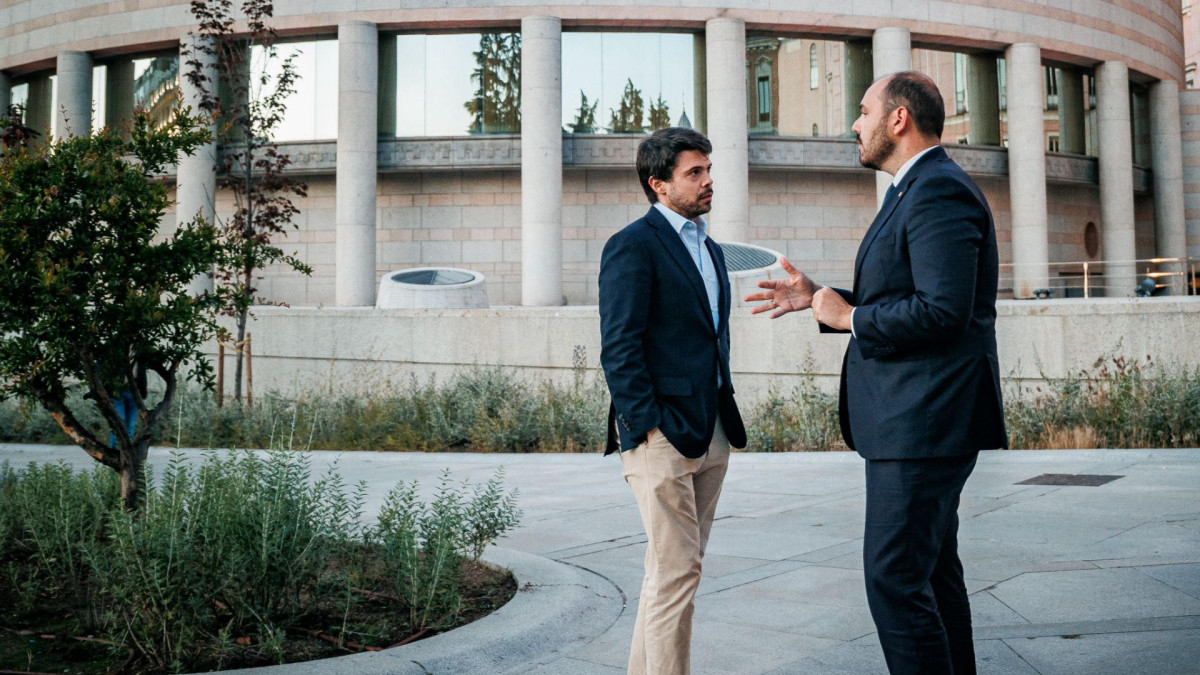
Albert Dalmau talks with Nacho Corredor about the new stage of the Salvador Illa Government. Photo: Agenda Pública / Tania Sieira
How do you govern without budgets?
With the same level of ambition, of course—both to continue governing and transforming the country and with the desire to get budgets approved and pushed forward. We are committed to passing the budgets, and our objective is to have them approved and in motion next month.
Councillor, please explain exactly what was agreed between the PSC and ERC regarding financing. The reality is that each side explained different nuances of the agreement, and two years later it is important to understand the basis of that pact.
Catalonia must take a leap forward in financing. We start from the premise that Catalonia is an underfunded region, and we want to be able to compete on equal terms with the rest of the communities. We aim to develop our public services and our infrastructures under the same conditions, and for that, it is important that the Spanish Government present a proposal.
“We must put on the table the courage shown by the Government of Spain in proposing a model that improves financing for the entire system”
We have spent a year and a half working on a proposal that would guarantee more resources for Catalonia and for all autonomous communities: a system that is fairer, that reduces the differences between Spaniards, and that, in Catalonia’s case, given its particular elements, would provide space to fund those elements and, by virtue of our competences, such as the autonomous police. A proposal that would enable us to gain greater capacity and greater fiscal co-responsibility. This is the central element of the proposal we agreed with ERC.
There is a need to put on the table the courage that the Government of Spain has shown in proposing a model that improves financing for the system as a whole, among the autonomous communities, which reduces the gap between Spaniards and that, in Catalonia’s case, not only increases funding by 4.7 billion, but also recognizes those peculiarities that, due to our competences, are different. And it also solves a very relevant issue: the system has been expired for thirteen years.
The President of the Generalitat presented himself at the elections with a pledge to bring to Catalan society a new financing proposal and to be able to agree on it. And, a year and a half later, after thirteen years with the system expired, we can present ourselves to Catalan society and tell them that we have fulfilled it.
Why does one more euro for Catalonia not mean one less euro for other communities?
Because in the proposal put forward by the Government of Spain, an additional 20,000 million euros is added to the system as a whole and to all autonomous communities.
We must help our country understand that what is good for Catalonia is also good for Spain.
“What history has shown us, and what we are convinced of, is that for Catalonia to do well, Spain must do well, and for Spain to do well, Catalonia must do well”
There are those who have tried to perform a divisive role in Spain. They call themselves patriots, but they also occasionally push a narrative that divides Spain and suggests that for Spain to prosper, Catalonia must suffer. What history has shown us, and what we are convinced of, is that for Catalonia to do well, Spain must do well, and for Spain to do well, Catalonia must do well.
The Government’s proposal is not only a solid plan for Catalonia; it also narrows the gap among the autonomous communities. That is a fundamental element of the system’s design. We currently have an expired system, but one that also fosters inequalities among citizens and communities. Those communities that are worse funded see a significant delta with those that are better funded.
It is a good proposal. It benefits Catalonia, but also Andalusia, the Valencian Community, Murcia, and the whole system—especially those areas that have financing problems.
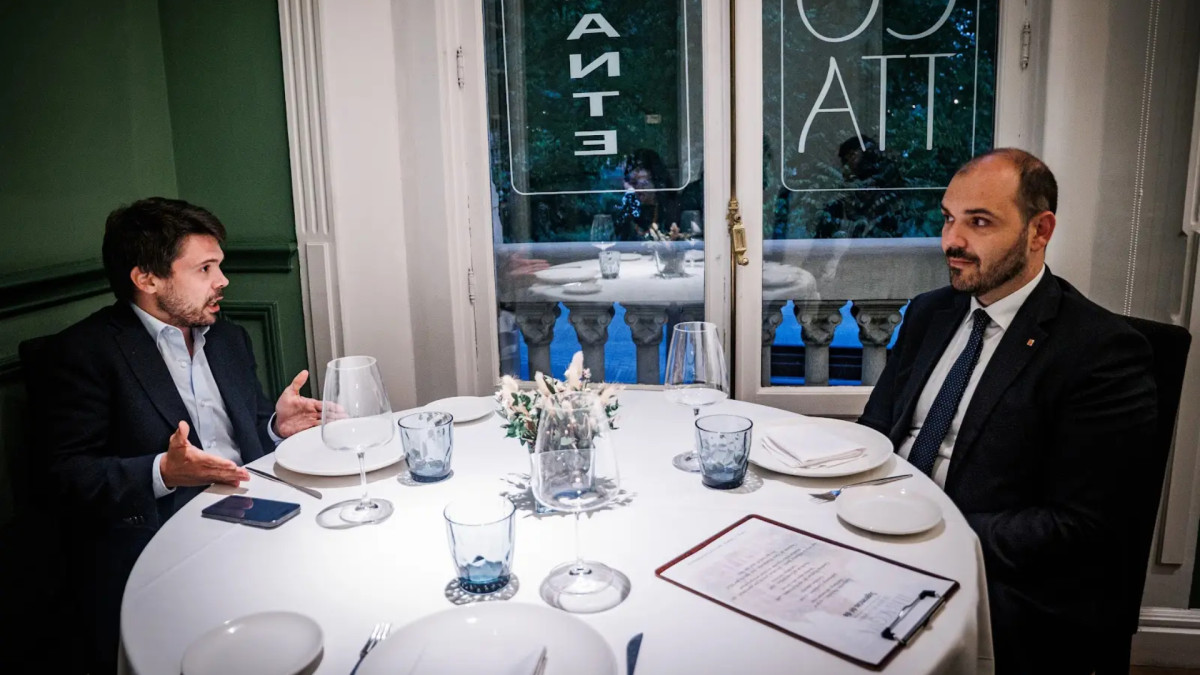
Nacho Corredor questions Albert Dalmau about autonomous financing and the relationship between Catalonia and Spain. Photo: Agenda Pública / Tania Sieira
The statutory process and the procés were a chain of irresponsible decisions. Would it be prudent to approve a new financing system without the support of the Partido Popular?
What would be prudent is to move forward with a new financing system after thirteen years of expiry. I would like the Partido Popular, instead of blocking everything, to lay out a concrete proposal if, when they governed with an absolute majority and had the chance to present a proposal, they did not do so. If they were unable to reform the financing system despite an absolute majority, perhaps they could allow us to articulate a financing proposal that is beneficial for communities governed both by the PP and by the PSOE.
I wish that what they privately admit, but publicly decline to say, could be spoken aloud: that this is a good financing system for both Andalusia and Catalonia.
What are the Illa government’s achievements during this period?
Catalonia has managed to open a new chapter focused on directing energies toward projects that affect the region’s economic competitiveness and the prosperity of its people. A new era of stability has emerged, in which we have encouraged the return of companies and unleashed Catalonia’s potential that, in our view, had long been restrained by the inability to reach agreements among Catalans and with the Spanish institutions.
We have reached very important accords to unlock matters such as the expansion of the airport, a fundamental infrastructure for Catalonia’s economy to stay competitive. We have agreed to expand the Mossos d’Esquadra, the autonomous police force, by 5,000 officers to better address one of Catalonia’s main problems two years ago: insecurity. We presented a plan to get Catalonia moving, and two years later we have placed the country’s energies where they were most needed.
How will a Catalan citizen notice the administration reform you are pursuing?
They will notice it when they go to carry out a bureaucratic procedure and no longer need to book an appointment in advance, as had been the case. They will notice it when a resident of a rural town does not have to travel to Barcelona for every service because we are relocating citizen service offices to cover all procedures. They will notice it in a rural municipality when its council can facilitate housing or economic activity more easily because the regulations are simplified and things move faster. And citizens applying for assistance for dependency will experience a process that, instead of taking four hundred days, could be completed in sixty days.
When I participate in Catalan media talk shows, I often sense more bitterness than hope. I do not know if that is because, indeed, there is not yet a page turned on the procés.
Catalonia must overcome the political culture of the procés. Opening a new chapter means inoculating against skepticism and pessimism to explain a country that has everything ahead of it, that has many tasks to undertake, acknowledging that for many years energies were not directed where they should have been, and that embarking on this path will be challenging at times, but we are on the right track and there is a horizon of hope ahead.
“I champion the need to govern without self-consciousness, to direct energies where the country needs them to overcome the ten-year trough”
Our objective is to explain to people that we work to make the country function. The contemporary world will divide between those who carry hope and, therefore, explain and anticipate the future—those who believe we can move forward and grow—versus those who sell a future of despair and resignation, looking backward without a plan for the future. We have chosen to explain to Catalonia that the country still faces many challenges, that it can succeed collectively, that we can build the infrastructure necessary for the country’s competitiveness, that we can address the housing problem, that we can regain economic leadership in Spain, but that achieving all of this requires embarking on a program of reforms, transformation, investment, and the willingness to govern without inhibitions. I reaffirm the need to govern without shyness, to direct energies where the country needs them to overcome the trough of the last decade. And we must wake Catalonia back up, which means doing so ambitiously and without reservation.
RELATED ARTICLES
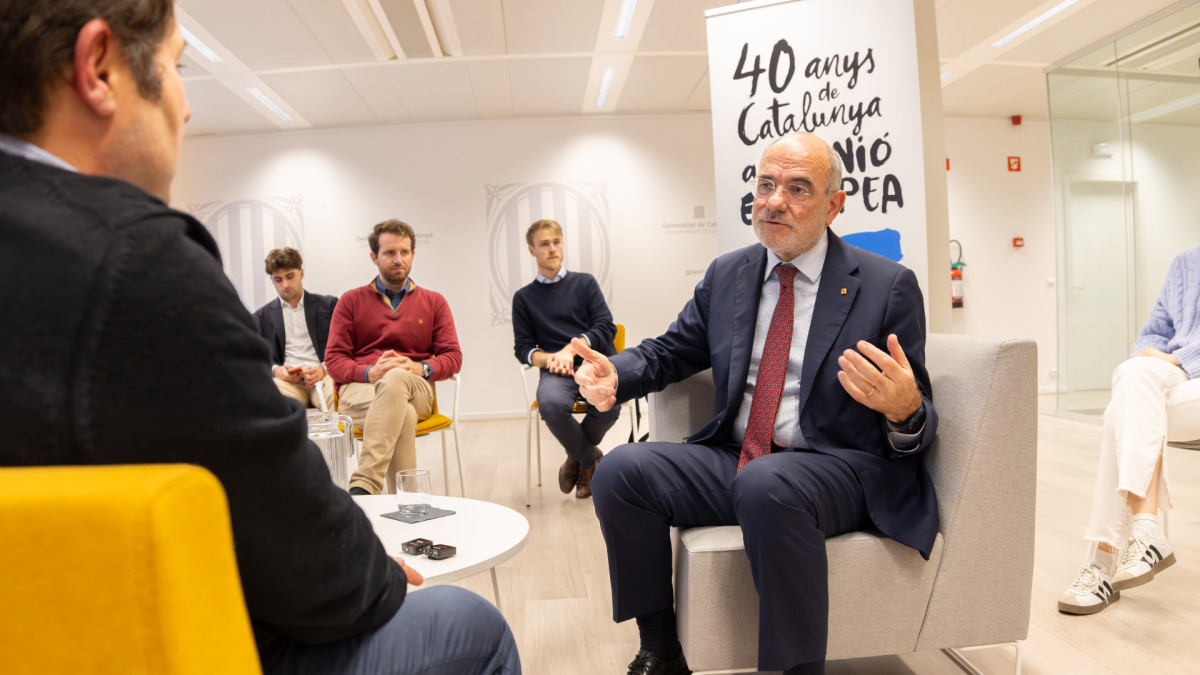
The Catalan Government’s Minister of European Union and Foreign Action, Jaume Duch, speaks with Agenda Pública’s director and editor, Marc López Plana.Bru Agency
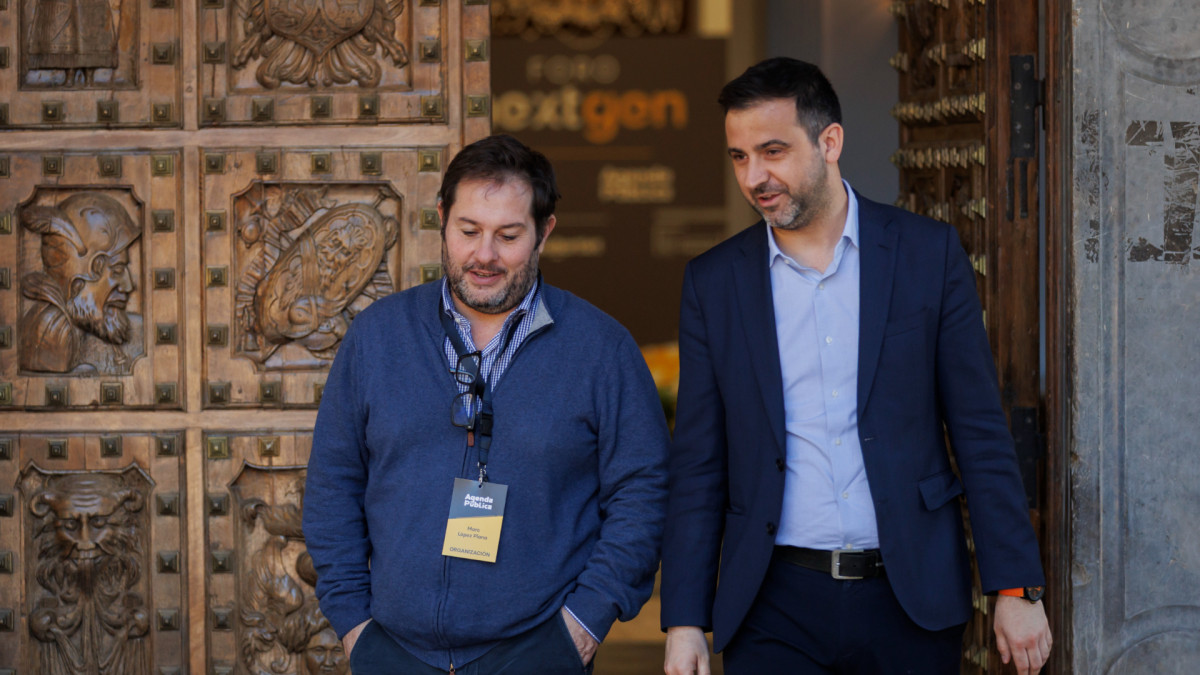
Pol Gibert, general secretary of Business of the Government of the Generalitat de Catalunya (right) and Marc López Plana, editor and director of ‘Agenda Pública’ (left).Agenda Pública / Álex Cámara
Why should an international company choose Barcelona or Catalonia to invest in Spain over other competitive and stable options like Madrid?
For a company to grow in Europe or globally, what it needs and seeks is talent. Today Catalonia or Barcelona stand out as Spain’s principal talent hub: you’ll find competitive infrastructure connecting you to Europe, economic stability, and, above all, a lifestyle that supports the cohesion necessary for talent to reside in our city or our country.
“There is a Madrid of inequality where the ultra-rich are growing, while the middle classes struggle to hold on”
There are places that sometimes tout their dynamism, yet companies cannot find housing so their workers can live. And that is happening in Madrid. There is a Madrid of inequality where the ultra-rich are increasing, but the middle class cannot be sustained. That is bad for the economy and will be even worse for the long-term economy.
We hold moderate values, with a government that is calm, one that presents a horizon of stability, yet one that is pro-business, pro-economic growth, and pro-infrastructure. That is what has led a company like AstraZeneca to decide to locate its global hub of innovation in Barcelona.
I have the sense that the Illa Government is like a laboratory for updating Spain’s social-democratic ideology. You have a clear stance on security, a development-oriented economic position, and you approach migration both from the defense of human dignity and from recognizing that growth must be addressed with more investment and resources, acknowledging that it has not always been done well.
We are a clearly social-democratic government, though many people from various political traditions have trusted President Illa because he is the right person to open a more ambitious era for Catalonia and the country. I also think we speak without inhibitions on certain topics. The left should have a clear, unabashed stance on security: talking about safety is a leftist stance. And this is something we must be able to address because it concerns duties and rights, the right to live peacefully in your street, your square, your town or city, and it requires being firm against violence and crime, making safety a clearly progressive policy.
“We are not afraid of certain debates that the left sometimes rejects. Yet we are a government that, for instance on immigration, understands it as a global phenomenon
However, safety is not a matter we can tackle only through policing or the judiciary; we must also address it from the standpoint of social cohesion. We are the government that has recovered the Neighborhood Plan because we understand that safety policies form a value chain spanning from the police officer to the courts—who judge the repeat offenders—but also involve transforming public spaces, ensuring well-lit streets, rehabilitating housing, safeguarding people’s dignity… There must be a comprehensive vision that advances a progressive model of what safety should be.
We are not afraid to engage in debates that the left sometimes rejects. Yet we are a government that, for example on immigration, views it as a global phenomenon without turning our backs on how our own past was, and we must maintain a humanitarian perspective toward someone who comes to earn a living in our country, while at the same time being able to combine that with a discourse of duties and rights and the need to keep integration within our culture or our identity.
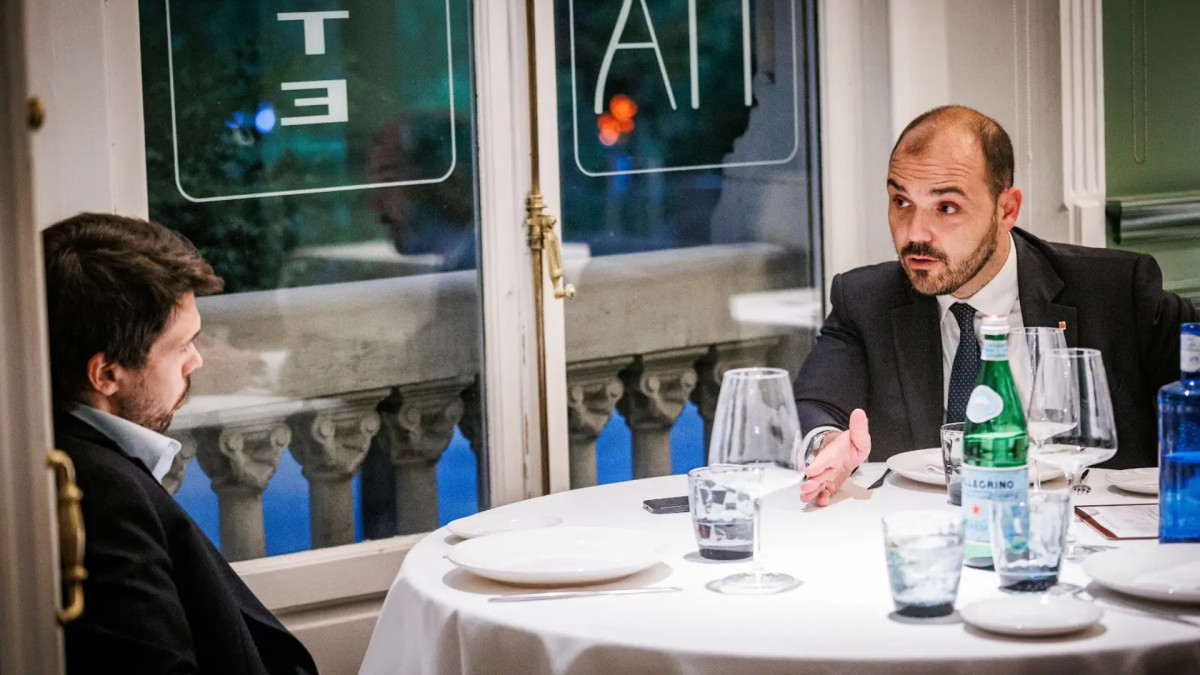
Albert Dalmau develops the Illa Government’s social-democratic ideology and its views on security, immigration, and social cohesion. Photo: Agenda Pública / Tania Sieira
Councillor, you are part of the first generation of citizens born in a democracy who assume spaces of institutional responsibility. What is the mandate of our generation?
There is a generation in the world of literature, business, entrepreneurship, science, that is carrying a high level of ambition—one that has also claimed its place in the world and it is natural for that to happen in the public sphere as well. There is a generation that wants to listen, to contribute ideas, that has lived the world with a different perspective, and that must be compatible with doing so alongside other generations.
What does Spain represent to you, Councillor?
Spain represents my country, the country where gay marriage was legalized, a country of freedoms, a wonderful nation with a history I share, where I understand that the convergence of identities between my homeland, Catalonia, and my homeland, Spain, must be possible; between my language, which must be possible; the dialogue between Picasso or Miró, but also with Gabriel Celaya.
Thank you very much.
