
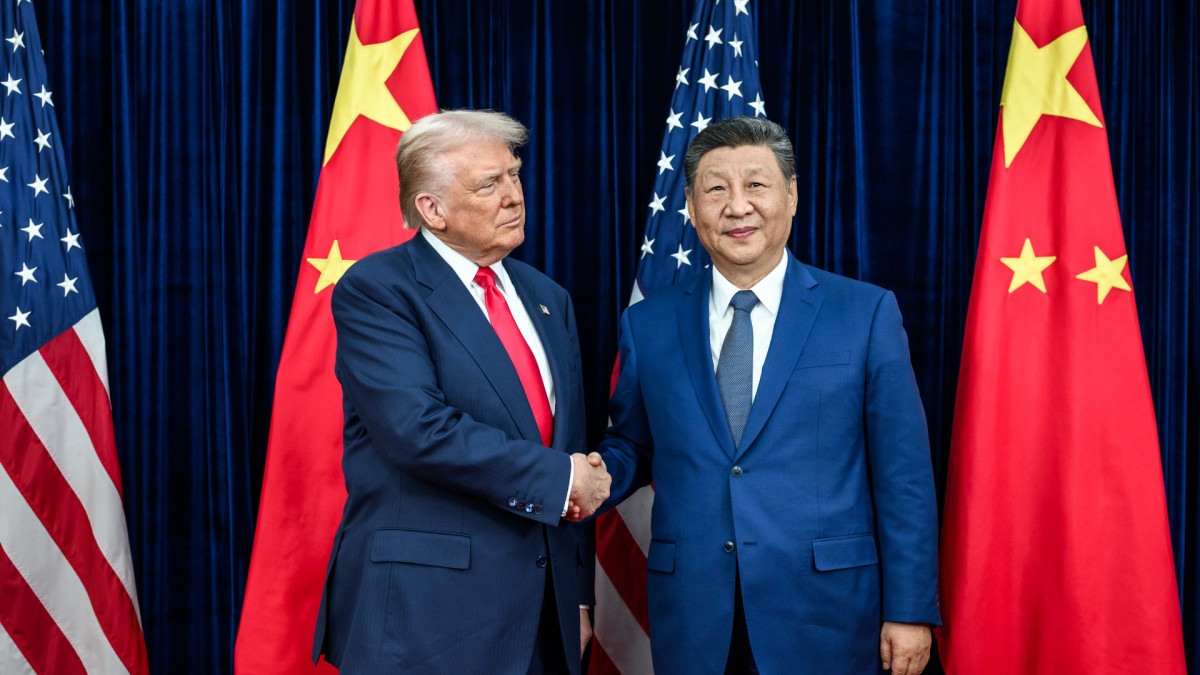
For the first time in United States history, the same president will repeat an official state visit to China. Although nine years have passed between the two engagements, the irony remains that it is Donald Trump, the supposed nemesis of Xi Jinping, who will go down in the annals as the only American president to visit mainland China on two separate state occasions and with full honors.
If the summit ultimately takes place —it is reasonable to contemplate a last‑minute cancellation—, it will be a historic milestone whose magnitude dwarfs the four China visits that Spain has carried out, one per year, which have provoked many protests about Madrid’s fondness for Beijing.
“It is precisely the enormous imbalance in the relations between the two countries that makes rapprochement unavoidable. Spain has to play its cards”
China is a formidable rival. That is why one must keep it as close as possible. This is how Spanish diplomacy has thought for many years, adopting a strategy based on “if you can’t beat him, join him.” A policy that generates public frictions due to the dictatorial character of the Chinese regime, but also because the size gap could leave Spain at the mercy of the Asian giant. It is precisely the enormous imbalance in the relations between the two countries that makes rapprochement unavoidable. Spain has to play its cards, many or few, to shape the enormous trade gap with Beijing.
But the context in which Spain and other European countries have been working for years depends in part on the meeting that the two septuagenarian leaders will hold this week. Washington has thus far opted for a confrontational policy toward Beijing, with an explicit rejection of its trade and even its investments, which has opened a space to reorganize relations with the European continent. Europe has been handling for months the challenge that Anglo-Saxon media have labeled as shock 2.0. This means the shift from massive exports of value-free Chinese goods to a new flow with technological input that has put doubts in some traditional Western sectors, with particular impact on the motor industry.
It is worth recalling the utter lack of success of Trump’s strategy toward China over the last twelve months. In April, Chinese exports to the United States rose 11.3% compared to the same month the previous year —the one marked by the Day of Liberation, when the failed tariffs were announced—, which has driven the trade deficit to widen by 13% in favor of Beijing. An epic failure. A year later, China’s role in global trade is greater, with its exports shooting up toward nearly every market.
Trump, to be sure, deserves credit for his audacious resilience,<> will shake Xi’s hand humiliated on multiple fronts: the tariffs have been ruled illegal in his own country, but Beijing had already bent his arm beforehand by closing the spigot of rare earths. China has shown not a shred of weakness in the face of the oil supply cut from Venezuela and the Gulf countries. Iran has turned its weakness into a stalemate by exploiting the Hormuz Strait as a bargaining chip.
“Trump presents himself in Beijing, a counterintuitive move for a supposed loser that triggers alarms about how far he will go in his negotiations with Xi”
America has failed to find a chink in China after a year of aggressively destabilizing the economic and political board. With such materials, Trump goes to Beijing, a counterintuitive move for an alleged loser and one that triggers alarms about how far he will go in his negotiations with Xi to strike something that might remotely look like a victory for the Republican. The great fear is that Trump’s position of weakness and his desire to notch up a victory will push him to make concessions on Taiwan.
Experts, such as the Spanish analyst Alicia García-Herrero explained in this article, are convinced that Xi will raise the issue. China wants the United States to at least stop supplying weapons to Taipei. For now, Trump has moved part of his fleet in the South China Sea to the mouth of the Hormuz Strait, in addition to having emptied his missile arsenal against Iran. The New York Times reported this past weekend that Chinese intelligence services believe the U.S. would not currently be capable of defending Taiwan against an invasion.
There is a paradox: 2027 is the year that American intelligence and military officials marked—more than a decade ago—as the most probable for a Chinese invasion of Taiwan. At the start of Trump’s term, that date seemed implausible, but there is a sense that the U.S. administration is working, consciously or unconsciously, toward making it come true.
Whether or not an extreme concession on the island is reached, to recall, its strategic importance derives from the concentration of chip production and supply to the rest of the world —almost 90%— the experts warn that the president will have to show something in his hands after the visit. And Europeans hold their breath in case this transactional negotiation damages Europe’s fragile relationship.
“The chances that the two leaders reach some form of agreement that harms the EU are high. The scenario in which Trump returns empty-handed is also likely”
In a context where European capitals, especially Madrid, are trying to restrain China’s shock 2.0, a tilt toward the United States could derail the strategy. The diplomatic triangulation with two poles of leadership so extreme, and one so unpredictable, is marked by extreme volatility. The chances that the two leaders will close some form of agreement that harms the EU are high. The scenario in which Trump returns home empty-handed is also likely.
Thus, international and geoeconomic relations enter this week in a critical phase, the latest historical moment in the last year. Whatever happens, the episode validates the Spanish pragmatic view. One must be part of the change and, certainly, keep the antennas and the proxies to stay as informed and close as possible to the flow of events in regions geographically so distant.
Spain holds a unique position because it has much less to lose than the rest of its European partners. As Miguel Otero, senior researcher at the Elcano Royal Institute, notes in this recommendable article, France and Germany are the most threatened by the new Chinese industrial policy that is constraining their usual strengths. Madrid has far more room to profit from attracting Chinese investments, provided it continues regulating deals, refining technology transfer, and creating local employment.
Spain’s success in renewables is intrinsically tied to China’s industrial power in the sector. Not only because of the known photovoltaic value chain or even wind energy; also because Spain needs to multiply—by eighty!—its battery storage capacity for the grid to avert new blackouts and approach energy sovereignty. Today, that capacity can only be supplied by China, and projects like the one announced in Navarra to build batteries on Spanish soil are existential.
Fortunately for Spaniards, the U.S. energy-dominance policy is heavily centered on fossil fuels and does not seem poised to play a major role in negotiations over draining these resources to Europe. But the history remains to be written this week in Tiananmen Square. If some kind of agreement is reached, whether on artificial intelligence limits, arms sales, or oil, its reverberations will impact the European economy.
