
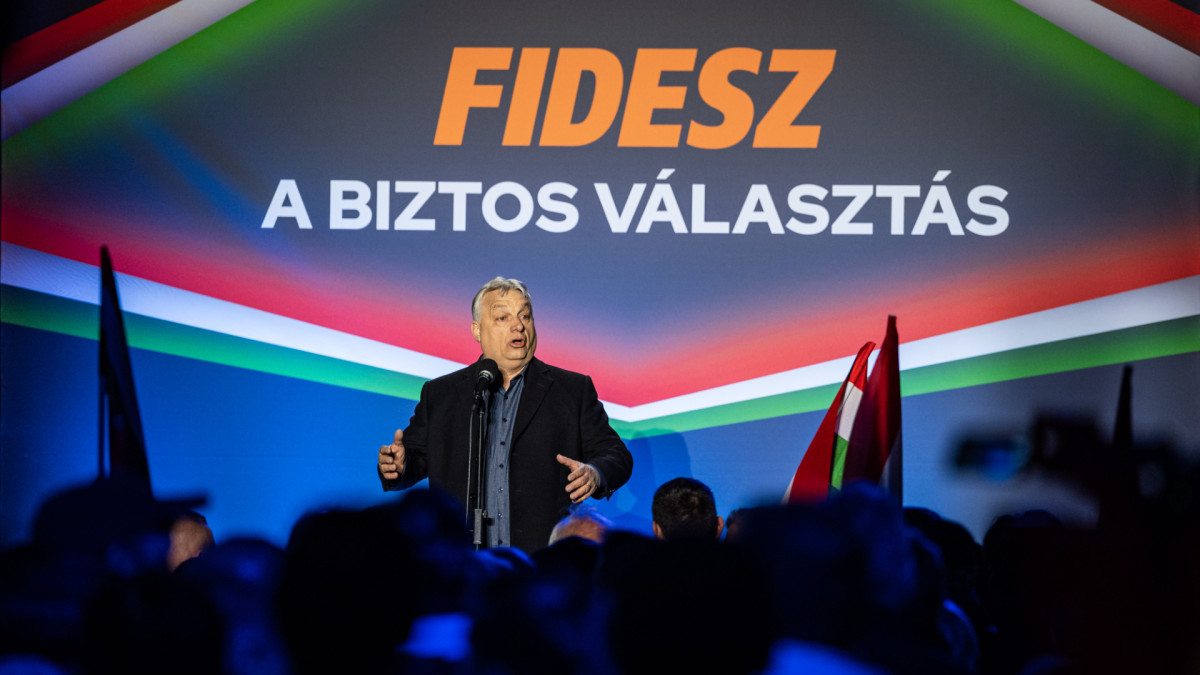
For the first time since 2010, Hungary is approaching a general election — scheduled for April 12, 2026 — in which the outcome does not appear fully predetermined. The political system built around Viktor Orbán and his party, Fidesz, faces an electoral challenge that, at least according to polls, opens the possibility of a change of government. The rise of the Tisza party, led by Péter Magyar, has unsettled a political balance that for more than a decade seemed unshakeable.
However, it is worth avoiding hasty readings. Hungary is not a fully liberal, competitive system. The institutional and electoral architecture has been progressively reformed under Orbán’s governments with the aim of reinforcing Fidesz’s structural advantages. The mixed electoral system — which combines single-member districts with proportional lists —, together with compensatory mechanisms that benefit the governing party, introduces significant distortions in translating votes into seats. Add to that the delimitation of electoral districts favorable to the ruling camp, as well as a deeply unbalanced media ecosystem.
“For the Hungarian opposition, winning votes is not enough; it is necessary to win with a sufficient margin to overcome the system’s biases”
In this context, the slight edge polls give to Tisza should be interpreted with caution. It is not enough to win votes, but you must win with a margin large enough to overcome the system’s biases and, furthermore, to do so in rural areas where Orbán’s clientelist networks run unimpeded. But even in that scenario, the institutional challenge is even greater. To overturn key reforms —affecting the judiciary, regulatory bodies, the media system, or even the Constitution itself— it would be essential to secure a two-thirds majority in Parliament. This threshold, which Fidesz has achieved on several occasions, constitutes today one of the main safeguards of the regime.
The internal electoral dynamics, moreover, are having visible effects on Hungary’s European politics. Polls unfavorable to Orbán have coincided with certain tactical moves within the European Union, especially regarding funding to Ukraine. Budapest’s stance on decisions linked to aid packages cannot be understood apart from the electoral calendar. This tension in relations with Brussels coexists with an intensification of the nationalist-sovereignist discourse that has characterized Orbán for years. The narrative against alleged Brussels interference has been reinforced during the campaign, presenting the European Union as an actor that threatens Hungary’s sovereignty. Parallelly, the tone toward Ukraine has hardened, incorporating more aggressive nationalist elements intended to mobilize segments of the electorate in identity terms. This strategy follows a logic well established in Fidesz’s political repertoire: the construction of an external antagonism that allows internal cohesion among the electorate.
In this discursive field, the main novelty does not reside so much in Orbán’s message as in the ability of his principal opponent to contest it. Péter Magyar is not an outsider in the strict sense. His trajectory within Fidesz’s structures has given him a deep understanding of the governing party’s political, organizational, and communicative logics. This political capital has been key to shaping an electoral strategy that, far from positioning itself as an outright opposition from classical liberal-progressive parameters, has chosen to operate within the same symbolic field. Magyar has maintained a nationalist tone, but he has reconfigured it in a way that avoids the dichotomies posed by Orbán. Rather than directly challenging the sovereignist rhetoric, he has re-signified it, introducing elements of democratic renewal and anti-corruption critique without breaking completely with the dominant identity frameworks. This strategy has allowed him to broaden his electoral base toward voters who, while critical of the Government, did not identify with the traditional opposition.
The Tisza campaign, in this sense, has managed to sidestep some of the “discursive traps” that historically have weakened Hungary’s opposition. By not situating itself on an exclusively pro-European axis against a Eurosceptic government, it has avoided reinforcing the polarization designed by Fidesz. Instead, it has posed a more complex contest, where the question is not necessarily EU membership but the quality of governance and the management of power.
Nonetheless, uncertainty remains high. Even in the event of a Tisza electoral victory, the system’s structural limitations raise questions about the real capacity for change. The need for a two-thirds majority to modify key aspects of the institutional fabric constitutes a considerable obstacle. Without that margin, any alternative government would be obliged to operate within a normative framework designed by its predecessors.
“Recent experience in Poland suggests that the process of institutional transformation is neither immediate nor linear”
This raises a deeper question about the nature of change processes in contexts of illiberal drift. Is it possible to reverse, through electoral mechanisms, transformations that have been designed precisely to hinder reversal? The recent experience in Poland suggests that the process is neither immediate nor linear. Despite the change in the executive, the rebuilding of the rule of law faces institutional, legal, and political resistances that slow down — and even condition — the capacity for reform.
In Hungary, the challenge is even greater. The illiberal project promoted by Orbán has not only been in motion longer, but has penetrated more deeply into the structures of the State. From controlling the media to reconfiguring the judiciary, and through the creation of clientelist networks, the system has been designed to endure beyond specific electoral cycles.
There is one final unknown: Péter Magyar’s own political will. His trajectory within Fidesz raises questions about how far his project implies a real rupture with the existing model or, on the contrary, a more moderate reformulation of it. The strategic ambiguity that has characterized his campaign — and which has been key to his electoral growth — could become a source of uncertainty if he were to reach government.
In short, the April 12, 2026 elections should not be interpreted solely as a contest between two parties, but as a turning point in Hungary’s political evolution. On one hand, they test the resilience of a consolidated illiberal regime. On the other, they open up the possibility — still uncertain — of political change whose real scope will depend as much on the electoral results as on the system’s structural conditions.
Beyond what the ballots decide, the fundamental question remains: to what extent are democratic mechanisms enough to reverse long-running erosions of democracy? Hungary offers, in this sense, a paradigmatic case for comparative analysis in Europe. And, as such, its evolution will be watched with careful attention not only in Budapest, but also in Brussels and in other European capitals where the balance between democracy and illiberal drift remains a matter of dispute.
