
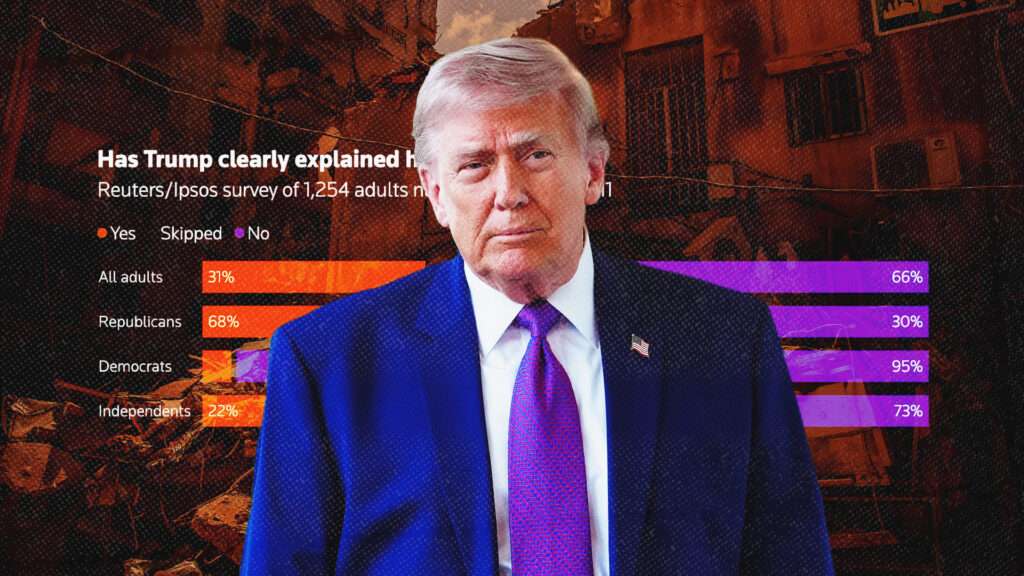
The American public never received a clear justification for why the Trump administration chose to strike Iran in the first place.
Two-thirds of Americans say that President Donald Trump did not lay out his aims with sufficient clarity in the Iran conflict, according to a poll conducted by Reuters and Ipsos and released on Monday. The same survey found that approximately two-thirds fault rising gasoline prices—tied to the fighting in the oil-rich Persian Gulf—on the Republican Party.
The survey adds to a lengthy sequence of polls indicating that the public did not want the war to begin and was unsatisfied with how it unfolded. The Trump White House appears to be aware of this reality. The conflict was launched by the president in a surprise move on a Friday night. After the United States and Iran reached a ceasefire in mid-April, the administration asserted that Congress no longer has a say under the War Powers Act, arguing that the timing window of the war had effectively reset.
Spurred by the swift outcome of Venezuela’s regime-change efforts, Trump publicly and privately suggested that the war would only last a weekend. If the battle would conclude before the public could weigh in, why bother presenting a case to them at all? Since then, Trump has argued that the public still needs to observe before rendering judgement.
Rather than concluding with a definitive end to hostilities, the conflict seems to have settled into a lower-intensity yet ongoing clash. While both sides continue negotiating the terms of future talks, they keep exchanging fire across the Strait of Hormuz.
“Don’t rush me,” Trump told reporters last month, soon after the ceasefire took effect. “We were in Vietnam for 18 years. We were in Iraq for many, many years. I don’t like to say World War II, because that was a biggie. But we were four-and-a-half, almost five years in World War II. We were in the Korean War for seven years. I’ve been doing this for six weeks.”
Supporters on the liberal side of the aisle who favored the war have voiced comparable frustrations. A few weeks into the conflict, The Atlantic described it as “a war between a democracy’s impatience and a theocracy’s ruthless endurance.” Rather than blaming the U.S. government for failing to win backing for the war, author Karim Sadjadpour appeared to blame Americans for not rallying behind their leaders.
For decades there existed an informal pact between those who advocated war and the American public: hawks could pursue the conflicts they wanted without public input, provided they did not press the public too hard. The Iran War shattered that social contract. The hawks propelled the nation into a far larger and more demanding war, while still expecting the same passive public consent.
Even dictators do not wage wars in this manner. Authoritarian regimes—whether singular rulers or one-party states—invest heavily in war propaganda to mobilize the citizenry. While their subjects may not be able to vote them out of power, such governments cannot extract sacrifices without offering at least some justification. If they push too hard, they eventually face consequences.
After all, the U.S. effort was predicated on the belief that Iranian public opinion mattered, even in the face of Iran’s internal repression. Trump began his military buildup after the Iranian government violently suppressed an uprising, and Israeli Prime Minister Benjamin Netanyahu told Trump that only a modest amount of pressure would topple the Islamic Republic. That outcome did not come to pass, and the United States found itself mired in a protracted war instead.
Just before the ceasefire was declared, Trump threatened to unleash destruction on Iran’s modern infrastructure, and shortly thereafter, he imposed a blockade on Iranian ports. The objective behind both actions was to deepen the hardships endured by the Iranian population. (Indeed, the combination of war damage and the blockade has produced double-digit inflation and severe unemployment in Iran.) The underlying idea behind this approach is that public unrest would either topple the government or force a surrender.
Yet the hawks in Washington who chose this course appear to believe that the views of their own citizens—who enjoy the right to vote and to protest—should count for little in policy calculations. The administration has dismissed the notion that it needs any form of public approval.
“They don’t like the word ‘war,’ because you’re supposed to obtain authorization, so I’ll use the term ‘military operation,’ which is basically what it is,” Trump stated at a Republican fundraiser in March. He labeled it “treasonous” to question whether the United States is prevailing in the conflict during a speech earlier this month.
Meanwhile, the Pentagon has taken steps to suppress unfavorable news from the Middle East. After Senator Mark Kelly (D–Arizona) warned of dwindling U.S. munitions in a Monday interview, Secretary of War Pete Hegseth threatened to prosecute Kelly for “blabbing” about “classified” information. The ammunition shortage is not a mystery; extensive reporting has provided far more specific figures than Kelly disclosed.
The point goes beyond the notion that the president can initiate a war without public consent. He and his advisers also seem to believe they owe no explanations or defenses once the action has begun. Americans have picked up on this message—and they are far from pleased.

Natalie Foster
I’m a political writer focused on making complex issues clear, accessible, and worth engaging with. From local dynamics to national debates, I aim to connect facts with context so readers can form their own informed views. I believe strong journalism should challenge, question, and open space for thoughtful discussion rather than amplify noise.