
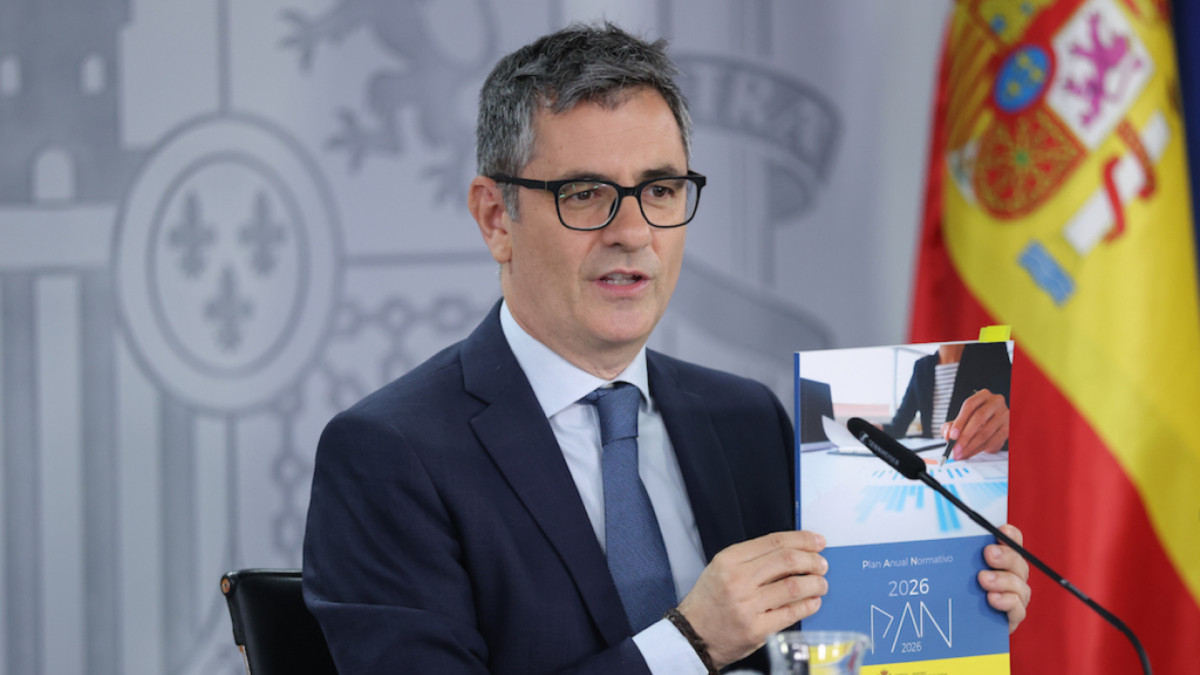
Advanced democracies across Europe have their own distinctive mechanisms for announcing government plans. In the United Kingdom, the monarch delivers The King’s Speech to outline the legislative agenda; in France, the General Secretariat releases its formal Programme de travail; and in Brussels, the European Commission publishes its Work Programme every autumn.
In Spain, this exercise in transparency is known as the Plan Anual Normativo (PAN), and while it often passes unnoticed in public debate and is underanalyzed by the media, it’s among the most revealing of tools, offering insight into how Spain’s contemporary Executive understands power.
The PAN was first employed during the final mandate of Mariano Rajoy, who after the 2015 reform of the Ley del Gobierno introduced an obligation to map out the legislative course; that mechanism was refined in 2017 and began operation in 2018. Law 40/2015 and especially Law 39/2015 on Administrative Procedure ushered in a new philosophy inspired by the principles of “better regulation” promoted by the Organisation for Economic Co-operation and Development (OECD) and the European Commission – more planning, more ex ante evaluation, and greater transparency about which rules the Executive intends to approve in a given year. Today, this is a formal obligation of the Executive; since its inception, the PAN has served as an annual legislative roadmap that the government is expected to publish.
“What began as a technical instrument for regulatory predictability (the Annual Regulatory Plan) has evolved into something more political”
The initial idea had two purposes: first, to offer predictability to companies, administrations, and citizens about the Government’s regulatory agenda; and second, to limit improvisation in the legislature and to force the ministries to justify any new regulations, along with their administrative and economic impacts. But what began as a technical instrument for regulatory predictability has evolved into something more political – a way of ordering priorities, coordinating ministries, and projecting government capacity, even in fragile parliamentary contexts such as the present one.
Thus it can be said that the Plan Anual Normativo for 2026, fresh from the ovens at Moncloa Palace and numbering 95 pages, is much more than an OECD procedure. With a total of 179 regulatory proposals (10 organic laws, 38 laws, and 131 royal decrees), this is a map of what’s meant to be perceived as the continuation of President Sánchez’s left-wing coalition throughout a complicated year. It’s also possibly the last PAN for Sánchez, since general elections will be held in 2027.
What follows is a political autopsy of Spain’s plan for 2026, where the European standard clashes with both the geopolitical context and the stark political reality at home.
A permanent “extraordinary and urgent need”
The first striking aspect of the plan is that, in a document designed for technical planning, the government in its introduction justifies how its agenda has been altered by “unforeseen events.”
“Is Sánchez setting the stage to justify future legislative blockages, or does he consider that the current geopolitical situation will require extraordinary and urgent legislation?”
Moncloa cites having been forced to operate on the basis of emergency legislation (royal decree-laws) after two serious railway accidents in January, in Adamuz (Córdoba) and in Gélida (Barcelona), plus meteorological disasters that sharply affected Andalusia and Extremadura. And the emergencies range beyond the national: the government explicitly points to the crisis in the Middle East, especially the military operation against Iran launched by the U.S. and Israel on 28 February and its fallout – general declines in international stock markets, rising prices, disruption of air traffic, and the impact on the Strait of Hormuz, all of which forced the adoption of emergency legislation during the first quarter. The question, therefore, is whether Sánchez is setting the stage to justify future legislative blockages, or whether he considers that the current geopolitical situation will require extraordinary and urgent legislation.
The end of ‘NextGen’ and the weight of Brussels
Over the past five years, the president has had a superpower: the EU-funded Recovery, Transformation, and Resilience Plan (RTRP). Those billions of euros acted as a powerful political lubricant, and above all they’ve served as the ‘budgets’ that Sánchez hasn’t presented or approved, due to his lack of a majority.
That era is now over. Five years after approval of the RTRP, regulatory efforts have been undertaken to hasten its end, although experts have spoken of effects that could last for 2 to 3 more years. Of the 179 total initiatives planned by the government, only 5 royal decrees are linked to that Recovery Plan.
“Without the European checkbook to sweeten reforms or placate partners, the coalition will have to govern without buffers”
Nevertheless, the machinery in Brussels continues to set the pace: 61 initiatives (34.08% of the total) aim to incorporate EU law into the Spanish legal system. Spain is among the countries that has been slowest to transpose EU directives. Without the European checkbook to sweeten reforms or placate partners, the coalition will have to govern without buffers.
The defense of the government’s narrative
The president’s core of power lies in the Ministry of the Presidency, Justice, and Relations with the Cortes, which leads the ranking of activity with 20 regulatory proposals. Indeed, Justice is the sector with the highest regulatory impact for 2026. At Moncloa, political ‘czar’ Félix Bolaños has decided that the best defense against the opposition and the critical press is a comprehensive legislative offensive:
1. Advertising and media: Under the premise of adaptation to Europe, Spain will promote the Ley de Publicidad del Sector Público (Public Sector Advertising Law), which seeks to update regulations in keeping with “transformations to the information landscape” and to implement the European Regulation on Freedom of the Media. In practice, this is Moncloa’s tool for institutional public financing of the media.
2. The fight against deepfakes: The government will reform the Organic Law for the protection of the right to honor. The aim is to protect citizens against phenomena like the disclosure of their digital profile, or the use of one’s image by technology (deepfakes and “ultra-impersonations”). Obligations will be imposed on social networks to moderate content and encourage the removal of elements that infringe on rights.
3. The struggle against corruption: Through the Organic Law of Public Integrity, the socialist government wants to snatch the flag of ethics from the opposition. This is a massive reform, with 84 measures that will alter up to 18 laws (six of them organic). The icing on the cake is the creation of a new independent agency for public integrity.
Necessary concessions to the coalition partner
In the absence of budgets, the left-most wing of the government can only be satisfied with ideological victories.
“Worth noting is a ‘Law on Democracy in the Company’, promoting more effective participation by workers in their places of employment”
The Ministry of Labor and Social Economy is pushing hard, with 17 projects planned. Worth noting is a ‘Law on Democracy in the Company’, promoting more effective participation by workers in their places of employment. What we would call a left-PSOE measure might be characterized in Germany as belonging to the heritage of ‘Rhenish’ capitalism.
What is certain to make employers tremble is a modification of the law on dismissal, which wants to establish guarantees against termination and to modify the compensation regime for unfair firings, to reclaim its “dissuasive and compensatory” function.
One ideological niche addressed by the plan with zero economic cost is the law for the protection of the rights of the great apes. Although it might sound unusual, this represents an ideal victory for the greenest base.
Regional financing and the political key
Hidden in the policy section of the budget is what is might be the most complicated law of this legislature: the amendment of Organic Law 8/1980, of 22 September, on the financing of the Autonomous Communities.
“Politically, Sánchez will try to use this as a political trump-card in his favor”
The official objective here is to undertake “update and reform,” ostensibly to make the regional financing system “more efficient and equitable.” Politically, Sánchez will try to use this as a political trump-card in his favor, to reform the model of fund distribution for the regions of common regime. The new model would offer more money for all territories; and in the face of a likely refusal from Autonomous Communities governed by the PP (almost all of them, many in concert with VOX), the government will make the PP and VOX responsible for not receiving more money to manage public policies.
Spain’s Plan Anual Normativo for 2026 complies perfectly with the standards required by the OECD and Europe. In administrative terms, it’s an impeccable exercise in planning; politically, it’s a meticulously designed position of resistance, meant to last through the rest of the legislature, and with a very clear warning: given a fragmented parliament with the capacity to block activity, whenever legislation isn’t possible, the concept of “extraordinary and urgent need” will be forced by royal decree-law.
“Moncloa is preparing to use its own legislative (in)capacity as its principal shield”
Faced with a turbulent world and a hostile parliament, and stripped of its post-COVID financial buffer, Spain’s government is preparing to use its own legislative (in)capacity as its principal shield. Whether protecting itself from A.I.-assisted defamation, rewriting the rules of job dismissal, or redesigning the distribution of regional funds, Moncloa has made itself clear: in 2026, legislation will be a central arena of political dispute, under the argument “I have a plan, but they won’t let me apply it.”
