
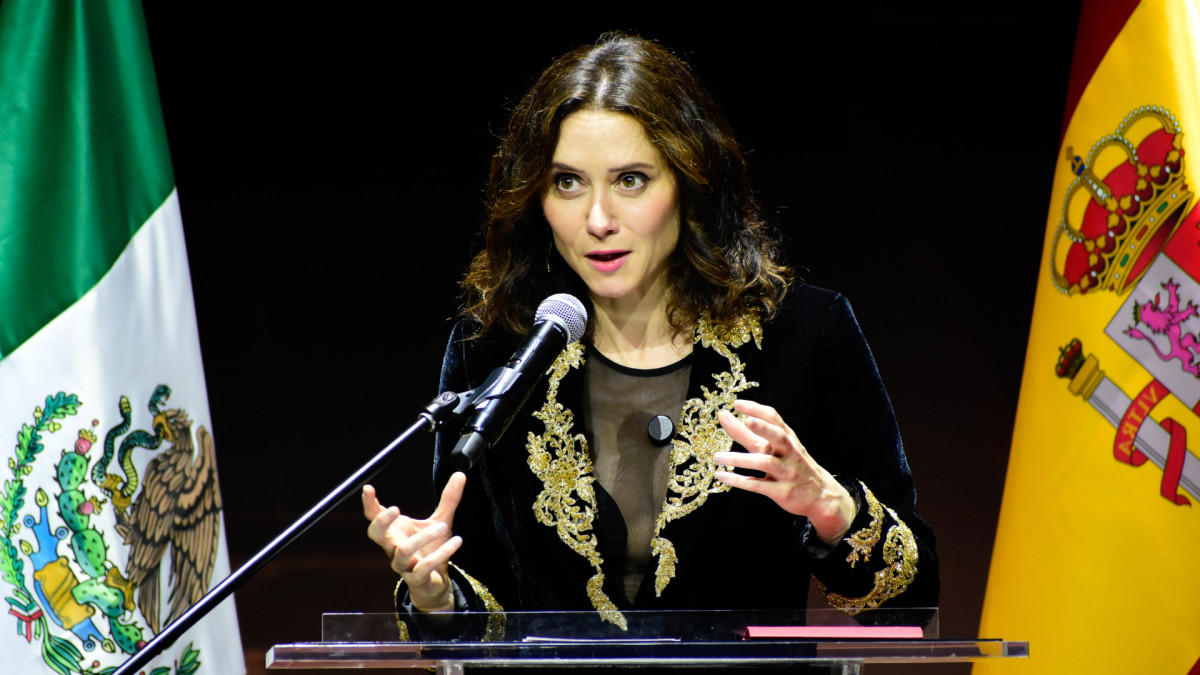
There are as many readings and interpretations as there are perspectives after the recent visit of Isabel Díaz Ayuso to Mexico. Of course, the most polarized stances respond to the obvious controversy that trip generated on both sides of the Atlantic. But, regardless of how radical the opinions are, which hardly admit a serene analysis, there is an idea that appears like a light impossible to ignore: “Madrid is leaving.”
“Ayuso has presented herself as the ambassador of a different Spain: the one that proclaims itself as a global capital”
From there on, the Madrid president’s trip to Mexico can be read as a calculated gesture: a journey that did not merely seek to tighten ties with powerful businessmen and politically aligned figures, but can also be interpreted as a counter-programming to the foreign agenda of the Spanish government. While Moncloa has designed strategies and meeting points to reinforce institutional ties with Latin America (see the case of Claudia Sheinbaum’s recent visit to the Barcelona Summit) through official diplomacy, Ayuso has presented herself as the ambassador of a different Spain: the one that proclaims itself as a global capital, the one that says “Madrid is Spain,” the one that aims to radiate its model beyond the Iberian Peninsula.
This diplomatic situation connects with the old hypothesis of Pasqual Maragall, the one mentioned in the first paragraph of this piece, namely, the idea of “Madrid leaving.” The capital, the Catalan politician had said, was shedding the country to play in another league. And Ayuso embodies that naturally: her visit to Mexico was not a political act but reached performative dimensions. Ayuso’s Madrid was on display in Mexico as a city-state, as the great Spanish metropolis that relates directly to other cities and governments, without, of course, passing through the filter of national diplomacy. The autonomous president’s step was the confirmation that Madrid not only “is leaving,” but that it has already left. For her, Madrid strolls through Latin America as if it were an autonomous actor, as if it were a counter-programming to the Spanish government’s foreign agenda.
On the other hand, let us consider the Disenso Foundation. Specifically, its Iberosfera project. They, as the backdrop to Vox’s global political strategy, have spent years weaving networks with Latin American conservative parties. But here lies the crux: Ayuso, although not an organic part of that machinery, benefits from it. What is the logic or, to put it differently, the primary objective? To promote (and exploit) the idea that Spain can lead an international conservative movement from Madrid. And, precisely, her visit to Mexico fits into that narrative: it was an institutional trip, but it also represented a gesture of alignment with sectors, with groups, that (ironically) preach economic liberalism while they defend (to the hilt) the most hermetic social traditionalism at any latitude.
“Isabel Díaz Ayuso —inspired by the political praxis of the Disenso Foundation— has gone to the ‘overseas’ to sell the model of freedom and prosperity of a Spain that is increasingly Madrilenized”
Now, in that mirror, an inevitable question emerges: is Ayuso a regional president acting as a parallel head of state? Her trip to Mexico suggests yes. It is, viewed that way, the confirmation of a new foreign agenda aimed at counterbalancing traditional Spanish diplomacy; one that begins in Madrid and seeks a narrative of its own, one with its own authority, moving with its own will and answering solely to the interests of Ayuso’s current agenda as Madrid’s president.
In short, Isabel Díaz Ayuso —inspired by the political praxis of the Disenso Foundation— has gone to the “overseas” to sell a model of freedom and prosperity of a Spain that is increasingly Madrilenized. Yet, after this episode—which began with glories and transatlantic fraternity but ended (prematurely) tainted by the response of the Mexican party-system that governs Mexico (which does not tolerate questions or dissidence)— Ayuso was the protagonist of two diplomacies that, just like the conception of Conquest and Colony, still have not found a meeting point for building a common path: Madrid is leaving, and in its departure it dragged a part of Spain’s foreign policy.
Sheinbaum and Ayuso: two opposed projects within a single diplomatic episode
On the global geopolitical chessboard, there are few examples of projects as divergent as Ayuso’s and Sheinbaum’s.
“Ayuso and Sheinbaum represent two projects that look at each other sideways: one bets on market openness and the other treats party discipline as an unquestionable system”
In Mexico, Ayuso’s visit was perceived as a living contrast to the political system that Andrés Manuel López Obrador established and that Claudia Sheinbaum inherits. Ayuso landed and, with her, the discourse of economic liberalism (one well known in Mexico and that has sparked much controversy for more than thirty years), with the idea that if there is a region of the world that has benefited from openness, capital attraction, and becoming a sort of guiding beacon for the transatlantic Hispanidad, it is Madrid. As expected, the Mexican president (and her loyal political circle) did not look kindly upon either the visit or Ayuso’s speech, though later—politically correct—she insisted that the Madrilenian was free to be in Mexico expressing her ideas. For Sheinbaum, her party-system cloaked as social welfare, which presents itself as the guarantor of rights but does not permit dissent or disagreement with its equally hermetic discourse, was an unwelcome audience. In short, Ayuso and Sheinbaum present two projects that look at each other sideways: one that bets on market openness (with the blessing of the global right’s political managers) and another that treats party discipline as an unquestionable system.
The discussion continued. The popular leader spoke in Mexico, before sectors aligned with her interests and the institutional script of the Partido Popular, about investment and competitiveness, about how the Spanish capital has become an economic hub thanks to fiscal policies that attract companies and talent. The problem was that she forgot that this discourse was spoken in a land that, as we have argued before, does not tolerate dissent, does not concede any argument: Sheinbaum’s narrative is that of an unbreakable state, an absolute manager of resources that controls everything from the margins of the gubernatorial palace. In this way, Ayuso’s visit was read as an elegant provocation: more than a direct challenge, it was the exhibition of an alternative model. The only thing is that it was precisely the failure of that neoliberal model that led Andrés Manuel López Obrador to create the system that now governs Mexico, with little opposition.
“The good intention of Ayuso, to advocate mestizaje and the shared cultural ties between Spain and Mexico, ended up being «a boomerang»”
Finally, that episode, which ended prematurely and unexpectedly for the Madrid leader, was eclipsed by the controversy, due to an unresolved feud between two sides that, to this day, unfortunately continue to view each other as irreconcilable. The turning point came when Ayuso moved from the economic and commercial terrain to the murky realm of historical studies: her appropriation of Hernán Cortés and mestizaje not only reopened wounds in the consciousness of the most disadvantaged popular sectors but was welcomed as an attack on a political system established in a narrative that advocates a single (and inscrutable to present Mexican rulers) version of history. In other words, strategically, the good intention of Ayuso, to promote mestizaje and the shared cultural ties between Spain and Mexico, ended up as “a boomerang” because Sheinbaum’s administration lives precisely on not admitting questions to the narrative and discursive pillars of the system that controls everything in its country, including the reinterpretation and rewriting of the past.
Thus, Ayuso landed in Mexico City carrying the banner of Pasqual Maragall’s maxim, “Madrid is leaving,” and returned to Spain perhaps with the sour taste of the attacks and provocations she faced after moving from the realm of investments to the realm of historical vindication. A Madrid Community statement about a boycott and an official Mexican statement insisting that Ayuso’s visit was a provocation are the elements that already build the story of a diplomatic episode that, in general terms, appears as a more accident-prone than fruitful event.
