
After seven months in Donald Trump’s presidency, his autocratic instincts have become increasingly evident. In the recent weeks, to name just a few, he has attempted to oust, without any legal basis, one of the governors of the United States Federal Reserve, sent National Guard troops to the capital to confront an imaginary wave of crime, threatened to do the same in other cities — all of them conveniently led by Democrats, such as Chicago — and continued the purge of impartial officials in nonpartisan institutions like the Federal Statistics Office or the FBI, pushing for their replacement by sycophants. He has also coerced various countries and the European Union into accepting unilateral tariffs, and a long etcetera.
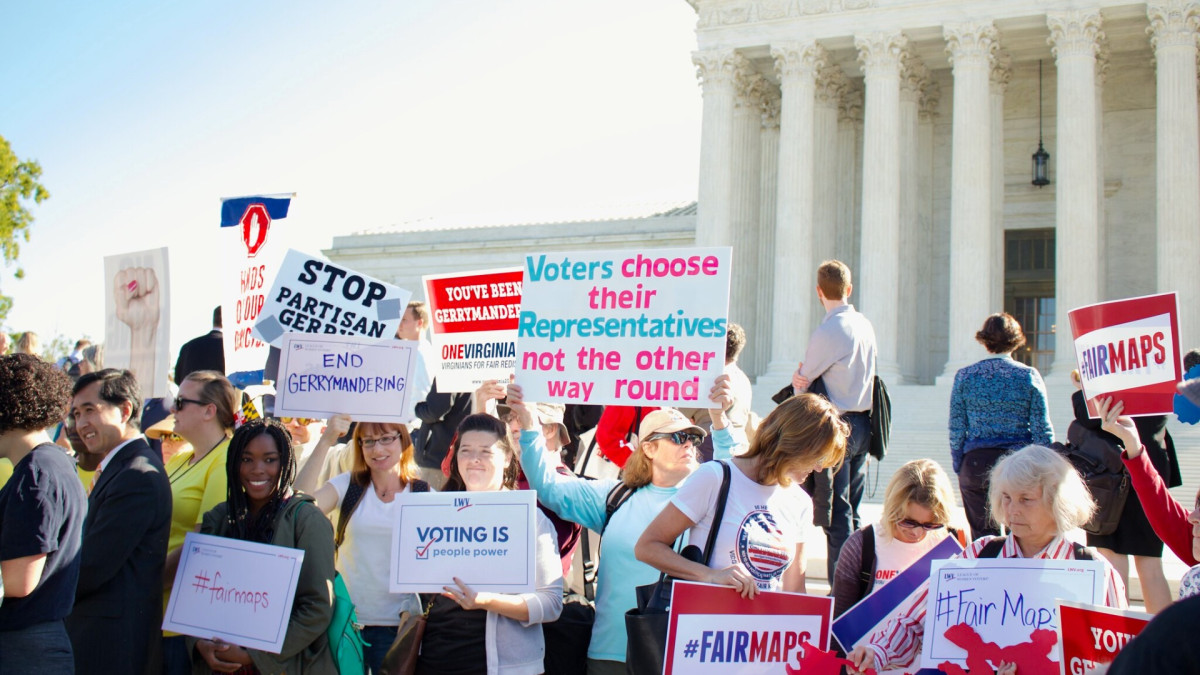
But few things make Trump’s autocratic tendencies as evident as his pressure on Republican state legislators across the country. He urges them to redraw the borders of their electoral districts ahead of the 2026 midterm elections, in order to obtain an illegitimate advantage and artificially sustain the Republican Party’s majorities in the House of Representatives.
At the start of every decade (the 2000s, 2010s, and 2020s so far this century), states gain or lose representation in the federal House of Representatives based on population growth or decline (the number of representatives has been fixed at 435 for more than a hundred years). Even if their representation remains the same, states are required to redraw the boundaries of their electoral districts to take into account internal changes in their population.
“This, sadly,
has been being exploited by state and federal lawmakers essentially since the founding of the Republic to design electoral districts that secure their reelection or the election of members of the same party.
This, sadly, has been exploited by state and federal lawmakers essentially since the founding of the Republic to design electoral districts that secure their reelection or the election of members of the same party (the name of this practice, gerrymandering, originates from one of the Founding Fathers, Elbridge Gerry, who started it in his capacity as governor of Massachusetts). The Supreme Court and the Legislative Branch put a brake on during the 20th century to some of the most evidently fraudulent practices (districts of clearly unequal population and districts designed so that minorities — particularly Black voters in the South — would be denied effective representation) but that has not prevented numerous states from sending the House of Representatives monocolor delegations even though there are significant Democratic or Republican minority groups within them.
In that sense, it must be said that although both parties have engaged in this practice, the Republicans are more to blame than the Democrats, as shown in the attached map: in states that elect 184 of the 435 members of Congress, Republicans (in red on the map) have full control of the process, while Democrats (in blue on the map) only have it in states that represent 67 of the 435 members.
This is largely due to the fact that in recent years Democrats have advanced, legislatively or via referendums, that the drawing of electoral districts be carried out by independent electoral commissions (in green on the map), something Republicans have opposed, as a general rule, in a ferocious manner in the states they control.
“That form of unilateral disarmament on the part of the Democrats now places them in a very dangerous position in the face of Trump’s pressures on the Republican states to redraw their electoral districts”
That form of unilateral disarmament on the part of the Democrats now places them in a very dangerous position in the face of Trump’s pressures on Republican states to redraw their electoral districts aimed at maximizing the number of Republican congressmen in states where they hold absolute control. Very notably, in Texas, Trump has managed to get the state legislature to approve new maps that, under circumstances like those of 2024, would turn a delegation already heavily skewed in favor of the GOP (25 Republicans and 13 Democrats) into 30 Republicans and 8 Democrats. And Trump wants other states, such as Florida or Missouri, to carry out similar maneuvers.
In light of this, the Democratic base is demanding a response of the same tone, but, as noted above, there are few states where Democrats control the redrawing process, due to their quixotic push to defend independent electoral commissions. But California Governor Gavin Newsom, as part of his unofficial campaign to run for the Presidency in 2028, has found a “creative” solution: to put to a referendum the abolition (in theory, temporary) of the California Independent Commission and the transfer of the power to redraw district boundaries in that state back to the Democratic-controlled legislature. Since California still has nine Republican members of Congress, Newsom hopes to craft a partisan map that can at least offset the maneuver carried out by Texas Republicans.
The big loser of all these maneuvers, of course, is democracy, which sees how electoral results are massively distorted, leaving the voters of the parties in states where the majority belongs to the opposite party with little or no representation.
That said, Trump would need to watch what he wishes: since polls show that the coalition that brought him to power in 2024 is eroding — and especially among Hispanic voters — backing a redistricting reform in Texas (or Florida) that relies precisely on the continued Hispanic vote for Trump in 2026 is, at minimum, a very dangerous premise for Republicans. In this way, they may find themselves in November next year facing a very unpleasant surprise if Hispanic Trump supporters stay home or vote for Democrats, even in districts that on paper would today seem safe for the GOP.
