
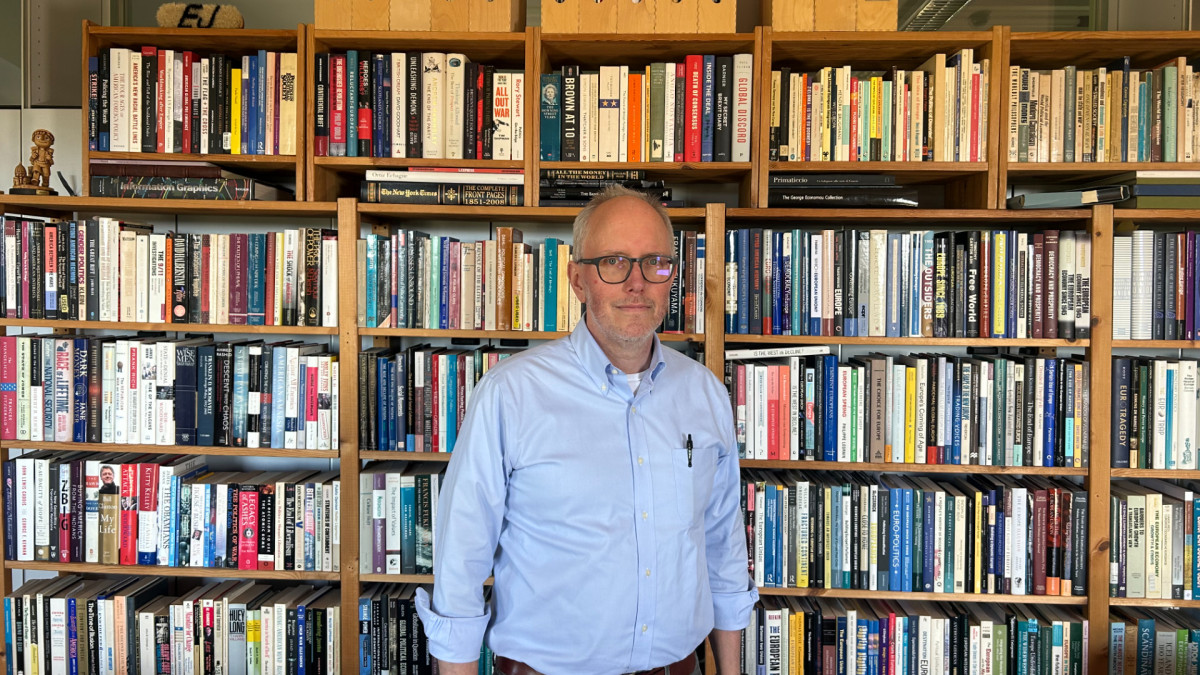
If knowledge could be transmitted like a virus, spending a few hours in Erik Jones’s office would be one of the easiest ways to catch it. The director of the Robert Schuman Centre for Advanced Studies at the European University Institute (EUI) welcomes Agenda Pública in Florence to discuss the complex context in which Europe operates. With a pedagogical yet incisive tone and a strong American accent, he offers an analysis of what the continent’s playing field looks like (and how it should evolve).
A PhD in International Relations and a renowned scholar, Professor Jones does not appear especially concerned about Ukraine’s accession to the EU (“it’s going to happen”), but he does express doubts about the European budget and about the spending that must be allocated to the enlargement process, which includes up to twelve candidate countries. “How will that enlargement be incorporated into the budget?” he asks.
In the conversation, held during the 50th anniversary of the EUI, of which Agenda Pública was a media partner, there was time to talk at length about the relationship between Europe and the United States. Jones has written about a suggestive concept, the post-Atlantic Europe, and in this regard he insists that “it’s not just that Europeans have to realize that the situation has changed. They have to realize now and act now”.
After glancing at some of the covers of his books and several decorations — Ukrainian, Indonesian or Slovak — the professor acknowledges that he does not have many books on Spanish politics, although at the end of the interview he highlighted his enormous interest in the country’s external projection.
A part of Jones’s library, with various decorations and mementos of his academic career. Photo: Agenda Pública / Jorge de Diego
My first question is about a very current topic: the European Union’s Multiannual Financial Framework (MFF). There is an important discussion on this issue, which has also been addressed today here, at the EUI’s 50th anniversary. I wanted to ask what your expectations are for this MFF and to what extent the outcome of these negotiations will indicate the future of Europe or the focus of European institutions.
There are three important things to keep in mind about the next multiannual framework.
The first is that, as with any MFF, there is a big question about how money will be distributed among the different spending categories in which the European Union participates. If we assume the same level of spending proportional to gross national income, there will be movements from one heading to another.
And we know those moves will occur because there is a huge rise in spending needs in defense, in industrial policy and in infrastructure. Moreover, the EU continues to try to finance the digital and green transitions. All of this forces a reshuffle of the cards.
“Everything is becoming more expensive: security, the digital, the green, infrastructure and industrial policy are now much more important”
That adjustment is always difficult, because there are sectors and interest groups — farmers, for example — that currently receive money from the EU budgets as they are designed now and will lose resources if those budgets change. So far, this is fairly normal, except that everything we’ve mentioned is becoming increasingly expensive: security, the digital, the green, the infrastructure and the industrial policy are now much more important.
But there are two more issues that complicate the picture even further. One is that additional own resources are needed to repay the loans of Next Generation. The Commission has included this in its initial proposal, but that means the ratio to gross national income rises significantly, by about a quarter of a percentage point, just to service and amortize the debt of Next Generation EU.
Member states look at that and say: “Wait a minute, we also have budget constraints and now you are asking us for more money.” The answer is: we are not asking for more; we need to repay the money we have already borrowed. However, this is not easy to sell politically.
The third issue is that there are twelve countries that want to join the European Union. How is that going to be funded? How is this enlargement going to be incorporated into the budget? Where will the budget be squeezed or expanded to accommodate the needs of Ukraine, Moldova or the Western Balkan countries? Are we going to abandon Turkey? Because whatever is done in the budget will send a clear signal to politicians in that country. If no financial projection is made, everyone in Turkey will understand that Turkey is no longer really in the race. They know it, but the symbolic dimension is very important.
“If no money is allocated to enlargement in this MFF, the credibility of the enlargement process before candidate countries will disappear overnight”
If no money is allocated to enlargement in this MFF, the credibility of the enlargement process before candidate countries will disappear overnight. They will see that there is no money to accommodate enlargement and to conclude that there is no plan.
Speaking of enlargement, I would like to talk about Ukraine, because right now it is a particularly sensitive issue. Do you think accession could happen soon? How would it integrate with NATO?
The European Union needs to support Ukraine because it cannot allow Ukraine to fall to Russia. And the Union must ensure Ukraine is rebuilt. It also must ensure that Russia does not return after reconstruction and destroy it all again.
There is only one way to do all of this: to formalize the relationship between Europe, the European Union, and Ukraine in some way. We can call it accession or enlargement, but we do not have to do it. We can call it whatever we want. The problem is that it will be just as costly. People often think of enlargement as the moment a country becomes a member state, but it should not be seen that way. Becoming a member is the end of the process.
We must think about the people and the companies. Millions of Ukrainians live in the European Union. Ukrainians depend on the EU and access to the EU for their daily survival, and Ukrainian companies are redirecting all their activity toward the bloc. At the same time, EU companies are integrating into value chains in Ukraine, even in the context of this war.
Curiously, although we do not think of Ukraine as an official member state, Ukraine is integrating with Europe faster than any country of its size in the past. Faster even than the United Kingdom in the 1960s and 1970s.
That kind of enlargement creates enormous vulnerabilities. But the vulnerability arising from Ukraine falling into Russian hands would be even worse. The question, then, is how to address these vulnerabilities that will be generated by integrating Ukraine into the European economy.
The simplest answer is to build capacity in the Ukrainian government. How do you build that capacity? Through the accession process. The meritocratic approach to enlargement is precisely about building capacities: you demonstrate merit by showing capability. That is exactly what the enlargement process is.
Is this process going to make Ukraine a member state on January 1, 2027? No. Will it make Ukraine a member state on January 1, 2029? I don’t know. But what I can say is that the process is moving much faster than we thought.
When you look at the timeline from the core goals of the Helsinki summit in December 1999 to the decision on who would join in December 2002, you are talking about two or three years. Countries that had not even started the accession process, like Slovakia, were admitted in three years. Bulgaria and Romania were told they could join in 2007, in four years.
“As those blocks get unlocked, Ukraine will advance rapidly. There will be problems, certainly. There will be turbulence. But at some point it will join”
When you look at that timetable, how long have we been working on Ukraine’s accession process? We have already been at it for a couple of years. It is going to happen. Negotiations will open this year. The negotiation blocks will begin to unlock in June, provided the Hungarian government does what it should. And as those blocks unlock, Ukraine will advance rapidly. There will be problems, certainly. There will be turbulence. But at some point it will join.
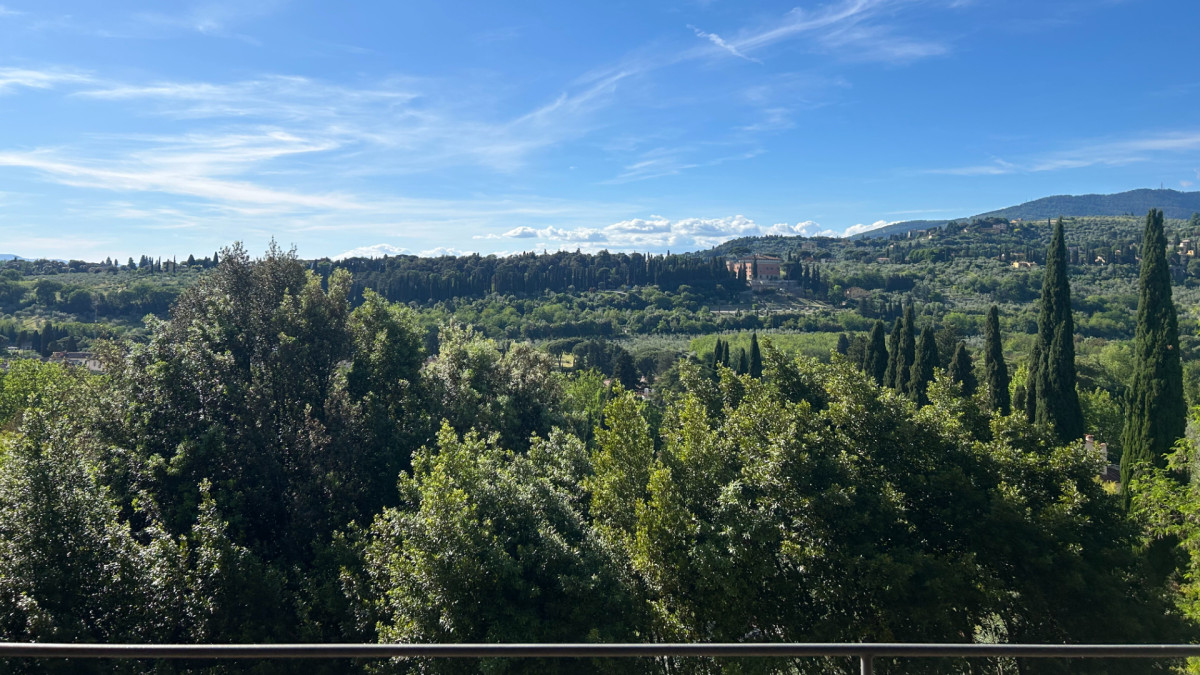
Views from the balcony where the conversation took place, in Fiesole. Photo: Agenda Pública / Jorge de Diego
It is interesting, because I expected him to talk about the United States when I asked about Ukraine and he did not. So let us talk about what he defines as “post-Atlantic Europe.” Things seem fairly clear, but I have the sense that some EU states behave as if, once Trump leaves, everything is going to go back to the way it was.
The essential thing is to remember that Europeans have lived all their lives with the United States as not only a reliable partner but also an admirable one. And that is hard to abandon. It is also hard to abandon it within the United States.
Recently I was in Washington talking with people, especially on the Democratic side, and they were saying: “When we win the midterm elections, the transatlantic relationship will be like before.” And I told them that this will not happen. They also said: “If we win the presidency in 2028, everything will be like before.” But it did not become like before under Biden, and Biden is very pro-Atlantic.
“The United States has always said that Europe needs to spend more on its security. But it has also always said that Europeans should not invest in duplicating assets that the United States already provides”
Here is the key point. Throughout the existence of this transatlantic relationship, the United States has always said that Europe needs to spend more on its security. But it has also always said that Europeans should not invest in duplicating assets that the United States already provides: large, costly assets such as satellite intelligence, command, control and communications, strategic transport, or carrier groups.
The United States used to say: “Buy light armored units that can move across the terrain and, if we need to project force, we will send the strategic transport to carry those units somewhere else, like Afghanistan.”
That is no longer credible. Europeans are wondering how long it will take to develop strategic transport. The answer is: a long time. And if it will take a long time and there is a possibility — not certainty, but a possibility — that the United States will deprive Europeans of access to that strategic transport, there is no other option. We have to start now.
To anyone who says that Trump is only an anomaly, I would say: Trump I was an anomaly. Trump II was the voice of the American people saying that, despite what happened on January 6, despite what happened during the first Trump Administration, and despite everything we know about his relationship with women, he still wants to be president. When the American people say what they really want, you have to believe them.
“It’s not just that Europeans have to realize that the situation has changed. They have to realize it now and act now”
Therefore, it is not only that Europeans have to realize that the situation has changed. They have to realize it now and act now. And when you tell that to Europeans who love the United States and want the United States to always be there, it is very hard to accept.
But the argument is resonating because they cannot afford to wait. And it is not just about strategic transport. It is also about large data servers, data farms. We need a place to host our own data. It is also about the infrastructure of financial telecommunications and post-negotiation activities. We need the capacity to manage our own finances without going through the dollar and without relying on institutions that the United States can access or block.
I think Europeans are arriving at that conclusion with a lot of reluctance, with considerable discontent, and not all at the same pace. It is regrettable, but they are arriving.
That does not mean the transatlantic relationship is going to end. There will always be enormous American investments in Europe and enormous European investments in the United States. There will always be people who have had great experiences on both sides of the Atlantic and want to repeat them.
But it does mean that the relationship will be very different. And if Europeans disagree about how that difference will look, I’m not surprised. Different is different. Everyone has to experience it in their own way before understanding it and accepting it.
If you had to choose one reform to help the European Union navigate the next ten years, which would be the most important?
If I could do only one thing, as someone who studies politics, I would rewrite the budget. Because if I rewrote the budget, that would change everything. That’s how politics works: on one side people argue; on the other, money flows. While people argue, if you allow me to decide where the money goes, I would do that.
And what would you do, specifically?
What’s interesting about making money flow differently is that there are certain things we have to do, yes or yes. And it will be painful. One of them is to redirect a significant portion of the funding that today goes to agricultural support. That doesn’t mean abandoning farmers to their fate. It means reinterpreting the way we design support for rural communities, moving away from treating agriculture as a business.
Because farming is a business. There are very productive people in farming, and we will have to rely on that. But we also have to find a way to cushion the blow for all those rural communities that will be affected.
“When Ukraine joins the European Union, it will bring a large number of highly productive farmers”
This is the same point we address in the context of Ukraine. When Ukraine joins the European Union, it will bring a huge number of highly productive farmers. And many other, less productive farmers will suffer the consequences. We must already help them stop doing things that are unproductive. That does not mean removing them from agriculture, but making them more productive in other ways, integrating them into the rural community in another form, and supporting those communities. Because, honestly: a lot of the work you and I do could be done from a rural community. But rural communities are not designed to host us. Perhaps we should rethink that.
Thank you very much.
