
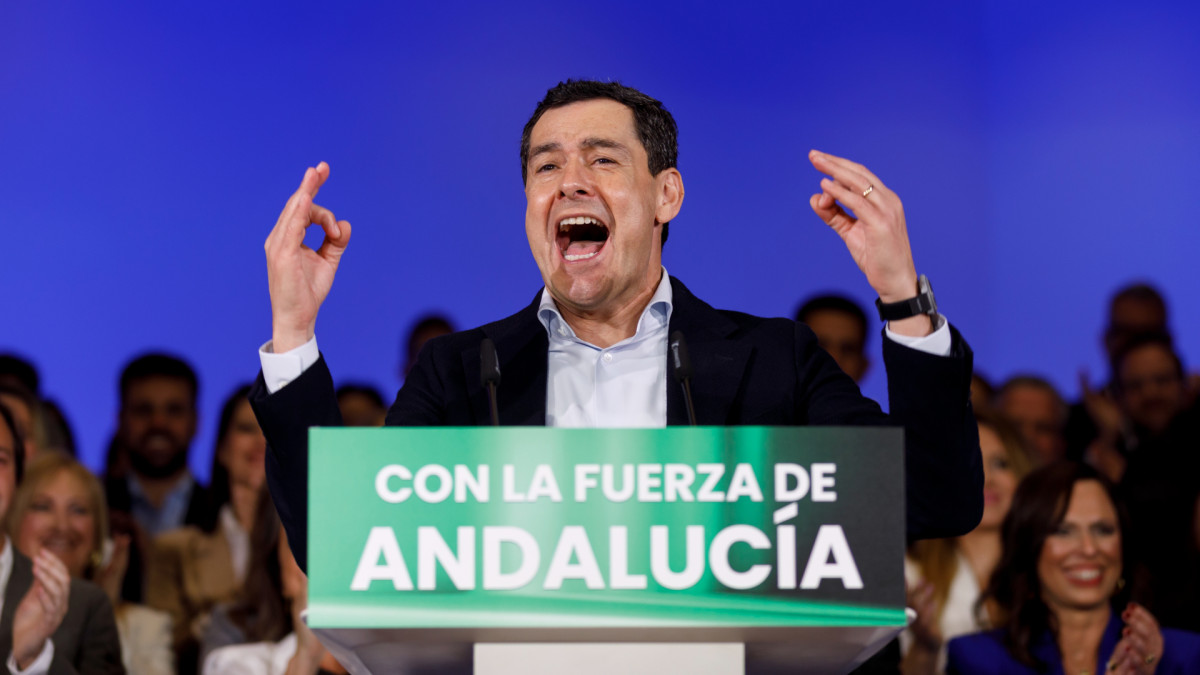
The Andalusian Parliament elections on May 17 arrive with a citizenry that has completely reordered its priorities. The latest CENTRA Barometer of Public Opinion in Andalusia shows three things: that health care, housing, and unemployment have converged into an unprecedented triple tie in the historical series; that Juan Manuel Moreno Bonilla’s personal leadership remains the PP’s main asset, but that his management has accrued the greatest wear and tear of the legislature; and that the opposition arrives very limited to challenge him for the presidency. A month before the ballots, the map favors the PP, but the ground on which it rests is no longer that of 2022.
The central question: Hegemony or ceiling?
Typically pre-election analysis in Andalusia is framed in one direction: whether the PP will repeat an absolute majority or whether it will need Vox. Yet CENTRA’s barometer allows flipping the question: has the PP hit a ceiling and is there room for an alternative that the opposition is failing to seize?
The direct voting intention places the PP at 29.8%, clearly the leading force, but at the legislative low — far from the peak of 43.3% in December 2023. The drop to 23.8% by December 2025, before the current modest rebound, confirms that the conservatives face the elections far from their maximum support.
“Vox is not a stagnant party; it is a volatile one, and the gap between its declared intention (9.5%) and its party affinity (12.1%) suggests there is an embarrassed vote still to mobilize”
The alternative bloc adds more in direct voting intention: PSOE (18.7%), Por Andalucía (9.4%), Adelante Andalucía (6.0%) and Vox (9.5%) together account for 43.6% versus 29.8% for the PP. As for Vox, it is prudent not to rush: after sinking to 4.9% in September 2024, it has steadily recovered to 12.9% by December 2025. It is not a stagnant party; it is a volatile party, and the gap between its declared intention (9.5%) and its party affinity (12.1%) suggests there is an embarrassed vote still to mobilize.
The underlying question is not only whether Moreno will secure an absolute majority. It is why the opposition, facing a citizen agenda so loaded —health care, housing and employment in a historic tie—, is unable to translate it into voting intention.
Personal leadership: Moreno’s edge, but erosion
The personal leadership data reinforce the PP’s position, but they do not secure it. Moreno Bonilla obtains 39.9% in preference to preside over the Junta, almost 22 points above María Jesús Montero (17.6%). He is known by 94.9% of the electorate and his average rating is 5.46 out of 10: an approval that remains, but which has fallen in every wave since December 2022 (5.95). In a media system that personalizes voting, Moreno Bonilla’s advantage is the main obstacle for any alternative, but it is an advantage that erodes, not grows.
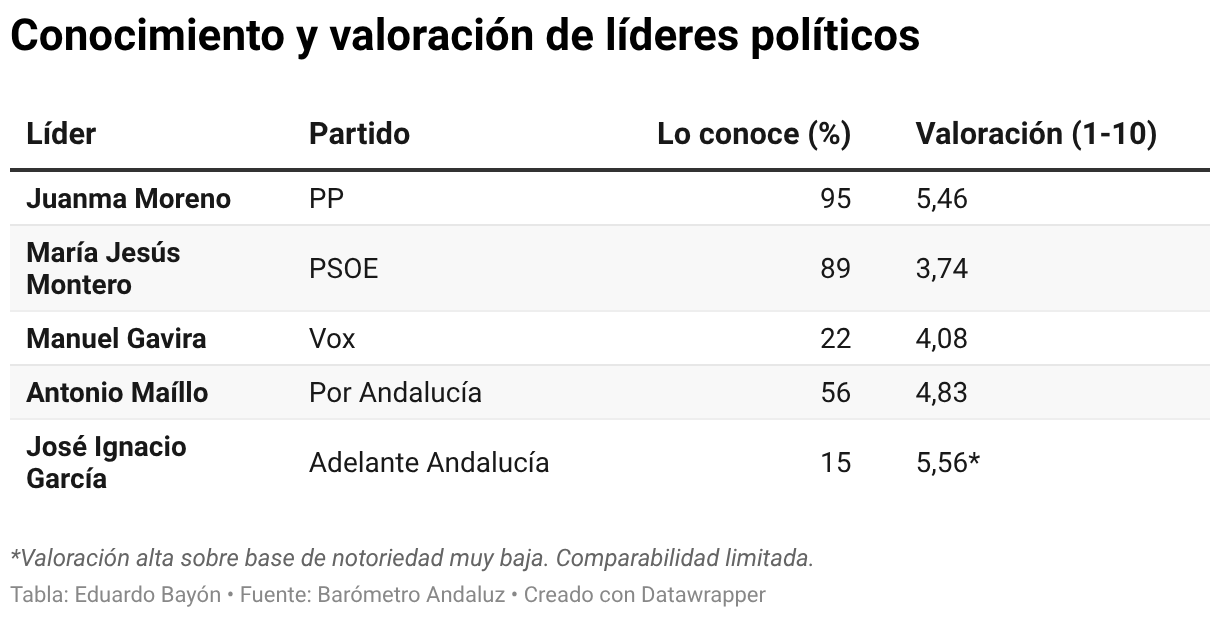
The full series leaves little room for transient explanations: the slight decline is progressive and sustained since the start of the legislature, wave after wave. The average rating confirms it: 5.95 in December 2022, 5.73 in December 2023, 5.58 in December 2024, 5.46 in March 2026. Half a point lost in three years and a half. Moreno Bonilla has not found at any moment during the legislature a policy or an event that reversed the trend.
“The perceived deterioration of public services is at the core of the wear, driven by an accumulated trend that explodes with the crisis of the screenings”
On the other hand, the assessment of the Andalusian president’s management is the most relevant barometer datum for anyone looking for signs of vulnerability in the PP. In March 2026, the positive rating (very good or good) falls to 45.7% and the negative rating (bad or very bad) rises to 40.8%: a difference of only 4.9 points, whereas in December 2023 that margin exceeded 40 points (64.2% vs 24.0%).
The possibility that the PP might lose its absolute majority depends on whether the opposition performs above what the barometer foresees. The most uncomfortable figure for the progressive space is not the PP’s strength, but its inability to translate the wear on Moreno Bonilla’s leadership and the shift of the agenda toward health and housing into a competitive electoral offering. Health care has become the population’s main problem in Andalusia. That is the most direct indicator: the perceived deterioration of public services is at the core of the wear, determined by an accumulated trend that explodes with the crisis of the screenings.
An agenda with no owner: the opportunity no one is capitalizing on
One of the barometer’s most relevant data points is the unprecedented triple tie among unemployment (21.5%), health care (21.8%), and housing (21.6%). Never in the historical series had all three lines crossed in this way, nor had such a close tie emerged among structurally distinct problems.
Unemployment reached a maximum of 46.4% in December 2023, solidifying as the dominant problem for most of the term. From 2024 onward, however, it unravels: from 28.1% in December 2024 to the current 21.5%, it has lost almost half of its relative weight.
Parallel to this, health care rises from 3.3% in September 2022 to 21.8% in March 2026, and housing surges from an initial 0.3% to 21.6%, climbing from nearly residual levels to equaling unemployment.
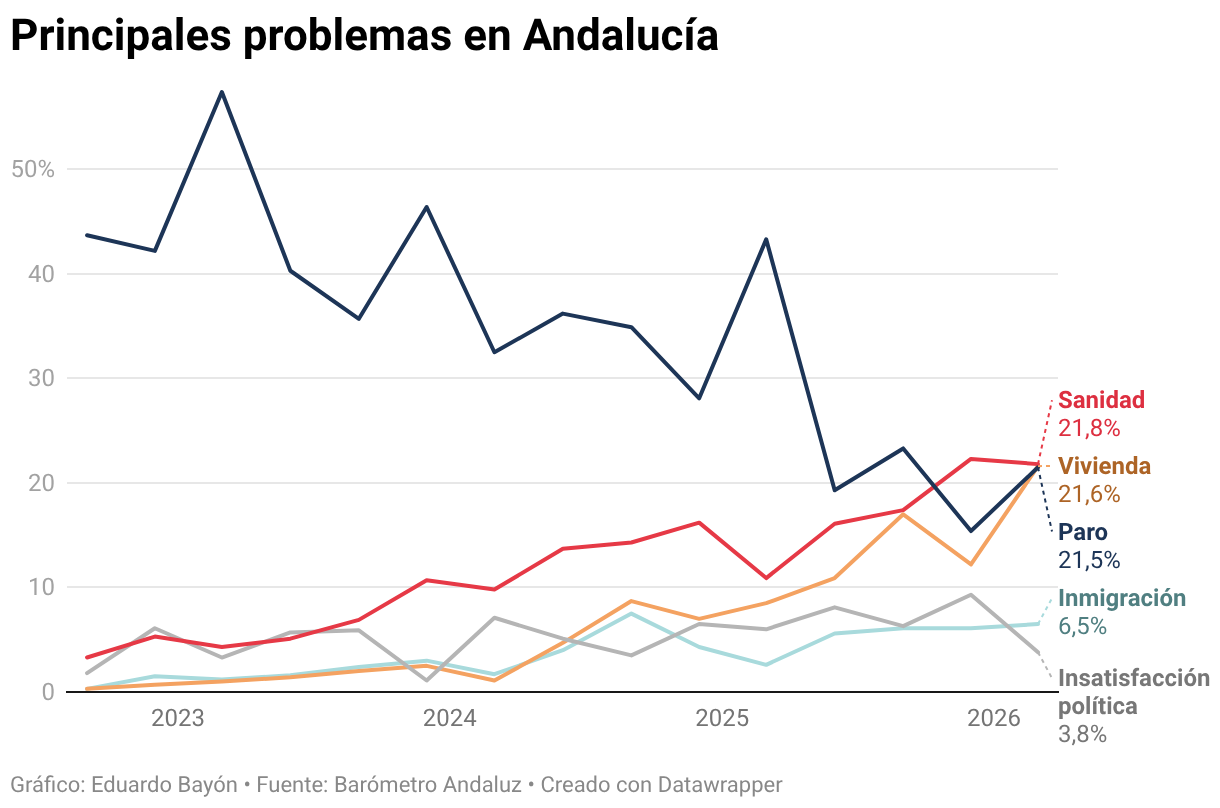
Immigration sits in fourth place (6.5%), triple from 2022, but still far from the triple tie. Political dissatisfaction drops to series lows (3.8%), well below the 7-8% peaks of 2023-2024.
“The board has objectively moved in favor of the left; not capitalizing on it says more about the opposition’s state than about the PP’s strength”
Unemployment, the concern that most benefited the PP due to its direct link to job losses, has lost central weight on the agenda. Health care and housing, where the public perceives deterioration of services and where the left enjoys greater issue credibility, have become top structural problems. The board has objectively moved in favor of the left; not capitalizing on it says more about the opposition’s state than about the PP’s strength.
One month to May 17
What the Andalusian Barometer portrays one month before the elections is not an invulnerable PP hegemony, but a space for opposition that has not managed to turn objectively favorable conditions into an electoral alternative. Moreno’s wear is progressive and measurable, though he remains a solid leadership. And yet, none of this translates into a threat to the PP’s absolute majority, because the opposition arrives at the regional elections in three spaces that do not sum.
The arithmetic of May 17 will not be decided by the PP’s strength—which is stable, not growing—but by whether the Andalusian left is capable of capitalizing on the opportunities this barometer shows it has and which, to date, it is not taking advantage of.
