
Even the abundance wing of the left seeks ‘a much stronger government,’ in the words of movement advocate Ezra Klein.
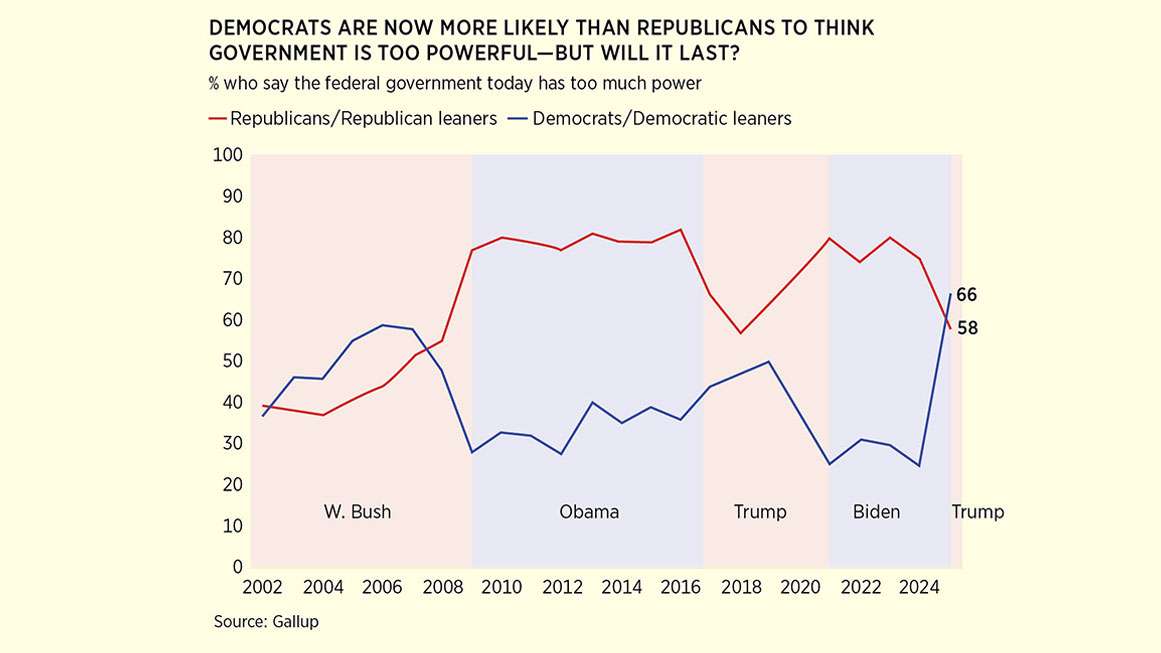
Consider a revealing fact about party loyalties and public sentiment that might catch you off guard: Gallup data show that Democrats have grown warmer toward international trade since 2008, and they have held a more favorable view of it than Republicans have since 2012. Amid ongoing chatter about political realignments, such data points have led some observers to wonder whether Democrats are evolving into the major party most in tune with libertarian ideals of free markets and a restrained government.
That argument can be supported. A separate Gallup poll indicates that, for the first time in nearly two decades, Democrats are more wary of government overreach than Republicans. When asked whether the federal government has too much power, the right amount of power, or too little, 62 percent of Americans say it has too much power. Among that group, 66 percent are Democrats or those who lean Democratic, compared with 58 percent of Republicans or those who lean Republican.
Republicans remain far more likely than Democrats to regard the government as doing too much that should be left to individuals and businesses (81 percent versus 31 percent), while Democrats are more prone to favor greater government action to address national challenges (62 percent versus 17 percent). Yet a majority of Americans earning $40,000 or less per year say the government should be doing more, a fact that matters because President Donald Trump narrowly beat former Vice President Kamala Harris among lower-income voters in the 2024 election, according to exit polls.
Over the last three presidential cycles, Americans without a college degree have gravitated toward Trump, while those with higher levels of education have leaned decisively toward Democrats. This has led many observers to contend that the GOP has become the “working-class party.”
If working-class voters show more openness to government action, it seems reasonable to wonder whether this demographic shift could drive an ideological shift, with the Republican Party in the years ahead following Trump into deficit spending, industrial policy, tariffs, and other government interventions in the economy. At the same time, the rise of the “abundance liberals”—policy wonks on the left who have begun to recognize that excessive regulation and the influence of interest groups are making everyone poorer—raises the possibility that the Democratic Party is moving in the opposite direction.
A 2025 podcast dialogue between former Daily Show host Jon Stewart and New York Times columnist Ezra Klein embodies the latter pattern of policy evolution. Klein devoted a substantial portion of the episode to navigating the labyrinth of sometimes-conflicting, always onerous mandates attached to federal spending: requirements that subsidized factories rely on costly green energy, mandates to diversify workforces, provide on-site child care, and more. When you add complications such as comment periods, review processes, and the tangled stages of applications, it’s no wonder that President Joe Biden’s efforts to accelerate infrastructure investment or to “reshore” manufacturing faced limited success.
“And also, by the way, it’s going to make it impossible for anyone other than larger corporations to comply,” Stewart observed, noting that “smaller, more agile, more local businesses…would not have the manpower, the financial resources. You are excluding an enormous amount of the American economy in terms of building things by laying on compliance costs that would drive most companies into the ground.”
Listening to two prominent progressives highlight the cronyism and inefficiencies of government bureaucracy that libertarians have been voicing for decades was as refreshing as it was maddening. But if you hoped those realizations would lead them to genuinely libertarian conclusions, you would be disappointed.
Ultimately, as the second half of the podcast makes clear, Klein and his allies back streamlining government because they want to empower the government to undertake big, audacious projects: nationwide high-speed rail, federal housing programs, and Medicare for All. They are not seeking to remove government so people can flourish; they want the government itself to flourish.
This distinction sits at the heart of the challenge to the idea that Democrats will soon be the party of free markets and limited government. Even the abundance movement—the libertarian-leaning portion of the broader Democratic coalition—advocates for “a much stronger government,” in Klein’s own words. And the party’s less libertarian factions—think of New York City Mayor Zohran Mamdani, who supports government-run grocery stores and free public transit—are pulling the party away from a free-market trajectory.
Admittedly, a Pew Research Center survey recently found that 87 percent of Democrats believe Trump’s protectionism would have a predominantly negative impact on the country. But much of this appears to reflect negative polarization: Democrats oppose the tariffs because they dislike the man imposing them, not because they are principled defenders of free markets and open trade. Biden ran in 2020 as a critic of Trump’s reckless first-term tariffs. Once in office, he kept many of them and even expanded some.
Democrats often display a newly minted respect for limited-government ideals when they are not in power, but the sentiment tends not to endure. The moment they return to the White House, expect progressives to experience a sudden lapse in memory about the lessons they did not truly absorb during the Trump years.
