
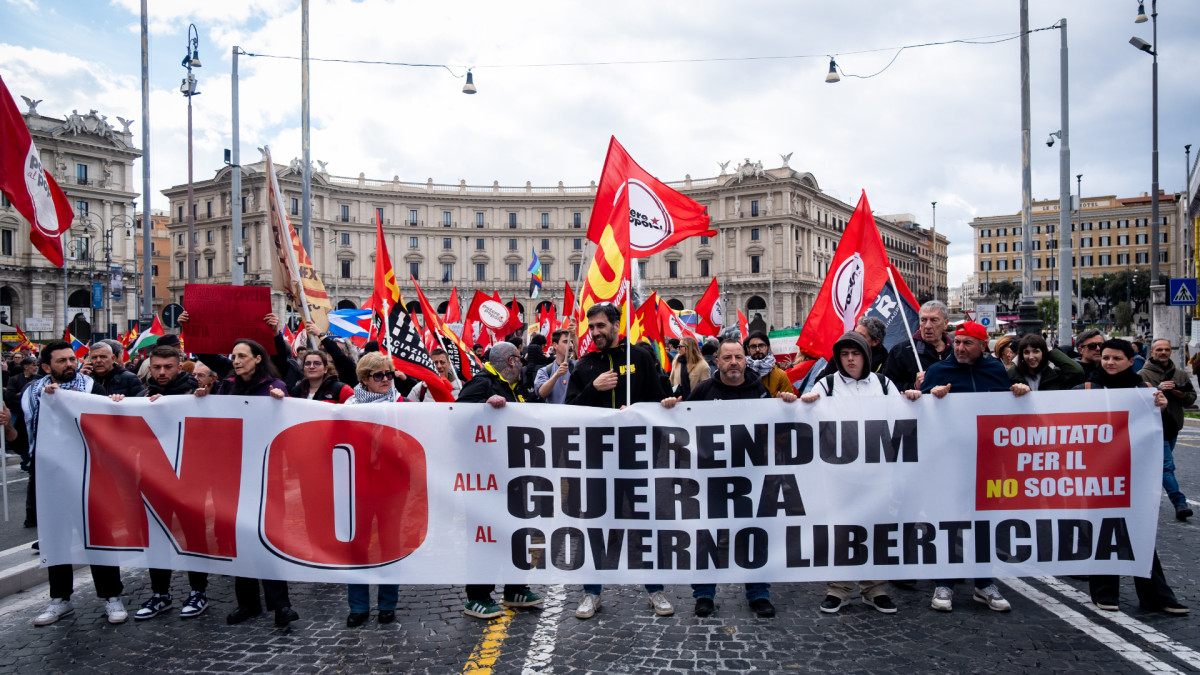
The military operation by the United States and Israel against Iran has exposed a fissure that had been forming for years. Italy, Spain, Portugal, and Greece reject the intervention in proportions that go beyond mere current events, and reject, above all, that their countries participate actively in it. In this sense, the correlation with European leadership assessments is fully established. And there is one exception worth mentioning upfront: Pedro Sánchez.
The latest Euroscope barometer from Polling Europe shows a significant European aggregate —57% consider the operation launched in February by Washington and Tel Aviv unjustified, compared to 27% who support it—, but the finding is not in the average. It is in the dispersion. In Italy, rejection rises to 72%. In Spain, to 69%. The average for Mediterranean countries —including Portugal, Greece, Malta, and Cyprus— stands at 70%. France, which is not exactly a pro-Iran country, remains at 47%. Germany at 51%. Poland, conditioned by the war in Ukraine, reaches 57%. The distance between Italy and France is twenty-five points for the same military operation, at the same time, within the same European Union.
Why Southern Europe Rejects the Operation Against Iran
That gap is not explained by pro-Iran positions — nonexistent in any of the Mediterranean countries — but by three factors acting simultaneously. The first is the stance on Gaza: southern societies have spent two years processing Israeli violence backed by Washington, and they read the Iran case as an episode continuing that dynamic. The second is the ideological composition of the Mediterranean space, where the transformative left retains significant electoral presence — The Left in the European Parliament rejects the operation at 77%, the S&D at 71% — while in Central and Eastern Europe that flank is weaker. The third, and probably the most structural, is that the South does not share the threatening reading of geopolitics: for Rome, Madrid or Athens, security priorities are the Mediterranean and the Sahel, not Tehran as part of a Risk board managed by Washington.
“Mediterranean public opinion has stopped accepting that United States military interventions are automatically European operations”
The result, therefore, is a Mediterranean public opinion that has stopped accepting the implicit premise of Atlanticism: that United States military interventions are automatically European operations. The fracture is not new — Irak 2003 was the warning — but at that time it was resolved in governmental terms.
The Data That Debunks the Pretext
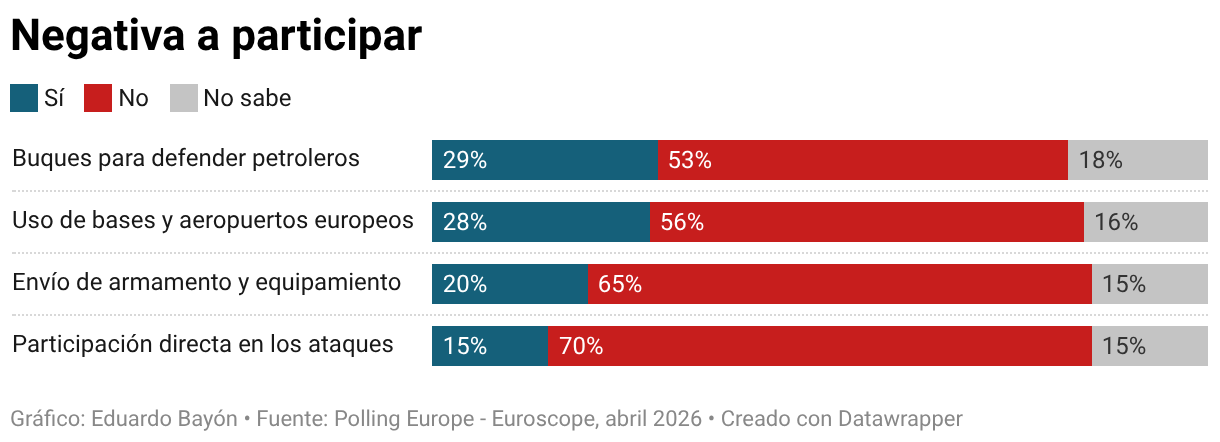
When asked what European countries should do concretely in operations like Iran, rejection grows proportionally to the degree of material involvement demanded: 53% reject the deployment of ships to defend oil tankers, 56% oppose the use of European bases and airports, 65% reject sending equipment and armament, and 70% deny direct military participation. It is a progression that does not fit the usual reading of declarative pacifism — “I’m against war, but…” —. Here, rejection intensifies precisely at the points where a European government would have to make concrete operational decisions. That is, where European complicity with the operation would rise from rhetoric to logistics.
“No southern European government can today authorize the use of bases or the sending of armaments if it is going to entail internal costs that the figures make foreseeable”
This matters for tactical reasons: a government can maintain a symbolically Atlanticist stance while public opinion tolerates it precisely because it remains symbolic. But no southern European government can today authorize the use of bases or the sending of armaments if it is going to entail internal costs that the figures make foreseeable. The double-track policy — verbal support without material commitment — has been the historical modus operandi of several Mediterranean governments in US-led operations. Nevertheless, this barometer suggests that track is no longer open.
The Seismic Shake-Up of Leadership
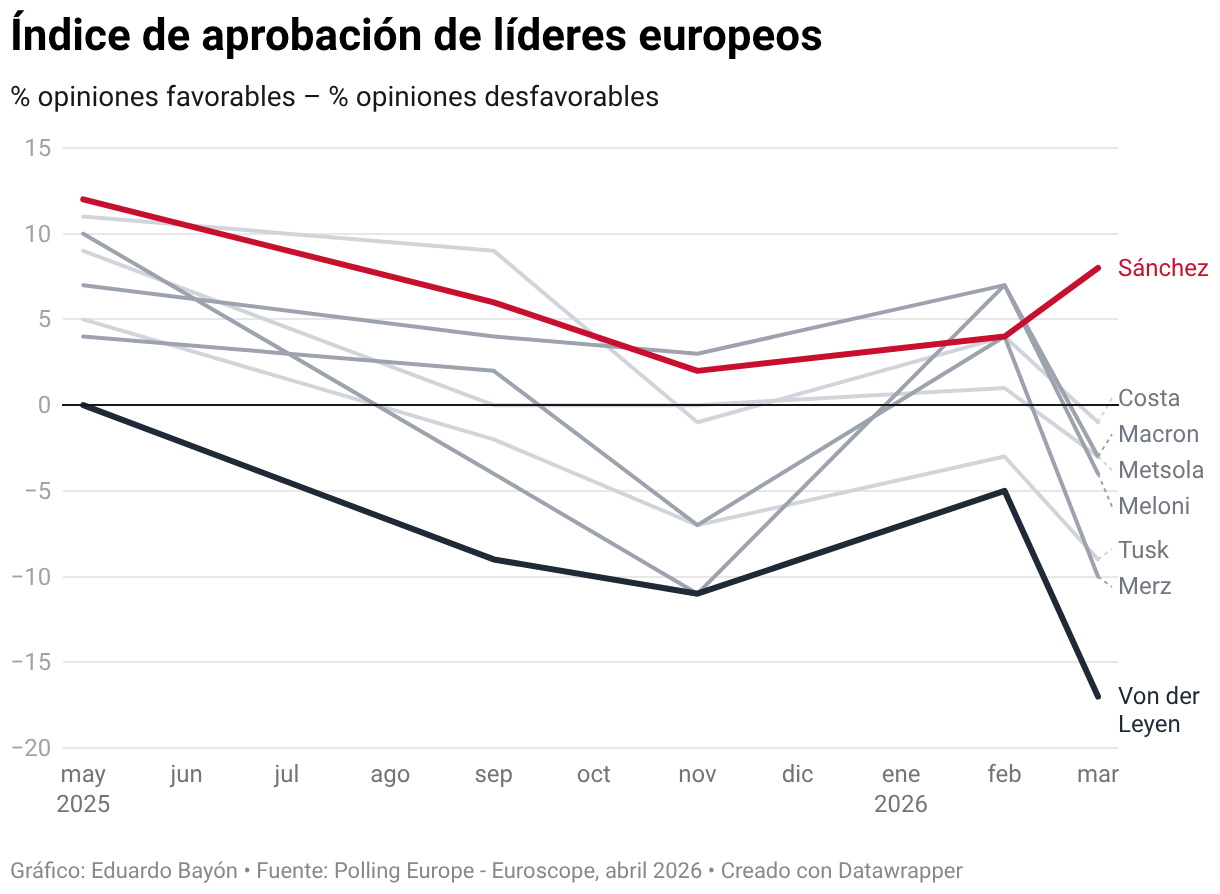
The political translation is also evident in the ratings. Between February and March 2026, practically all of Europe’s top leaders lose points, and by substantial margins that form a pattern. Friedrich Merz falls fourteen points in a month and ends at a negative –10. Ursula von der Leyen sinks twelve points to –17, the worst score in Polling Europe’s entire historical series for any leader. Giorgia Meloni loses eleven points and drops from +7 to –4. Emmanuel Macron slides ten points to –3. Donald Tusk declines to –9, Antonio Costa drops five to –1, Roberta Metsola falls four to –3.
“European leaderships are paying reputational costs for an exterior position —explicit or by omission— that their electorates do not share”
A synchronous fall of this magnitude among leaders from different political families, different countries, and different institutional roles cannot be explained by internal dynamics . It points to a common trigger: the United States–Israel operation against Iran on February 28, 2026. The only reasonable reading at this moment is that European leaders are paying reputational costs for an external position — explicit or implicit — that their electorates do not share.
In that frame, Sánchez rises four points to +8. He is the only European leader measured by Euroscope with a positive approval balance. The gap with Von der Leyen stands at twenty-five points on the same date. Sánchez’s approval is not sustained despite his external stance, but rather it holds because of it. The Spanish leader is the only one with a positive balance precisely because he has publicly voiced disagreement with the belligerent drift, both regarding Gaza and the demands for military expenditure from the Trump administration.
Pacifism? No: Rejection of Subordination
The southern European bloc has not become pacifist: 67% still support increasing European defense spending, though down six points from November. 81% consider preserving NATO important, a figure that in the south drops to 78%, but remains majority. In short, belonging to the Western security architecture remains intact, even if the definition of what it means to be inside is shifting.
“Southern Europe wants investment in defense, but yearns for its own deterrent capability”
The change is concrete and directional. Southern Europe wants defense investment, but longs for an autonomous deterrent capability of its own. 57% in Spain and 56% in Italy support funding rearmament with European shared debt — versus 34% in Germany, painting a clear preference for mutualizing military effort on a continental scale rather than increasing national spending to fund operations beyond the continent. It’s a form of European strategic sovereignty that the community institutions have yet to articulate, but whose electoral demand in the south is no longer marginal.
The Political Calculus of 2026
For Spanish political actors, the numbers open a playing field that warrants careful reading. The PP, which has opted for closer alignment with Washington and for geostrategic logic rooted in past decades — recall the maneuver of welcoming María Corina Machado alongside Lula and other progressive leaders at the Barcelona summit — moves against the current of the Mediterranean electorate. Vox faces a different and more grave problem: voters across Europe grouped under Patriots justify the operation against Iran at 41%, but reject military participation at 70%. In other words, they applaud the attack but do not want to bear the cost. It is a position that is rhetorically sustainable, though not operationally, because it creates contradictions.
The space opened by the barometer —strategically read— is not that of a fixed ideological stance. It is the emergence of a cartographic articulation: a discourse capable of joining three currently dispersed elements on the European political map — rejection of blind Atlanticism, defense of a European strategic autonomy funded jointly, and open critique of institutional complicity with foreign policies contrary to international law—.
“An opinion that moves fifteen or twenty points above the continental average in a given direction is rarely a statistical accident”
That articulation exists today in a single leadership with a positive balance, which suggests that the supply is far below the demand. An opinion moving fifteen or twenty points above the continental average in a given direction is rarely a statistical accident. It is usually a forward indicator of something that institutional structures take time to process. The southern Europe has arrived ahead of the others.
