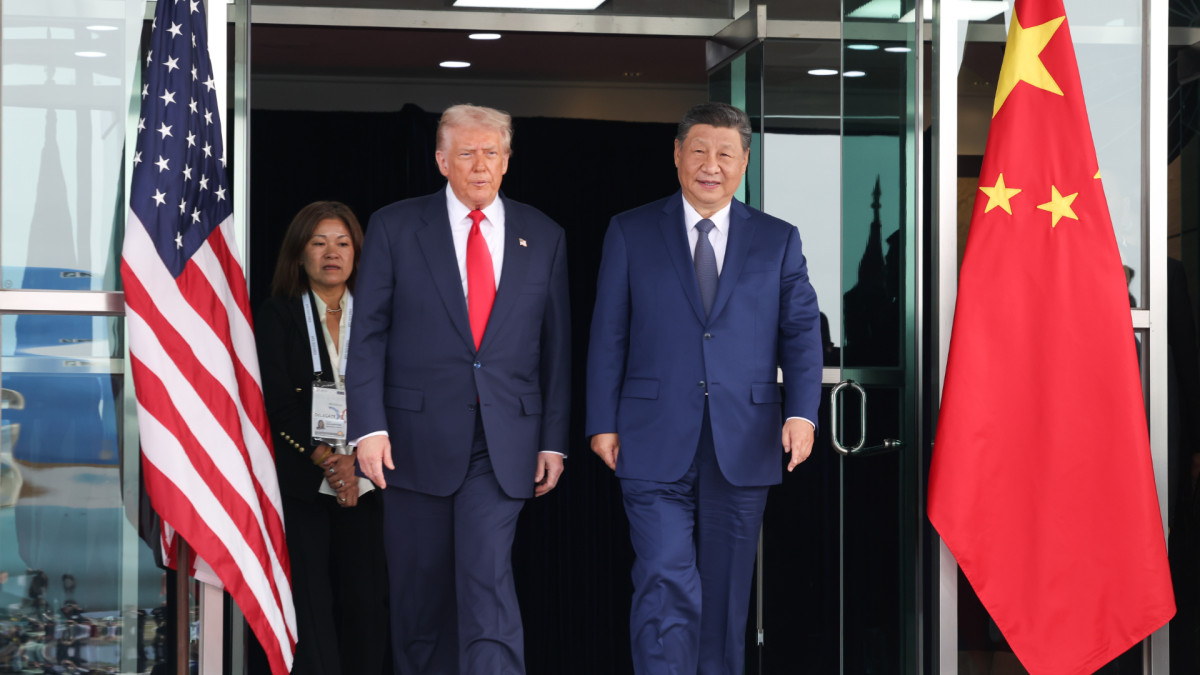
Ahead of the upcoming summit between President Trump and Xi Jinping in China, Agenda Publica consulted a broad range of policy experts, analysts, and former government officials to share their perspectives on the anticipated talks between the leaders of the two world powers. Here is what they conveyed.
Alexander B. Gray, Senior Fellow at the American Foreign Policy Council and former Chief of Staff of the National Security Council from 2019 to 2021:
The forthcoming U.S.–China summit presents a crucial chance for Washington to recalibrate the economic relationship in a way that advances American national and economic security interests. Beijing’s capacity to apply economic pressure against the United States, whether in the pharmaceutical sector or in rare earth minerals, has underscored the necessity of rebuilding domestic industrial resilience so that the United States possesses greater policy options in the future.
“Beijing’s ability to use economic coercion against the United States has demonstrated the need to rebuild domestic industrial resilience”
President Trump appears to grasp that, in order to buy time for the industrial policies his administration is pursuing to take effect, he needs a fundamentally steady US–China relationship in the near term. This stability will benefit the United States and its allies and partners in Europe and Asia, and will present a unique opportunity for allies to work together to strengthen their economic security resilience in the face of China’s ongoing malign activity.
Scott Shaw, Vice President, The Cohen Group. He is also a non-resident Senior Fellow at the Asia Society. Shaw is also a former Senior Foreign Service Officer who retired in 2024 – after a 36-year career with the U.S. Department of Commerce – with the rank of Minister-Counselor, and who served as the Deputy Assistant Secretary for China and Mongolia at the U.S. Department of Commerce:
I expect one of the most consequential outcomes of the Summit to be the unveiling of a Board of Trade and possibly a Board of Investment. While both would be meaningful, we will need to observe their structures to judge how durable these new mechanisms will be.
“One of the most significant outcomes from the Summit will be the announcement of the Board of Trade and perhaps a Board of Investment”
My expectation, drawn from similar bilateral formats in the past, is that these bodies will remain useful through 2026 as the two leaders meet three to four more times over the year. Yet because the two sides seem to pursue different goals and aims for these formats, when cabinet or ministerial leadership recedes after this whirlwind of leader-level encounters, the challenge will be to ensure these formats remain sturdy and effective.
Lucas F. Schleusener, former U.S. Defense Department official (2012 – 2017) with experience working on U.S.-China relations, who wrote speeches for former Secretaries of Defense Leon Panetta, Chuck Hagel, and Ash Carter:
The Trump–Xi summit should be seen less as a breakthrough moment and more as a stress test of American policymaking capacity. I would anticipate discussions covering trade, technology controls, critical minerals, Taiwan, military-to-military communications, and China’s role in managing spillovers from the Iran conflict, particularly pressures on energy markets, East Asian economies, and food security in parts of the Global South. Washington arrives at the meeting having weakened the very machinery that supports presidential diplomacy: the National Security Council process, key Cabinet agencies, and much of America’s development capacity.
“The Trump-Xi summit should be understood less as a breakthrough opportunity than as a stress test of American policymaking capacity”
That leaves the United States seeking Chinese cooperation from a position of reduced leverage, and Xi Jinping will clearly recognize those vulnerabilities. The most probable outcome is not a lasting strategic reset, but rather limited tactical understandings that keep space for dialogue while Beijing seeks to gain an advantage amid Washington’s volatility. For U.S. allies and partners, the question is not only what is said at the summit, but whether Washington can translate leader-level engagement into a coherent strategy. Personalized diplomacy cannot replace a disciplined process, specialist knowledge, allied coordination, and a clear articulation of U.S. interests.
Dominic Chiu, Senior Analyst of China and Northeast Asia at Eurasia Group:
The Trump–Xi meeting will be defined more by a shared interest in preserving stability than by dramatic breakthroughs. I foresee favorable optics and the issuance of deliverables that are comparatively easy to achieve. These include Chinese commitments to purchase U.S. agricultural and energy products, Boeing aircraft, and the formal creation of a Board of Trade to structure dialogue and enable targeted tariff adjustments. We’re likely to see a preview of these deliverables in the aftermath of the working-level trade talks in Seoul, which will occur a day before the summit. Neither side currently seeks to escalate tariff tensions. Section 301 investigations are expected to push Chinese tariffs modestly higher by late summer, staying below peak IEEPA levels. China could respond with a marginal tariff increase of its own, but the move will be calibrated. Importantly, I do not anticipate any new tariff tied to fentanyl, removing a major political irritant for Beijing that could otherwise complicate the summit’s atmosphere.
The Iran situation undoubtedly adds complexity to the discussions. The latest U.S. sanctions on Chinese entities importing Iranian oil and Beijing’s retaliatory measures won’t raise tensions, but they indicate that China is becoming more assertive in countering Washington’s coercive moves. I expect Trump to request Xi to intensify pressure on Iran over the blockade and to cease Iranian oil purchases. There may be language in the official post-summit readout stressing concern about the situation, but I doubt there will be substantive coordination beyond that.
“Beijing is holding its rare earths card close and calculating it will have more leverage over Trump as the midterms draw closer”
We are not planning a pre-emptive extension of the October 30 tariff and export controls truce to emerge during the summit. If such an extension were to occur, it would be a market-positive signal, removing a key source of uncertainty ahead of the midterms. Technological and investment deals are more likely to be deferred. Beijing is keeping its rare earths leverage close, anticipating greater bargaining power over Trump as the midterms approach. The wildcard remains Taiwan. We anticipate discussions about further postponements of U.S. arms sales to Taiwan. A verbal shift in the White House’s official stance toward Taiwanese independence is not our baseline scenario, but it cannot be ruled out, given that both leaders will have substantial one-on-one time without senior officials present to warn Trump against conceding that point to Xi. If Trump were to adopt a tougher stance on Taiwanese independence, the downstream effects on cross-strait dynamics and U.S. credibility in the region would dwarf other topics at the summit.
Zack Cooper, Senior Fellow at the American Enterprise Institute:
I would describe this summit as leaning more toward photo opportunities than substantive deliverables. The leaders will likely announce some Chinese purchases alongside participation from prominent American business leaders, but they are unlikely to confront the fundamental structural issues in the U.S.–China relationship—namely, trade and Taiwan.
As a result, while the short term may appear steadier, there is little progress that would secure long-term stability or safeguard against future crises.
Leland Lazarus, CEO and Founder, Lazarus Consulting:
Both sides arrive at the table with a perception of leverage to press the other. Xi Jinping is likely to portray China as the global stabilizer during the summit, casting Trump as the disruptor. He may also propose increasing purchases of U.S. agricultural goods and Boeing aircraft, while stepping up pressure on Iran to yield.
In return, Xi would push for further easing of chip-export controls and a stronger denunciation of Taiwanese independence. Yet the true extent of each side’s pain and their real bottom-line demands remain unknown.
Ali Wyne, Senior Research and Advocacy Advisor for U.S.-China Relations, at the International Crisis Group:
Although the summit is unlikely to yield major breakthroughs, it remains essential for Trump and Xi to engage with each other regularly, given that their relationship is likely to shape U.S.–China relations for the remainder of Trump’s second term.
“While the summit is unlikely to produce major breakthroughs, it is essential for Trump and Xi to engage one another regularly”
The two leaders should prioritize two tasks in Beijing: extending the Busan trade truce reached last October and demonstrating joint support for Iran’s return to negotiations. Chinese officials have signaled Taiwan will also feature prominently on the agenda. While Trump is unlikely to alter official U.S. cross-Strait policy, he may be amenable to discussing U.S. arms sales to the island with Xi, thereby departing from more than four decades of precedent.