
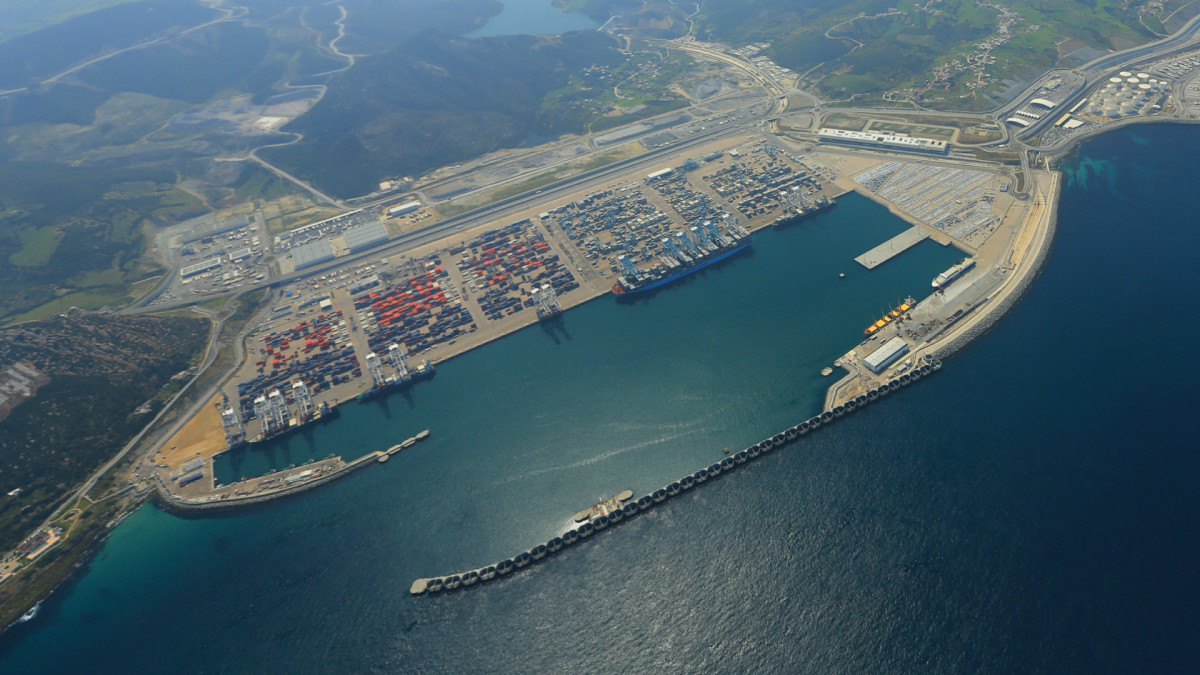
Tanger Med moved 10 million containers in 2024. Algeciras, 4.7. What is happening in the Strait of Gibraltar is not a mere reconfiguration of trade routes, but a redistribution of political power in the western Mediterranean. Spain, trapped in its own institutional contradictions, watches as its voice loses weight in decisions that define the future of its own trade routes.
“The geographic centrality of Spain in the Mediterranean, turned into tangible traffic, was a political asset that the country monetized”
For decades, Spanish geography was a blessing that translated into concrete political power. When in the nineties Maersk, MSC or CMA CGM decided where to set their hubs in the Mediterranean, they could not ignore Spain. Not because they were obliged to, but because the numbers were inescapable: a ship from Asia unloading in Algeciras could reach Zaragoza in 36 hours, Madrid in 40 hours or feed intermodal services to French and Italian ports in a matter of hours. That position meant that for years Algeciras concentrated more than 70% of the Strait’s transshipment traffic. The Spanish governments knew that any decision on Western Mediterranean maritime trade passed through their ports. European governments, multinationals, global shipping lines considered indispensable Madrid’s involvement in negotiations over strategic trade routes. That geographic centrality, turned into tangible traffic, was a political asset that the country monetized in various ways: veto power in European port-regulation negotiations, ability to attract logistical investments or influence over regional infrastructure decisions.
That primacy, then unquestioned, no longer exists. Not because Spain has lost its geography, which remains excellent, but because it has allowed another actor to redefine it to its advantage. Morocco understood something that Spanish governments never fully internalized: geography is a necessary condition but not sufficient. What matters is turning those coordinates into a value chain that other players cannot do without. That is exactly what Rabat has done. But that also means that the initial advantage remains real and that the terrain can be recovered if Spain decides to play the same game with determination.
The Moroccan strategy in the Mediterranean
Tanger Med is not merely a more efficient port. It is the realization of a state strategy where every political decision points toward the same objective: to make the Moroccan port-industrial complex an indispensable node in global trade routes. When Morocco invested €16.7 billion in infrastructure, it was not only buying container-shipment capacity. It was calculating that with lower labor costs (12-15 euros per hour versus 35-40 in Spain), higher productivity (30-35 moves per hour versus 25-32) and aggressive tax regimes, it could turn the port into the inevitable choice for major shipping alliances. When it loosened labor regimes and created duty-free zones with corporate tax exemptions for five years, it was not being liberal, it was being strategic. When it attracted more than 1,100 industrial companies to the free zone (Renault, PSA, Bombardier, Safran) it was not boosting employment in the abstract, it was weaving a network of dependencies that would make the port indispensable for global players whose commercial interests converge there.
“Spain has ports better connected to Europe, a geography more central to serve the European domestic market, and a more skilled population”
The contrast with Spain is telling because it shows that the ingredients of competitive advantage are not mysterious. Spain has ports better connected to Europe, geography more central to serve the European domestic market, and a more skilled population. Valencia is ranked fourth in European connectivity according to UNCTAD. Barcelona offers cruise services and value-added logistics that Tanger Med cannot replicate. Algeciras is the most efficient port in Europe according to the World Bank. But that operational excellence is realized in a context of dispersed resources and fragmented decisions.
While Rabat decided to concentrate public investment in two global-scale port complexes, Spain dispersed €1.2 billion annually across the entire national port system. While Morocco took regulatory risks by creating free-zone environments with tax benefits unmatched in Europe, Spain faithfully complied with EU competition directives that prevented replicating those incentives. The result is that, two decades later, decisions about where containers pass are no longer taken solely in Madrid. That responsibility has begun to be shared with Rabat.
What changes in that reconfiguration is not only the movement of containers, even if it is real. It is the political relevance of Spain in negotiations affecting the Mediterranean. Logistics value chains are not neutral. When a nation controls critical nodes in those chains, it gains leverage that transcends economics. It can condition security decisions in the Strait, influence migration policies, and veto trade agreements that affect its territory. It can force other players to consider it an indispensable interlocutor.
The port geopolitics
Morocco is already using that capacity. When Rabat negotiates with Washington it does so as the controller of a strategic node in euro-African connectivity. When it talks with Brussels it does so from the position of a privileged partner indispensable for migratory stability. That possibility of turning port infrastructure into political power is the leverage Spain has lacked. While Algeciras contends with labor reforms and operational efficiency, Tanger Med has already moved beyond those debates to function as a political instrument of Rabat.
“While Algeciras discusses labor reforms and operational efficiency, Tanger Med has already moved beyond those debates to function as a political instrument of Rabat”
But here is where analysis must allow for nuance. While Tanger Med has consolidated its position as a hub for Strait transshipment, it has not yet reached the global scale of Rotterdam, Singapore or Shanghai. Valencia retains real competitive advantages in connectivity with northern Europe. Barcelona remains strong in value-added services where proximity to European markets matters. Algeciras continues to be used by new shipping alliances for specific routes where its operational efficiency justifies their choice. The game is not lost, but the dice are already in the air.
The real challenge is that Spain must choose between two paths. The first is to accepting a relative decline in pure transshipment and specialize in niches where it maintains a real edge: value-added logistics services, distribution to the European interior, gateway functions that require proximity to high-spending consumer markets. A realistic position, though it implies abandoning the historic aspiration to be a global re-export hub. The second is to replicate Morocco’s strategy: concentrate public investment in a few ports, adopt a competitive cost structure and consolidate the position through large alliances. It is technically feasible, though it requires sustained political coherence for decades and not just during a single electoral cycle.
The problem is that Spain moves perpetually between these two options without fully committing to either. It invests enough to avoid growth in specialization, but not enough to compete at global scale. It negotiates superficial labor reforms, generating social tension but without streamlining processes. It debates competitiveness without choosing between concentration or dispersion. The result is that it ends up competing with Tanger Med with one hand tied behind its back, not for lack of capability but for indecision. While Spain continues to pick among options that no longer exist, Tanger Med represents the opportunity cost lost of what Algeciras could have been.
“The real cost is the erosion of Spain’s political relevance in the decisions that define the Mediterranean’s future logistics”
The real cost goes beyond the 12,000 to 20,000 jobs displaced or the 150 to 280 million euros annually in lost tax revenues. Those damages are real but localizable. The true cost is the erosion of Spain’s political relevance in the decisions that define the Mediterranean’s logistics future. When conversations about what passes through the Strait stop including Madrid as an indispensable participant, Spain has ceded something far more valuable than goods: its ability to influence decisions that directly affect it. If you are not at the table, you are on the menu.
The question is not whether Spain can curb Tanger Med’s growth. Morocco has built structural advantages that no marginal adjustment can reverse. The question is whether it can avoid falling into irrelevance while others define the future of the trade routes that cross its territory. And there is still no answer.
