
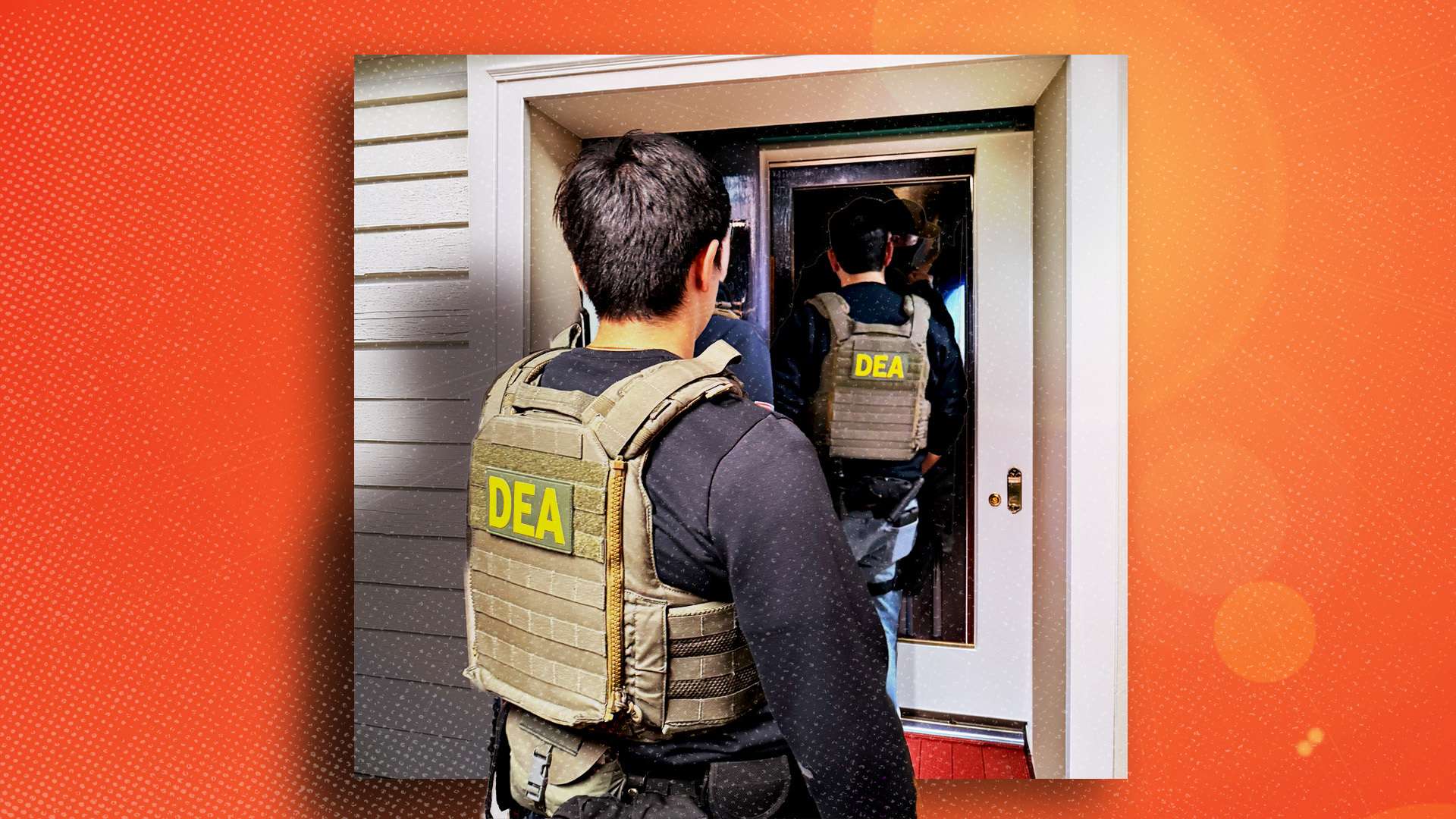
A Pennsylvania family has brought a civil action against the federal government, the Drug Enforcement Administration, and their local police department, asserting that their Fourth Amendment rights were violated when officers conducted a mistaken raid on their residence.
According to the federal civil rights complaint filed in the U.S. District Court for the Eastern District of Pennsylvania, the McLaughlin family was awakened by “repeated, forceful banging” on the front door of their Bucks County home around 4:30 a.m. on May 16, 2024. Resident Robert McLaughlin says he was jolted by the loud noise downstairs, and in fear for his family’s safety, he allegedly “shouted towards the front door in an attempt to scare off the intruders.”
Officers then used a “battering ram” to forcefully breach the front door and dragged McLaughlin into the front yard, aiming assault rifles directly at him and placing him in handcuffs, “all while still being undressed,” according to the lawsuit. McLaughlin also alleges that officers compelled his wife and children out of the home and into the front yard in their pajamas and underwear, where they watched him being detained. He contends he attempted to deescalate the situation by not only identifying himself but also repeatedly stating his address.
According to The Philadelphia Inquirer, which reported the story on Friday, the raid targeted Jose Correa, a man prosecutors say “was a member of a New Jersey-based drug ring that spread the drugs under the orders of the Latin Kings street gang.” His trial is “pending in federal court” in Newark, New Jersey, the Inquirer reports. The lawsuit asserts that officers intended to execute a warrant for Correa at 905 Morgan Drive, a different address from the McLaughlin residence.
Wrongful home raids by law enforcement are far from rare. For instance, in 2022, Texas cops entered the wrong dwelling and held a couple at gunpoint in the middle of the night. In another Texas case, officers raided a home based on faulty information, realized they had the wrong address, and continued the operation anyway. Between 2017 and 2020, Chicago police allegedly conducted at least 21 mistaken raids, according to an inspector general report.
One family’s “nightmare scenario” even reached the Supreme Court last year.
In 2017, the FBI burst into the residence of Georgia woman Curtrina Martin. Agents handcuffed her fiancé, Hilliard Toi Cliatt, while they held Martin at gunpoint and “screamed” at her. But law enforcement would not locate the person they were seeking there, Reason’s Billy Binion explained at the time, “because that suspect, Joseph Riley, lived in a nearby house on a different street.”
The McLaughlins sought redress against the federal government under the Federal Tort Claims Act (FTCA), which allows certain tort claims against the federal government. The federal district court and the 11th Circuit Court of Appeals dismissed their case, holding that the Supremacy Clause—which provides that federal law takes precedence over state law—barred the suit, according to the Institute for Justice, the public-interest law firm that represented the family. In a 9–0 ruling last June, the Supreme Court ruled that the Supremacy Clause did not prevent Martin from suing the federal government and remanded her case to the lower court, though the Court indicated that key FTCA exceptions could still apply depending on the 11th Circuit’s findings.
The McLaughlins are pursuing FTCA claims for negligent and wrongful acts and omissions by United States employees.
Brian Fritz, the McLaughlins’ attorney, tells Reason that his clients’ rights “exist for a reason, and when they are not observed by those acting under law enforcement, something must be done about it.”
Fritz notes that any damages would be determined by a jury. For now, he says, the central goal is to prevent this from happening to another family.
