
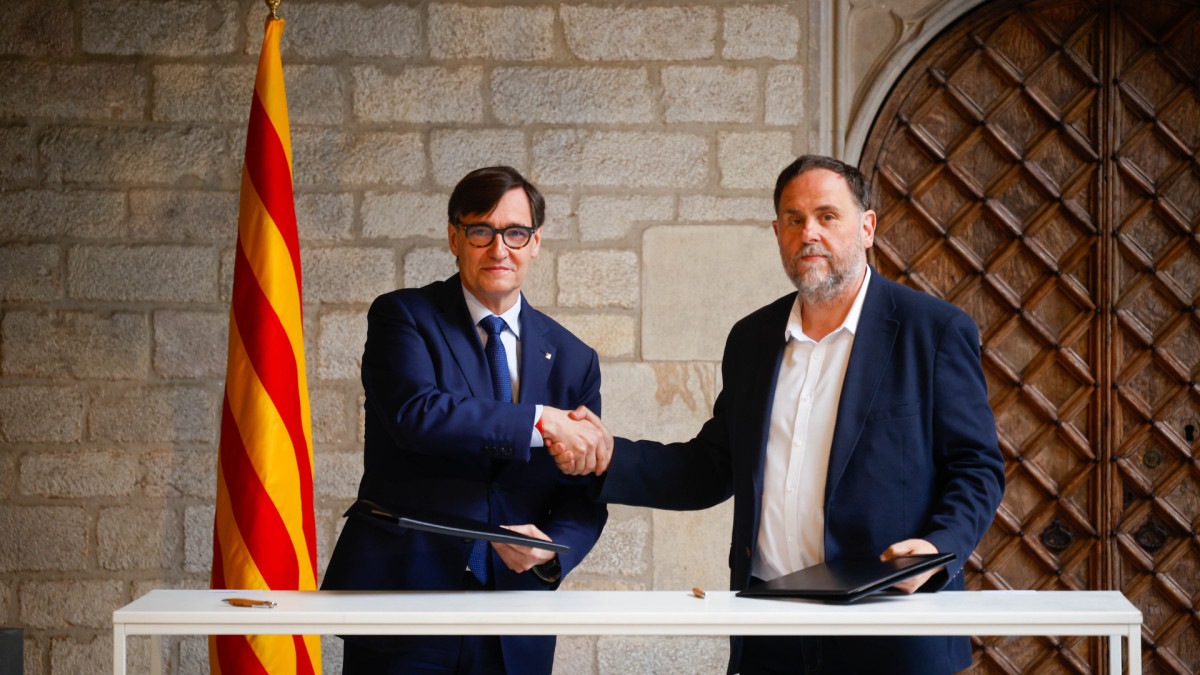
The president of the Generalitat, Salvador Illa, and the leader of Esquerra Republicana de Catalunya, Oriol Junqueras, signed yesterday a budget agreement that just a few months ago would have sounded frankly improbable: a stable alliance between the PSC and the party that symbolized the institutional rupture of the independence movement a few years ago.
“Catalonia has definitively entered a new political phase: less defined by the logic of secessionist confrontation”
This agreement on public finances transcends the economic realm. Both in Barcelona and in Madrid it is interpreted as a confirmation that Catalonia has definitively entered a new political stage: less marked by the logic of secessionist confrontation and more defined by governability, negotiation, and the interdependence between socialists and republicans.
For the head of government, Pedro Sánchez, the symbolism is evident. Illa’s parliamentary stabilization simultaneously reinforces the political architecture that sustains Sánchez in Madrid. And for ERC, the pact represents a calculated attempt to continue occupying the center of the Catalan board after the collapse of the independence majority.
In many respects, the agreement formalizes a political transition that began after last year’s Catalan elections. Let us not forget that, between 2012 and 2024, half of the time governance operated with budgets extended due to the inability of the independence movement to approve new accounts on as many as six occasions.
The victory of Illa already hinted at the social exhaustion of the perpetual dynamics of the procés. However, governing required a further turn: that ERC would agree to abandon the logic of sovereignist competition in favor of another logic, the logic of negotiated influence.
“Political survival required abandoning rhetorical maximalism and focusing on achieving concrete results”
That turn has not been easy. Within ERC, the debate has been almost existential. Over the past decade, the party sought to combine its pro-independence profile with an image of governance and an advocate of useful policies. But, after years of strategic fragmentation, internal tensions, and electoral setbacks, an increasing part of the Republican leadership came to the conclusion that political survival required abandoning the rhetorical maximalism and focusing on achieving concrete results.
The Republican diagnosis comes, in part, from the new Catalan political climate. Surveys by the CEO analyzed by this outlet show that a broad majority of Republican voters now prioritize budget agreements and institutional functioning over the old ideological red lines. The data reflect the emergence of a post-procés electorate more concerned with housing, public services, or economic stability than with permanent symbolic confrontation. The pact sealed by Illa and Junqueras precisely responds to that context.
The agreement includes an increase in social spending, strategic investments, and new developments of the “singular funding” model agreed between PSC and ERC during Illa’s investiture. Precisely the fiscal issue is what contains the greatest political charge of the agreement.
For ERC, differentiated funding has become the way to reshape the Catalan national question through less unilateralism and by incorporating, in return, greater capacity to influence within the State. The strategy has moved from the threat of rupture to the gradual broadening of spaces for political and financial autonomy. Moreover, the formula allows both parties to claim strategic victories.
For Illa, the pact consolidates the image he has tried to project since arriving at the Generalitat: that of a president of normalization. His political project does not move through emotional mobilization or ideological reinforcement, but rather fosters the institutional reconstruction after a decade of polarization.
“After years of tension, many voters simply want a functional administration, stability and managerial capacity”
The socialist leader understands that a large part of Catalan society no longer seeks grand epic narratives. After years of tension, many voters simply want a functional administration, stability, and managerial capacity. In this respect, the main strength of the Catalan socialist has consisted precisely in representing moderation without conveying passivity. In a delicate balance, he has managed to offer relaxation without explicitly trampling on independence supporters.
At the same time, that same balance explains why ERC has become a more viable partner than Junts. Now, for Oriol Junqueras, the calculation is tougher. ERC faces pressure from several fronts: Junts’ attempt to monopolize the opposition to independence, the growth of the PSC among urban progressive voters, and internal criticisms from sectors that deem the accommodation with socialists excessive.
Nevertheless, the pro-sovereignty formation remains aware that blocking governance begins to incur more electoral costs than facilitating it. Because, if the post-2017 political ecosystem rewarded confrontation, the new cycle seems to reward usefulness.
Therefore, the Republican leadership seems to accept that Catalonia is entering a long phase in which institutional influence—both in Barcelona and in Madrid—will be more important than rhetorical escalation. For ERC, the act of approving the budgets has been presented as a way to defend Catalan interests. The transformation is especially striking given the intensity of the previous cycle, since, just a few years ago, relations between the PSOE and Republican leaders were marked by judicial condemnations, mutual delegitimization, and constitutional crises.
The European Dimension
The European dimension must not be overlooked either. In Brussels, the de-escalation of the Catalan conflict has been viewed as one of Sánchez’s main political successes. European institutions watched the 2017 crisis with considerable discomfort, especially for the fear that a prolongation of territorial instability in one of the Union’s major member states could fuel .
For many European observers, Illa’s arrival symbolized precisely that: the return of a recognizable Catalan politics for the European capitals, based on management, pragmatism, and institutional stability. That is why the PSC-ERC agreement has a relevance that clearly goes beyond regional politics. It represents a testing ground on how territorial conflicts can evolve from confrontation to stable, institutional politics.
The agreement carries significant risks for both sides
Illa must avoid the perception that the PSC is overly dependent on republican demands, especially regarding funding, a matter extremely sensitive in the rest of Spain. The regional governments of the PP already argue that Sánchez is building fiscal privileges for Catalonia in exchange for parliamentary survival.
After the agreement, that critique is likely to intensify. The debate over funding touches probably the most delicate issue of the Spanish territorial system: to what extent can Spain evolve toward a more asymmetric and plurinal national structure without provoking strong political backlash in other autonomous communities. Even within the PSOE there are sectors uneasy with that evolution. Some regional leaders fear that excessive differentiation could become electorally toxic outside Catalonia.
On the other side, ERC faces a different danger. The more it is identified with the stability of Catalan and Spanish socialism, the harder it may be to maintain a mobilizing, independent identity of its own. Junts is already preparing precisely that line of attack, presenting ERC as the manager of an domesticated autonomy without a grand Catalan national ambition. In this frame, for Junqueras, positive results to cling to are indispensable. And yet, despite all these tensions, the logic pushing PSC and ERC toward understanding remains powerful.
“Neither side gains clear benefits from a new phase of blockading”
Neither side gains clear benefits from a new phase of blockading. Illa needs parliamentary stability to consolidate the image of a functional Generalitat and a definitively post-procés state. ERC—having been the party that grew the most in organizational and institutional terms during the procés era—needs to demonstrate that it remains decisive even after its electoral setback, and thus consolidate its strength in a context of political changes in the independence camp. And Sánchez needs to preserve the Catalan détente to sustain the delicate majority that keeps his government alive.
Even Catalan society itself seems increasingly aligned with that logic.
The emotional intensity that defined the years of the procés, although still present, has been partially replaced by fatigue, pragmatism, and a demand for governability. That may ultimately be the true political meaning of the agreement sealed by Illa and Junqueras. The Catalan national question has not been resolved, nor the ideological divisions, but this is a very significant advance.
What seems to be changing is the central axis of Catalan politics. The budgetary pact between Illa and Junqueras does not aim to shut down the territorial debate, but it may solidify a new phase in which that conflict is more negotiated and far more transactional. For Sánchez, that will probably be enough.
