
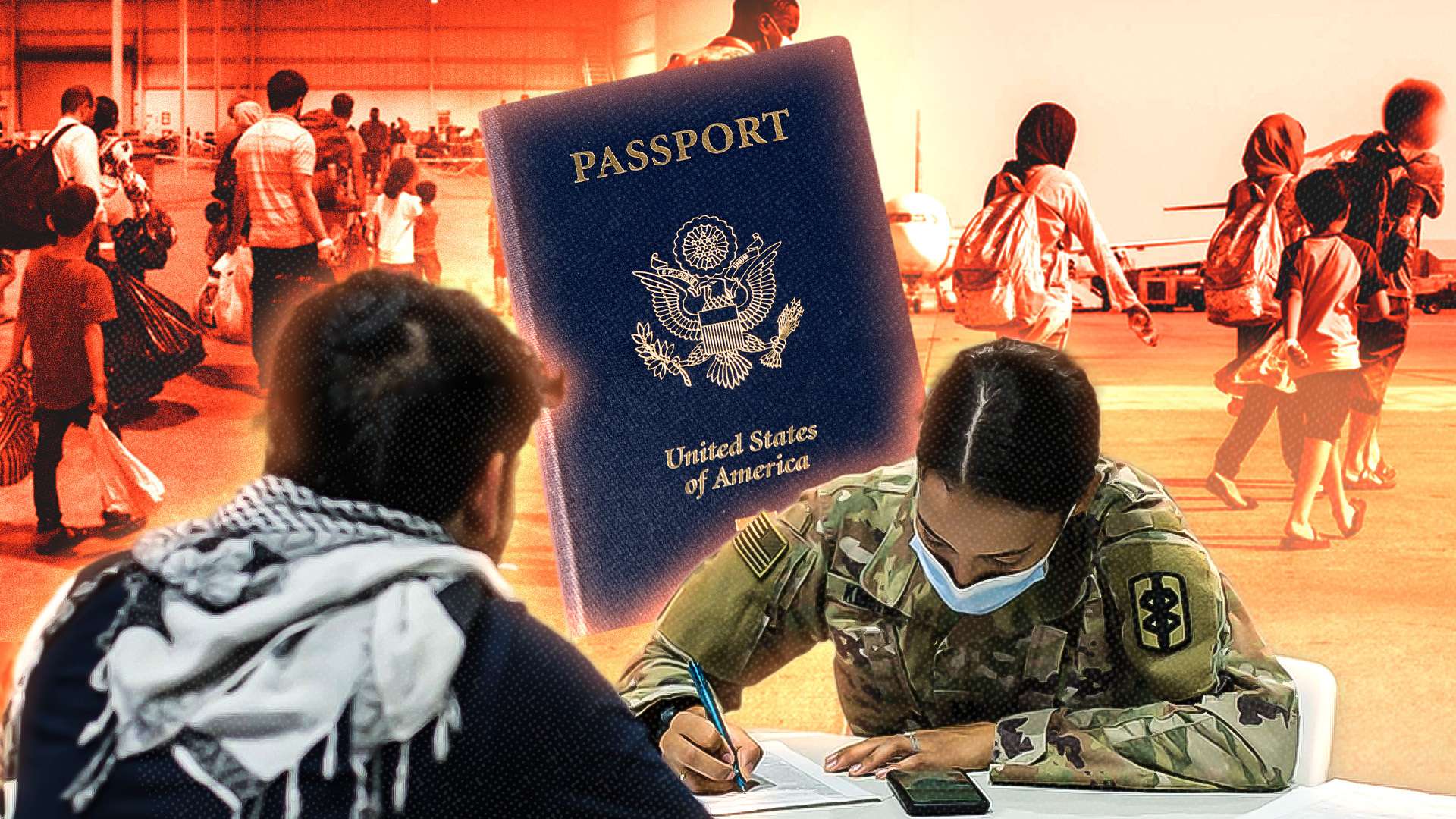
The biometric immigration system makes it impossible for bureaucrats to take a moral stand. I know this from firsthand experience.
The sweep of the 20th century, and especially the Holocaust, is filled with civil servants who acted with conscience—notable figures like Raoul Wallenberg, Chiune Sugihara, Frank Foley, and Aristides de Sousa Mendes. These diplomats bent the rules and issued unauthorized passports or visas to people fleeing persecution, saving hundreds of thousands of lives. Yet in the 21st century, as the threat of repeating those horrors grows closer, such insiders who ignore the rules are nowhere to be found. It isn’t that people lack the capacity to take a stand morally; it’s that the system itself denies them the possibility.
I know this from personal experience because I tried. In 2022, while serving as a midlevel visa administrator at the U.S. Consulate-General in Mumbai, I attempted to help an Afghan family stranded after the Taliban takeover. The parents already held U.S. visas, but when I tried to arrange a visa for their infant, a computer overruled my decision. I still don’t know what happened to that baby or that family. Such scenes are replayed across the globe, from the sealed Rafah crossing on the Gaza-Egypt border to U.S. deportation proceedings that end in detention in Salvadoran prisons. Images of starving people peering through gates are becoming disturbingly common again, and their fate is increasingly dictated by impersonal systems.
Ironically, the very immigration framework designed to prevent the repetition of World War II atrocities sought to do so by codifying human rights and encouraging international cooperation. The founders of refugee aid organizations and the lawmakers who drafted refugee and migration laws hoped mass displacement and mass murder could be deterred by a more orderly, rights-based global order. The more restrained, utilitarian charters of organizations like the United Nations High Commissioner for Refugees and the International Civil Aviation Organization carried that same assumption: that systematization and efficiency would safeguard vulnerable lives.
During my diplomatic training, State Department instructors would solemnly recount Wallenberg’s actions in Hungary. They warned that there could come a moment when we must choose between our principles and the letter of the rules. The stories of Sugihara, Foley, Sousa Mendes, and others are celebrated within migration-management circles as exemplars because they embodied virtue when it mattered most. After all, how many times can a visa-stamper be counted a moral hero?
The Diplomats Who Defied Orders
Wallenberg, a Swedish envoy in Budapest, stretched procedures to their limit. In the era of Hungary’s fascist regime, he got creative with his embassy budget: he leased numerous buildings around the city, proclaimed them Swedish diplomatic properties with full immunity, and sheltered thousands of Hungarian Jews inside. Without Wallenberg’s audacious improvisation and personal initiative, these people would have been gathered up and sent to concentration camps within days.
Sugihara, serving as a Japanese diplomat during World War II, is a peculiar hero in many respects. He oversaw visa issuance at the Japanese consulate in Kaunas, then under Soviet occupation, and chose to bend the rules to aid escapees. He began signing transit visas—permits to travel to and through Japan—for nearly anyone in need of departure from Lithuania. He didn’t strictly check onward tickets or financial means; he merely stamped passports and filled out what was required. Initially he granted visas mainly to middle-class businessmen and Jewish yeshiva students fleeing the Soviets, but gradually he extended them to anyone fleeing the Nazis. He worked eighteen-hour days at times, and even as he prepared to depart, he kept issuing visas, tossing the final, signed passes out of the train window as a last gesture of aid.
Foley, a British passport-control official in Berlin in the late 1930s, personally saved thousands of German Jews by issuing British visas to anyone in need before the war began. Unbeknownst to most, Foley was in fact a British intelligence operative, and his immigration duties were a front to conceal his actual role. The successful outcome for many people mattered far more than the spying he conducted.
Sousa Mendes, an aristocratic Portuguese envoy who led the Bordeaux consulate during the collapse of France, faced Circular 14—Salazar’s directive to restrict visa issuance to Jews expelled from their homelands and other listed groups. Mendes found Circular 14 grotesquely racist and chose to resist it. He issued transit and tourist visas without waiting for formal clearance, bending the rules to the limit. One applicant he helped, a Polish rabbi named Chaim Kruger, insisted that everyone deserved a visa, not just a lucky few. Mendes found himself morally drawn into Kruger’s demand and, after Kruger’s example, pulled Bordeaux into a collective rogue stance—issuing visas to all comers and, on occasion, Portuguese passports to people who weren’t citizens. He even drove to the Spanish frontier to plead for permission for refugees to cross. Lisbon responded by instructing the French government to cut recognition of visas bearing Mendes’ signature. Mendes was recalled to Portugal, investigated by the Salazarist secret police, demoted, dismissed, and died in poverty. Yet it is estimated that he saved more than 30,000 people.
How the Modern Passport Turned into an Unassailable System
In 1938, the German author Irmgard Keun penned Child of All Nations while fleeing persecution, a novel that follows a middle-class exile family as they scramble for safety across Europe. A child in the story observes: “A passport is a small book filled with stamps. It’s basically proof that you’re alive. If you lose it, to the world you might as well be dead.” Keun’s young narrator was right: without documentation, you essentially do not exist. This is a relatively recent development in human history; for most of it, passports weren’t essential, and border checks were often cursory. Yet passports have grown in importance, precision, and resilience against subversion.
Many people handing over their identification wonder what the official at the other end is looking at on the screen. How much does the state actually know about me? The contemporary biometric passport regime rests on standards set by ICAO, the United Nations body that governs air travel. Malaysia pioneered biometric passports in 1998. Now, after nearly three decades of ICAO-led regulation, only a handful of countries still avoid them. The passport now comprises a machine-readable data strip and an embedded chip, enabling any nation to retrieve a traveler’s information instantly at the border. The biometric data on the chip mirrors what appears on the passport page: name, date of birth, place of birth, and so forth. Some states opt to store substantially more data; the United States, for example, currently does not require fingerprint data in the passport information.
More crucial than the document itself is its integration into global databases. The ICAO standard was adopted just before the 9/11 attacks, after which nations shifted from physical visa marks to visas supported by centralized computer systems. You possess a machine-readable passport linked to your home-country database, and a visa that is tied to the issuing country’s database. Every element is cross-checked against another repository.
The security advantages are obvious. A counterfeit passport in the 21st century is virtually non-existent without the backing of a state. Identity theft becomes far more challenging. The system also poses a substantial obstacle to espionage. If a spy needs to travel somewhere but has a history as a child, their face, fingerprints, and legal name are already recorded; a fake identity would be detected the moment the passport is scanned. After the 2010 operation against Mahmoud al-Mabhouh, the use of forged or stolen western passports by Israeli operatives was quickly exposed by Dubai police, triggering a diplomatic crisis. It proved that such a cover could open doors, but not withstand long-term scrutiny.
Monitoring as a Mechanism of Control
The traceability and cross-checking built into the system are profoundly constraining for those who administer it. Immigration officers and diplomats who manage entry programs are now cogs within a larger mechanism, their decisions subject to immediate scrutiny. They cannot simply turn a blind eye to unjust policies or permit vulnerable people to slip through to safety. They swipe passports into sophisticated software suites that record user IDs and performance metrics, and their actions are logged and tied to biometric data linked to the applicant.
Consider a hypothetical scenario. A Customs and Border Protection officer in the United States admits a traveler named Mehmet Yilmaz at 8:35 a.m. last Tuesday after asking a standard set of questions and recording the responses. Mehmet shares this face, these fingerprints, and this birthday, and had used a visa issued at the Istanbul embassy a couple of months earlier, along with these justifications and this work history and travel history. All of this data instantly populates a centralized database accessible from Washington, D.C., and if Mehmet feels watched, perhaps it provides some cold comfort to know that officers John Smith and Jane Doe have their decisions reviewed by supervisors at every rung of the chain.
This kind of accountability can have merit. The State Department’s Bureau of Consular Affairs maintains a domestic “Wall of Shame” for visa officers who demanded bribes or engaged in coercion. Because of robust internal monitoring, those officers are typically identified and disciplined quickly. Yet accountability operates in only one direction, making the system increasingly restrictive. If you remove personal discretion, you expose everyone to the caprice of centralized power.
Years after the Holocaust, Sugihara reflected on what might have happened if his own fascist, Nazi-aligned government had discovered what he did for Lithuanian Jews. “No one ever mentioned it,” he recalled. He sat at his desk in Kaunas with his visa stamp, his pens, and his conscience. That world no longer exists.
Today, headquarters would have detected the mismatch instantly, would have digitally nullified every transit visa issued under Sugihara’s user ID, and would have made those records appear in other national systems. The current biometric passport regime and related ID technologies close the door on individuals acting alone when doing what is morally right.
How the Computer Blocked a Simple, Common‑Sense Remedy
I witnessed it firsthand not long after submitting my resignation from the State Department. One of my last assignments involved working at a makeshift call center that supported Afghan interpreters and their families trying to board flights without finalized visas after the Kabul pullout.
Six days before my departure, a subordinate brought me a baby’s passport that had appeared in the interview-waiver drop box. At that moment, the Trump-era rule changes had altered a prior policy in late 2025. The child was the offspring of two Afghan diplomats posted at the former Afghan consulate in Mumbai, now in precarious limbo due to the Taliban’s seizure of control. Both parents already held U.S. visas. If the baby could also obtain one, the entire family could seek asylum together in the United States; otherwise they risked years of exile in poverty or worse in a processing camp abroad while their case wound its way through a chaotic program for Afghan allies.
“Just issue it,” I urged the subordinate. “It’s the bare minimum we can do.”
“I won’t,” she replied. “My name will be on the case.”
It was against policy to grant a tourist visa if there was any indication the applicant might use it to travel and seek asylum. Her name would accompany the case file, and that would surely attract attention. She was newly minted and at the start of her career, making the risk even clearer for her.
So I told her, “I’m stepping away in six days anyway.” I didn’t fear for my career anymore. “Just hand it over.”
The moment I took the infant’s passport, I walked back to my desk, drafted a vague but acceptable justification, and pressed the print-to-visa button. This felt like my own Sugihara moment, a try to fling a few visas out the window of the train. A conspicuous red warning flashed, and the press-to-issue button remained inactive—blocked by a central counterterrorism screening in Washington, D.C.—the case had been flagged for further review. It didn’t reveal why an infant would end up on that watch list. I attempted to lean on my boss for an override, but I was told that pushing through a decision at the last week of duty wasn’t appropriate. The baby, and the family of young diplomats, vanished into the opaque apparatus at the end of the day.
Even with nothing to lose, even when you hold authority within the administrative machine, you cannot override the system. The world and its controls feel broken, echoing the sense of disarray that marked the 1930s and 1940s. Most officials simply obeyed the rules back then, as they do now. Governments failed to protect most people then, and they continue to fail today. Yet there was at least a sliver of possibility for individual courage. That possibility seems scarce now, spread thin across a system designed to dilute personal responsibility.
Where, in today’s world, could a person at a camp gate or a border crossing still be a hero?
