
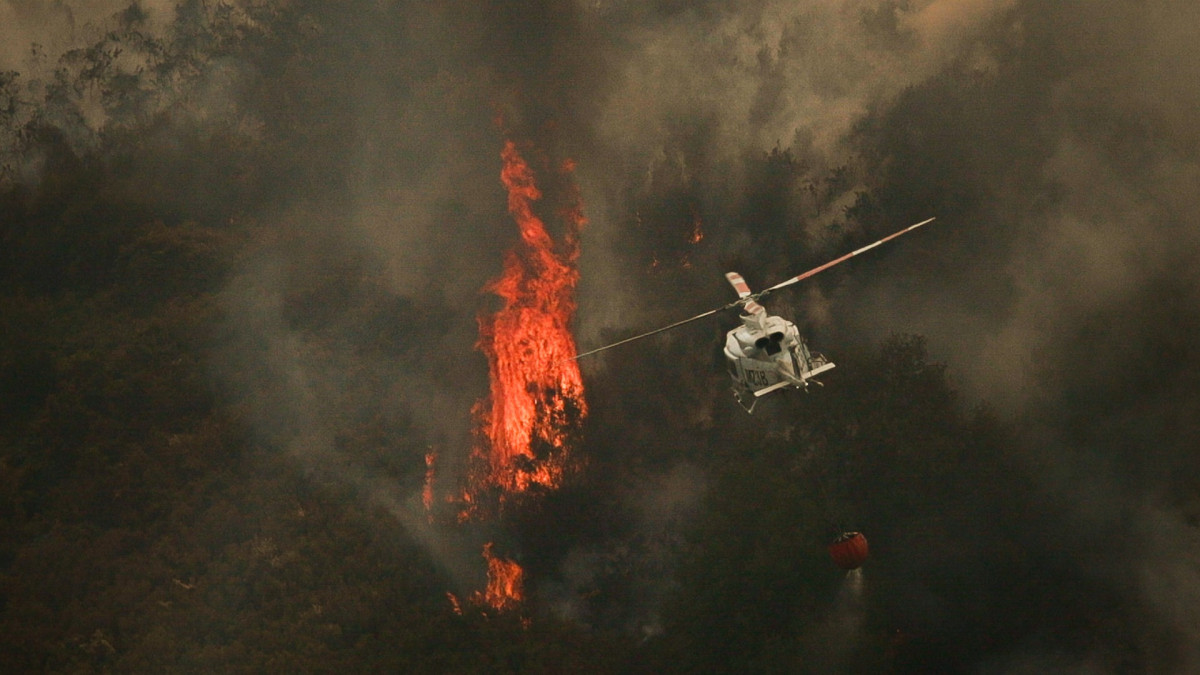
Indeed: it has been a particularly disastrous summer. The burned-area graphs—weekly and cumulative—paint a picture rarely seen. Until early August 2025 it appeared among the mildest years in the recent series; but in a matter of days, the red line shot up almost vertically. In a single week hundreds of thousands of hectares burned, and the cumulative total brushes— and probably exceeds— the decade’s highs. It’s not a dip; it’s an unusually severe extreme, but not a new normal. The fires concentrate in very brief windows, appear simultaneously across several communities, and encounter vegetation that is primed to ignite.
These episodes may become more frequent—or more intense—if we follow the most likely climate trajectory. The soberest international forecasts, both the World Energy Outlook’s declared policies scenario and the NGFS’s current policies scenario, converge: the world is not on track to meet 1.5–2 °C of the Paris Agreement targets, but to exceed 2.5 °C with a comfortable margin this century. In technical terms, this is the SSP2‑4.5 or RCP4.5 scenario of the Intergovernmental Panel on Climate Change. What does it imply for Spain? A country with longer, hotter summers: in the interior of the peninsula, summer heat could rise by between +3 and +4 °C by the second half of the century; there will be more tropical nights, less nocturnal relief, and more days of high fire danger. In round numbers, that translates into between one and a half additional months of high-fire-danger days in the south and Levante, and—for the first time with continuity—the northwest entering the risk map: Galicia could go from barely a few days to more than forty in some subregions.
In that more probable warming trajectory, what arrives is a more capricious hydrological cycle. Winters and springs with pulses of rain that trigger scrubland and grasses—the well-known green trap; summers and late springs drier and hotter, with elevated evapotranspiration that dries the soil; torrential episodes that wash away soil and barely recharge aquifers; and warmer nights that deny any respite. That pattern doesn’t just add degrees: it lengthens and densifies the danger season, starts earlier in June, intrudes into September and leaves continuous fuel that, at the slightest ignition, turns a spark into a front.
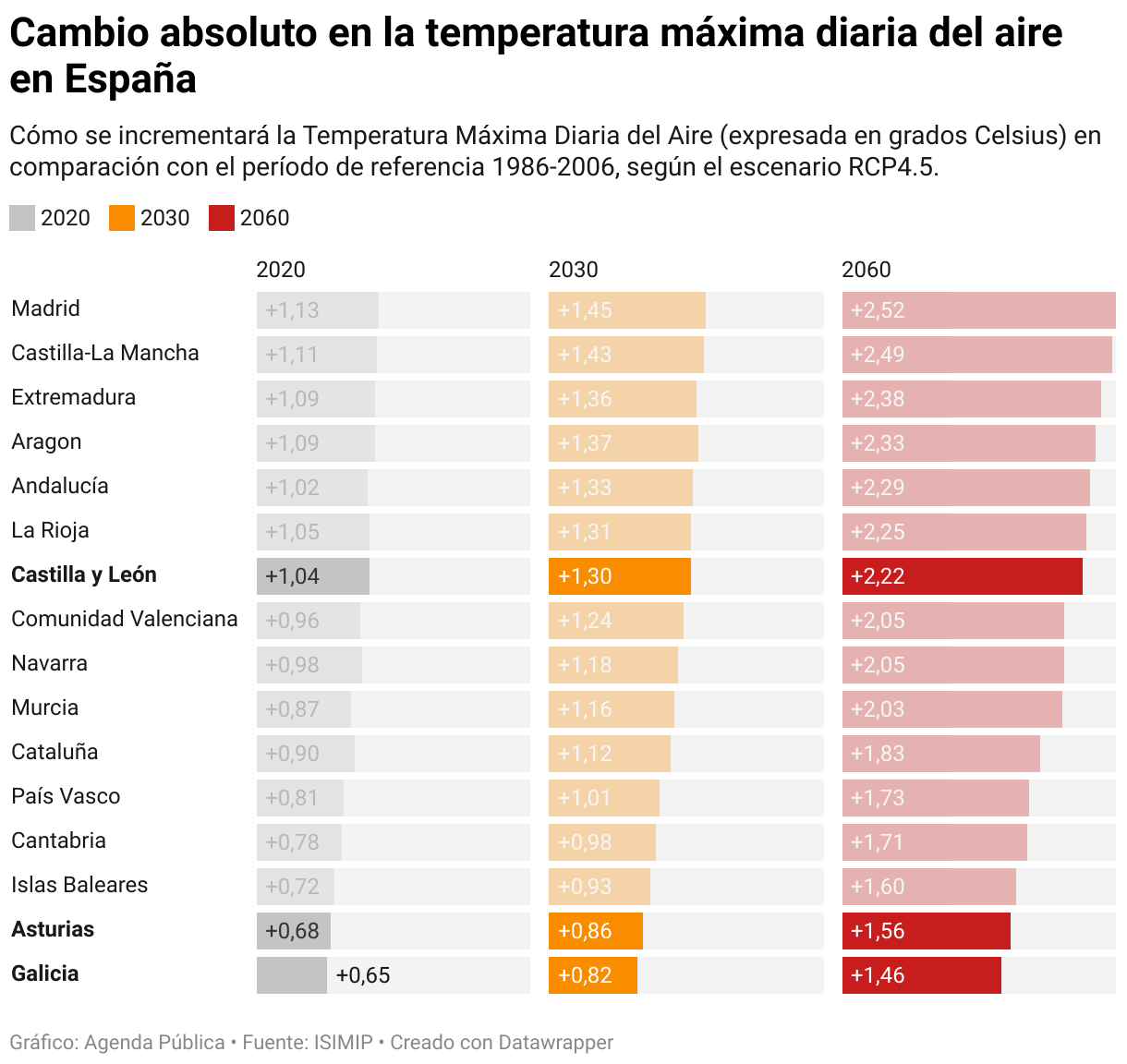
The regional data on the table also sketch a geography of expanding risk. Under an RCP4.5 scenario, by 2060 maximum temperatures could rise around +2.5 °C in Madrid and Castilla‑La Mancha, +2.49 °C in Castilla‑La Mancha, +2.38 °C in Extremadura, +2.33 °C in Aragón and +2.29 °C in Andalucía. Even in traditionally milder regions, such as Asturias (+1.56 °C) or Galicia (+1.46 °C), extreme hot days will be more frequent.
Meanwhile, soil moisture falls across all communities toward 2060: −4.14 % in Andalucía; around −3 % in Extremadura and Murcia; declines near −3 % in País Vasco, Cantabria, Asturias or Cataluña; and notable losses in Castilla y León (−2.49 %) and Madrid (−2.21 %). The pinch—more heat and less available water—is the underlying explanation for what happened in August: when a gust of dusty wind or an episode of instability arrives, a spark is enough to leap to a large fire.
The key piece for anticipating operations is the number of days of high fire danger. We are talking about days on which meteorological indices (such as the Fire Weather Index, FWI) indicate conditions conducive to a fire escaping initial attack. The projections are unequivocal: they rise in all autonomous communities. In the horizon 2041–2070 and 2071–2100 (RCP4.5), several regions already shift to four to five months of elevated danger. Murcia rises from 109 days in 1981–2010 to 137–138; Andalucía, from 98 to 122–131; Extremadura, from 94 to 118–125; Castilla‑La Mancha, from 90 to 111–120; Madrid, from 78 to 97–105; Comunitat Valenciana, from 71 to 89–99; Aragón, from 53 to 72–81. In the north and interior the jump is relative but decisive: Castilla y León climbs from 42 to 63–71; Galicia goes from 5 to 18–26 across the regional total and, in high scenarios or dry years, may surpass a long month—up to forty days—in subregions that thirty or forty years ago barely appeared on the maps; Asturias, which started practically from zero, enters the radar with several days by the end of the century. In plain terms: the perimeter of risk widens and shifts northward. In dry, warm years, some Galician subregions could surpass a full month of danger days, something that thirty or forty years ago was exceptional.
“Policy can cut that translation if it reduces the continuity of fuels through silviculture and grazing”
It is worth stopping for a moment to consider what meteorological danger measures—and what they do not measure. The FWI does not “predict” how many hectares will burn; it works as the forest’s traffic light: it indicates that, if a spark occurs, the fire will have an easier time spreading. The burned area is the result of many more pieces: where and when ignitions occur (many ignitions are unfortunately human), how continuous the fuel is, how many people and how many homes are on the urban‑forest interface, what accesses exist and with what speed and means the fire is fought. Therefore, more days in red mean more opportunities for a fire to get out of control, but not a sentence. Policy can cut that translation if it reduces fuel continuity through silviculture and grazing, if it professionalizes prescribed burns in safe windows, if it orders the interface with appropriate materials and buffers and if, in daily reports, besides the classic FWI, it incorporates instability indicators that warn of the truly explosive few days. There, to a large extent, lies the decision about the difference between a black summer and another that passes without headlines.
Economic Damages
The economic and social balance also shifts sign. In recent decades, many countries have multiplied firefighting expenditure, without preventing megafires from overwhelming their suppression apparatus. The result is well known: diminishing returns of suppression when not accompanied by structural prevention. To that bill are added invisible damages: the smoke associated with hundreds of thousands of premature deaths each year, spikes in hospitalizations for respiratory and cardiovascular problems, or the rising cost of potabilization after fires that carry sediments and nutrients into reservoirs. When we sum up that bill, the arithmetic is stubborn: prevention costs less than extinguishing.
Put differently: the economy also backs prevention. In the mid-mountain Mediterranean, clearing and forest management work costs range between 150 and 5,100 €/ha, with a mid-range around 2,000 €/ha for typical clearing, brush clearing and pruning. In La Rioja, the public cost of initial clearing has hovered around 375–420 €/ha and the Clearing Plan (since 1986) created a mosaic landscape that drastically reduced fire; the savings per hectare unburned have been estimated at around 2,722 €/ha, above the cost of clearing. Moreover, the extensive grazing that keeps those areas open saves about 900 € per year per UGM in feed, so maintaining living firebreaks tends toward a near-zero marginal cost.
“If we monetize that volume at the current price of the European carbon market the ‘climate cost’ of just that week rounds to €950 million”
A note that helps to order priorities: in the worst week of this summer, Spain’s fires emitted around thirteen million tonnes of CO₂. If we monetize that volume at the current price of the European carbon market (EU ETS, ≈ €73/tCO₂), the “climate cost” for just that week is around €950 million. Dividing by about 200,000 hectares burned in that period, we speak of ≈ €4,700 per hectare. It is clear that fires are not covered by the EU ETS, but that price is a good proxy for climate damage and, therefore, a yardstick not so much to guide public spending but to generate private incentives. Turning that implicit cost into an explicit prevention budget—payments per hectare managed, program-contracts tied to results, ecosystem services—is sensible: if fire costs us thousands of euros per hectare in a single week, rewarding fuel-reduction management is not an expense, but an upfront saving.
Prevention, consequently, is a territorial economic policy. Spain needs much more direct forest and land management and must pay for it with trades and markets where declining demographics do not allow other options. The realistic choice is not between “use” or “no use,” but between economic use that maintains and abandonment that burns. Commercial silviculture that creates discontinuities; clearings, pruning and clearing that reduce propagation speed; well-planned prescribed burns that return fire to its role as an ally; extensive grazing as a living firebreak; and the utilization of biomass — municipal boilers, heating networks, wood chips for public buildings — that turns a waste into local income. Resin forests, cork, chestnut, pine nut, mushrooms and truffles, beekeeping, certified timber or regulated hunting are not nostalgias but funding for prevention.
It is wise to read 2025 not as an anomaly, but as a test of effort. It has been a confirmation of what the scenarios anticipated: exhausted soils, persistent maxima, continuity of fuel and several simultaneous outbreaks that made August’s curve nearly vertical. The novelty—and perhaps the most unsettling—is geographic: Galicia and Asturias enter the annual exposure map; a northern Spain adds to the Mediterranean Spain, requiring the construction of material, social and administrative firewalls The projections that push four or five months of high danger are not a fatalistic omen, but a useful warning. If we take it seriously, policy ceases to be episodic and becomes preventive, professional, and economically viable. Without an economy there is no prevention; without prevention, the fire will dictate the country’s calendar.
