
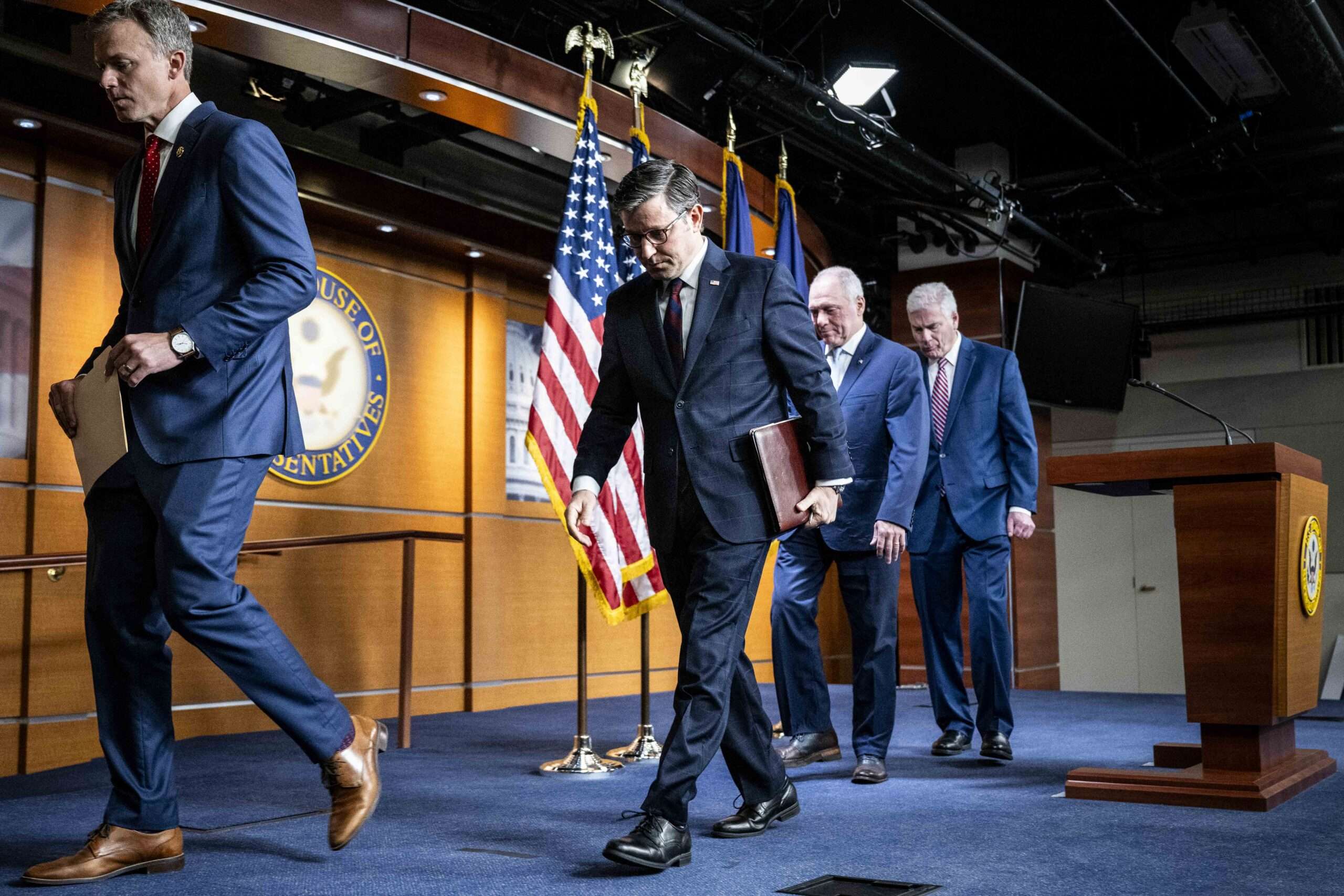
Johnson appears unable to push back against the Trump administration, even when Congress’ core duties are on the line.
Facing the obligation to defend a fundamental responsibility of Congress, Speaker Mike Johnson (R–La.) opted for what many labeled the coward’s route.
He retreated.
House Republican leaders scrapped a Thursday night vote on a measure intended to halt President Donald Trump’s confrontation with Iran.
With several Republicans ready to dissent and others missing, Politico reports, the war-powers resolution would almost certainly have passed—and that would have been true even without Rep. Thomas Massie (R–Ky.), a vocal critic of the war who had not yet come back to Washington after losing Tuesday’s primary.
With the vote canceled, the House recessed until June, thereby “avoiding a political embarrassment to President Donald Trump,” according to Politico.
Instead, Johnson is the one who should feel the sting of embarrassment.
Deciding when the United States goes to war is a power reserved solely for Congress. Even though Congress hasn’t issued a formal declaration of war since World War II, the nation’s more recent Middle East forays have at least been debated publicly, and lawmakers have granted authorization for the use of force.
That did not happen with the Iran combat operation, which the Trump administration began in February without congressional authorization. The Pentagon and White House offered a half-hearted justification, casting the action as a response to an imminent threat against American troops—but that justification is hard to square with the evidence, as Reason‘s Matthew Petti explains.
Congress has been slow to respond. But as the conflict stretches into its third month (producing little beyond disrupted supply chains and higher prices), the elected representatives are finally gathering momentum.
The Senate moved earlier in the week to advance a war-powers measure. “Until the administration provides clarity, no congressional authorization or extension can be justified,” wrote Sen. Bill Cassidy (R–La.) in a post on X after voting for the resolution.
Earlier House efforts had fallen short, but momentum appears to be turning. Polls show broad disapproval of the war, with even many Republicans turning against it.
Under the War Powers Act of 1973, presidents are given 60 days to obtain congressional authorization for ongoing hostilities. That deadline has passed. Defense Secretary Pete Hegseth has argued that the 60‑day clock does not apply because the two nations agreed to a temporary cease-fire in early April.
The resolutions now under consideration in Congress aim to enforce that limit and compel the president to withdraw American forces. In practice, they are largely symbolic since President Trump could veto such a measure if it were to pass.
All the more striking is Johnson’s alleged timidity. Why should he shield Trump from having to veto the action, when the president initiated a war without congressional authorization and should bear responsibility for it?
This pattern of timidity is not new for Johnson. It brings to mind the maneuver Johnson and his fellow House GOP leaders pulled to block votes condemning Trump’s tariffs. They altered the House rules so that a “day” on the calendar would not count as a real day, thereby undermining a statute designed to rein in executive power over trade.
Johnson seems unable to stand up to the Trump administration, even when a core constitutional duty is at stake.
With the House once again in recess until June, Trump gains a few more weeks to push forward his undeclared and illegal war—a conflict that Trump described as “very complete” as far back as March 9.
“Republicans are too scared to check executive power,” wrote Rep. Brittany Pettersen (D–Colo.) on X after Thursday’s vote was canceled. “They knew they’d lose. So instead of ending Trump’s illegal war in Iran, they killed the vote. Too weak to follow the Constitution. Too loyal to Trump to do their jobs.”
