
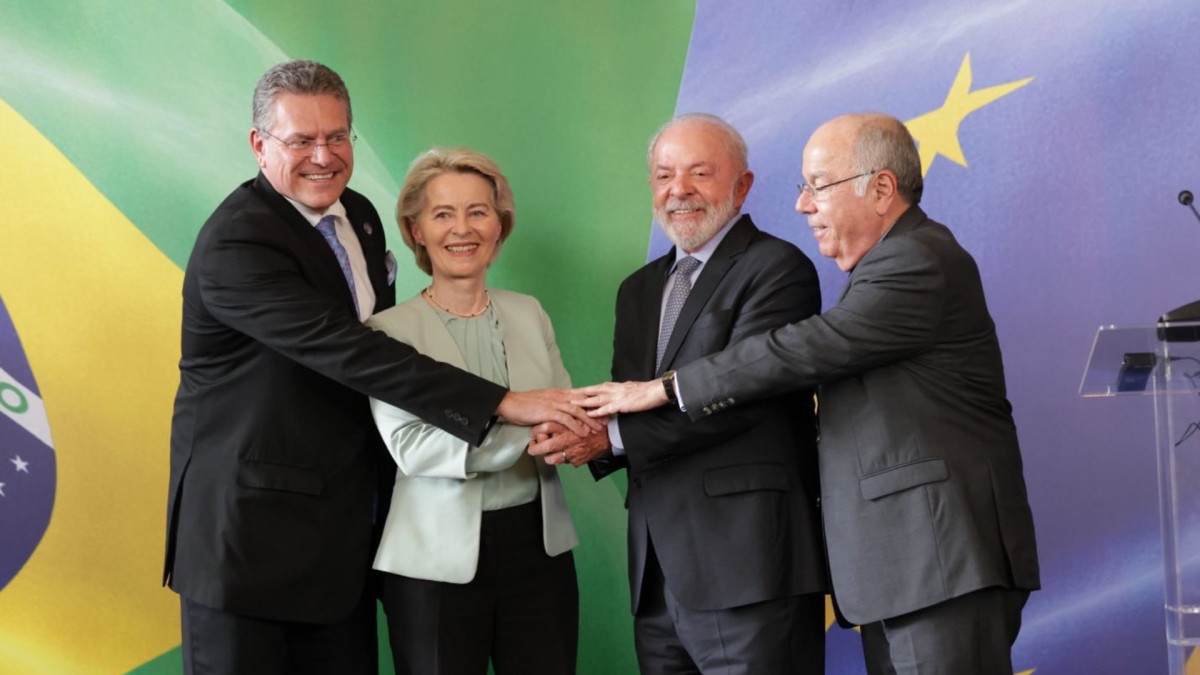
After twenty-five years of negotiation, the European Union culminates in signing the association agreement with Mercosur: Brazil, Argentina, Uruguay, and Paraguay. The length of the process is not a mere bureaucratic anecdote; it reflects the complexity of reconciling productive sensitivities, regulatory demands, and political priorities on both sides of the Atlantic. And it says something more: the scale of the decision we face. This agreement is not a technical gesture or a simple tariff treaty. It is an exercise in reaffirming sovereignty by establishing a firm framework of relations that blends gradual market opening, economic cooperation, and political dialogue.
“Global trade is fragmenting, geopolitics is cutting through the economy and supply chains have increasingly become instruments of power”
The international context in which this agreement arrives could hardly be more meaningful. Global trade is fragmenting, geopolitics traverses the economy, and supply chains have increasingly become instruments of power. At the same time, the forces of influence spheres, economic coercion, and unilateralism return with force. The reappearance, from Washington, of a contemporary reading of the Monroe Doctrine—the idea of a Western Hemisphere under tutelage—is not a rhetorical device: it is a political program. If Europe wants to remain a player rather than an object of others’ decisions, it must respond with policies and real alliances, and shed the lure of sweet subservience. In relation to Latin America, that response cannot be reduced to nostalgia, to cultural rhetoric, or to historical ties. It must be institutional, measurable, and sustained over time. EU-Mercosur is precisely that. It is, in essence, the European proposal for the region: a partnership of equals, governed by rules, offering stability and fostering cooperation. And, in political terms, the instrument that enables a leap forward in relations between Europe and South America.
The EU arrives at this point with a clear need to strengthen its strategic autonomy. Russia’s war of aggression against Ukraine and the return of Trump have permanently altered Europe’s security outlook. Global competition has hardened. And Europe has learned—often late—that economic openness without a strategy creates vulnerabilities. Geopolitical alliances, access to markets, dependability of supply chains, and the protection of the European social model are not separate debates: they are part of the same conversation about sovereignty and the capacity to act. In that frame, the Mercosur agreement takes on a dimension that goes beyond the commercial: it is also a foreign policy and economic-security decision.
It is worth recalling a basic fact: Mercosur had, until now, been the only major Latin American partner with whom the EU did not have a preferential agreement, despite a dense economic relationship. According to the latest available data, the EU-27 exports to Mercosur amount to around €55 billion in goods and €29 billion in services. The EU accounts for roughly 17% of Mercosur’s total trade. However, that relationship developed within an incomplete framework, subject to tariffs, uncertainty, and barriers that discouraged long-term investments. The agreement corrects that anomaly and brings predictability. Tariff reductions will be gradual, with long transition periods, precisely to avoid disruptions and allow adjustment. But its value lies not only in lowering exchange costs. It lies in the stability of rules, in orderly access, and in the possibility of building an economic relationship that is more oriented toward strategic objectives.
“Spain also has a differential advantage: deep knowledge of the region and a business presence accumulated over decades”
For Europe, in a moment of recurring trade frictions and protectionist temptations, opening a solid framework with a market of more than 700 million people has a direct effect: it diversifies opportunities, reduces dependencies, and offers our companies—including industrial, technological, and service sectors—more competitive access. For Spain, the agreement has particular significance. Our economy combines an exporting industrial fabric, a globally oriented services sector, and a high-quality agro-food sector. But Spain also possesses a differential advantage: deep knowledge of the region and a business presence accumulated over decades. That makes our country a natural actor to push a more ambitious bi-regional relationship. Market opening does not translate solely into more exports; it translates into more investment, deeper business cooperation, and greater capacity to build joint projects with lasting impact.
Too often the agreement is portrayed as a simple exchange: Europe sells manufactured goods and Mercosur sells raw materials. That reading is reductive and, moreover, politically misguided. The agreement offers real opportunities for Mercosur that go far beyond exporting agricultural or mineral products. Preferential access to the world’s largest integrated market, under a stable framework, creates an incentive to raise value-added, modernize processes, invest in transforming industries, and strengthen productive capacities. Europe is, by definition, a market of high standards. Access to that market demands better traceability, quality, health safeguards, innovation, and industrial capability. That effort is not a burden; it is a lever for modernization. And, in terms of employment, it means more chances to generate skilled jobs, higher industrial density, and stronger regional value chains. In short: the agreement can help Mercosur move away from a pattern of over-dependence on primary exports and counter extractive pressures with a more balanced, more industrialized model.
Another aspect worth underscoring: a partnership agreement with the European Union can also serve to strengthen Mercosur’s own institutions. In a world that tends to organize itself into large economic blocs, regional blocs endure only if they are endowed with common rules, internal coordination, and real capacity to negotiate externally. This agreement provides an incentive to reinforce the bloc’s cohesion, harmonize policies, and consolidate a regional project that has, at times, faced temptations of retreat or fragmentation. For the Mercosur countries, association with the EU is not solely about trade; it is also a chance for political and strategic consolidation.
In parallel, for Europe the agreement contributes to a goal that has become central: to ensure resilience and economic security. The European debate on strategic autonomy is no longer confined to defense or energy. It includes the capacity to sustain our industry and our green transition without excessive reliance on a few suppliers or routes. Secure access to critical raw materials and essential resources for future technologies, along with building diversified supply chains, are part of a European industrial-survival strategy. South America holds relevant resources and productive potential in this area, and the agreement provides a framework to build predictable, rule-based and cooperative relationships. It is not about promoting an extractive relationship but about constructing value chains with investment, technology transfer, and standards. That approach also aligns with Europe’s vision of partnership: shared prosperity and common rules.
“In a world where pressure and subordination reappear as a method, Europe needs to demonstrate that there is another way to exercise influence”
All of this would be incomplete without the political dimension. The EU-Mercosur agreement should not be read as a commercial treaty with a diplomatic veneer. Geopolitics is at the core. In a world where pressure and subordination reappear as a method, Europe needs to show that there is another way to exert influence: not through tutelage, but through agreements; not through impositions, but through institutions; not through blackmail, but through rules. Trump’s Monroe Doctrine for the hemisphere proposes a hierarchical relationship. Europe responds with a different offer: horizontal cooperation, respect, and institutional stability. EU-Mercosur is the main embodiment of that alternative.
In this regard, the role of Brazil is decisive. By weight in the economy, demographic heft, and diplomatic clout, Brazil is the axis of Mercosur and the actor without whom this agreement is politically viable. And within Brazil, it is hard to separate the moment of the agreement from the turn brought by the return of Lula. Under his government, Brazil has recovered an active diplomacy, with a multilateral vocation and regional leadership capabilities. It has placed Amazon protection and the energy transition as priorities, and it has re-established itself as a credible global interlocutor. That change was a necessary condition to unlock the agreement in Europe. Not out of sentiment, but out of political credibility: Europe needed a counterpart capable of sustaining commitments, integrating sustainability into the agenda, and defending an international insertion based on cooperation and rules.
Environmental sustainability has rightly been one of the central debates in recent years. After an initial agreement in 2019, the political context in Brazil at the time and the deterioration of environmental policies made progress unviable without additional instruments. The EU has worked to incorporate higher environmental safeguards than those typically found in trade agreements, combining commitments and cooperation. It is important to emphasize: the European method cannot be unilateral imposition or paternalism. South America rejects, for obvious historical reasons, any logic that sounds like neocolonial tutelage. The key lies in mechanisms that work: verifiable commitments, technical cooperation, and the right incentives. An agreement does not substitute national policies; but it creates a framework to raise standards and align interests.
In agriculture, the agreement demands rigor. Legitimate concerns exist in part of the European countryside, and they must be addressed earnestly. But the facts matter: this is not about unlimited opening. There are quotas, long transitions, European sanitary requirements, and safeguard mechanisms in case of significant disturbances. At the same time, the European agro-food sector also gains access, protection of denominations, and expansion of markets for high-quality products. European agricultural policy has committed to supporting these processes with adaptation instruments and financial backing. The strategy cannot be to deny the world; it must be to manage changes without sacrificing social cohesion.
“In a twenty-seven-member Union, complex agreements do not advance by inertia: they move forward when some governments decide to bear the political cost of defending structural decisions”
One element that should not be overlooked is the role played by Spain and Germany. This agreement would not have revived without clear European leadership. Spain, together with Germany, has been one of the engines pushing for its approval in the Council. Spain, for evident reasons: ability to interlocute, deep regional knowledge, and strategic conviction about the bi-regional link. Germany because an industrial export power needs stable frameworks and open markets governed by rules. In a twenty-seven-member Union, complex agreements do not advance by inertia: they advance when some governments decide to bear the political cost of defending structural decisions. This is an example.
EU-Mercosur thus arrives at the right moment. It is a decision that responds to economic interests, yes, but above all to political interests: European strategic autonomy, economic security, institutional strengthening of the ties with South America, and an alternative offering to the logic of spheres of influence. For Europe, it means diversifying markets, reinforcing industrial resilience, and consolidating alliances with partners with whom rules can be shared. For Mercosur, it means preferential access, investment, modernization, industrialization, and institutional cohesion.
In the world to come, influence will be exerted either by force or through well-established agreements and alliances. Europe is projecting the path it wants to follow in this crossroads with the EU-Mercosur Agreement. And now that its sovereignty is being pressured from all sides, it undertakes a firm exercise of strategic sovereignty. It is an essential starting point if Europe wants to be a relevant actor and if South America aims to strengthen its global position through development, industrialization, and cooperation. That is the opportunity. And that is, also, the responsibility.
