
I’ve spent twenty years reading Latin American elections, and few times have I seen a board as open as the one Brazil faces heading into 2026. And believe me, I’ve seen plenty: from Chávez to Milei, including half a dozen electoral upheavals that no one even imagined. But Brazil right now is something else: I’m not talking about statistical uncertainty, that’s normal a year and a half out. In this case, I’m referring to something deeper: the sense that the rules of the game have changed and no one has the complete manual yet.
The ghost that orders the game
Let’s begin with the paradox: Jair Bolsonaro cannot be a candidate, but he remains the candidate. For those who don’t follow Brazilian politics: the Superior Electoral Court disqualified him until 2030 for his attacks on the electoral system. In theory, he’s out. In practice, he is an omnipresent shadow who blesses, vetoes, and conditions every move of the right. The question isn’t whether they have a future without him, which they do, but whether that future will be built with or against his blessing.
“Thinking about Tarcísio de Freitas is thinking of someone with Isabel Díaz Ayuso’s rhetoric, but Alberto Núñez Feijóo’s manners”
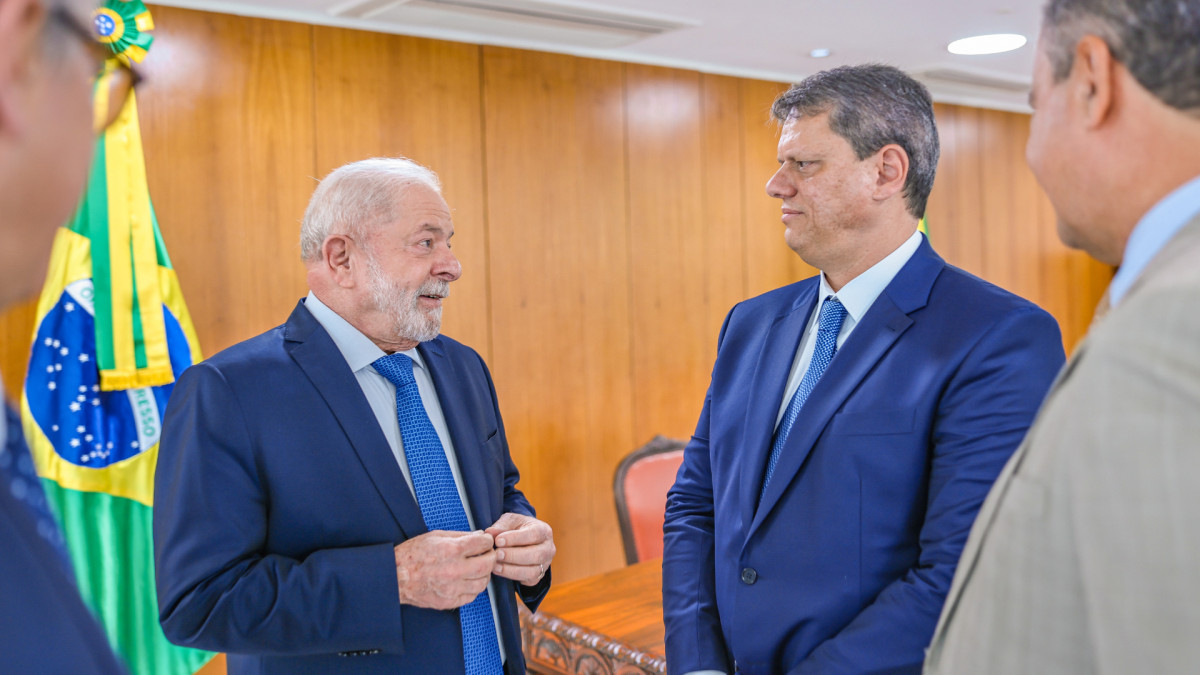
Tarcísio de Freitas is today the name with the best chance of squaring the right’s circle: inheriting the hard vote without inheriting the rejection. He is the Governor of São Paulo, an engineer, a respected manager, loyal to Bolsonaro but without his incendiary style. Think of someone with Isabel Díaz Ayuso’s speech but the manners of Alberto Núñez Feijóo. The problem is that to be a candidate he needs two things: to resign as governor before March 31 — Brazilian law requires leaving the post six months in advance — and convince Bolsonaro that a relative of his, his wife Michelle or his son Eduardo, has no more chances than he does. That conversation, I fear, won’t be easy.
If the former president imposes someone from his clan, we’ll see a campaign with a high initial transfer and even higher structural rejection. It’s the emotional bet: identity, faith, family, anti-corruption. It works to kick off at about 30%, but building to 51% from there is like climbing Everest in sandals.
Lula: the advantage of power and the limits of gratitude
On the other side, Lula has what every incumbent would want: a state machine, control of the agenda, resources, and the capacity to set the pace. At 80 years old, he seeks his fourth term — he governed from 2003 to 2010, and returned in 2023 after defeating Bolsonaro. But he faces something no machinery can buy: the end of political gratitude. Today, a Brazilian who receives Bolsa Família — the program equivalent to a basic income with two decades of history and reaching more than 20 million families — doesn’t experience it as a favor; he experiences it as a right. And if inflation, public services, or insecurity falter, the punishment at the ballot box is immediate. Lula’s successes may be the key to his vulnerability in 2026.
The post-pandemic world is cruel to leaders. No matter how much you do: if people don’t perceive that their lives are getting better, if they can’t renew the TV or if they fear returning home at night, your governance doesn’t exist. Macro data are for economists; elections are won by whoever connects with the economy as perceived. And even if it offends economists,
“The unionized worker is no longer the center of the Brazilian labor market, but the prototype is the self-employed and the gig-app rider”
That’s why I worry seeing the government still clinging to an eighties rhetoric. The unionized worker is no longer the center of Brazil’s labor market. Today’s prototype is the self-employed, the gig-app rider, the one who bills through platforms. Brazil has more than fifteen million of them. Those people don’t ask for protection of traditional unionism; they demand clear rules, accessible credit, and less red tape. If the Workers’ Party (PT) doesn’t update its narrative to reflect this Brazil, it loses.
Five keys to the election
I think there are five factors that will define this election, but there is one that matters more than the other four combined: the 10% truly swingable electorate.
Most Brazilians already know which side they’re on. Hardened Lula supporters, unwavering Bolsonaristas, market liberals, urban progressives — each tribe has its identity. But there is a segment, around 10–12%, that does not vote for ideology but for rejection. They are urban, university-educated, socially liberal, pragmatically minded economically. They live in the capitals and especially in Minas Gerais, the quintessential swing state (somewhat like Castilla-La Mancha or Aragon in Spain, but with twenty-one million inhabitants). And they decide in runoffs.
These people don’t ask “which politician do I like more?” but “which politician do I fear least?”. The winner is the one who lowers their level of rejection in that group, not the one who excites his base the most. That’s why tone matters: a Tarcísio who pacifies and builds bridges wins; an Eduardo Bolsonaro who inflames social networks loses. A Lula who speaks of stability wins; a Lula who only sells the ability to bargain in Brasília loses.
The other four levers are important, but subordinate to the above:
- Perceived economy: inflation is down, but can the family spend? That is the true barometer.
- Public security: it ceased to be a governors’ issue. It went national. And the narrative “police detain and judges release” sinks in Brazil the way it has in Spain. The government needs credible federal security policies and to stop offloading that responsibility to the governors, otherwise the one who shapes the security narrative will win in one of the campaign’s most important frames.
- Evangelicals and new workers: Brazil has more than 65 million evangelicals — nearly a third of the population, more than all of Spain. They aren’t right-wing by dogma, but they are more conservative in values and more entrepreneurial in practice. Talking to them from classic statism is a loss.
- Digital communication: TikTok is no longer the future; it is the present. And anyone who doesn’t understand that a fifty-minute speech must be crafted with thirty-second cuts in mind won’t arrive on time
Two possible paths
After all this analysis, I see two scenarios with higher odds than the rest:
- Lula against Tarcísio is the most probable if Bolsonarism does not impose someone from the clan. It would be a contest of project versus governance, of a present-state against an efficient state. It’s competitive, without crazy turns. The tone and the cross-rejection define it.
- The alternative, Lula against the Bolsonaro clan (Michelle or Eduardo), is pure identity. High initial transfer, a low ceiling in the runoff. It works if they manage to disengage from hate and open to the center without losing mystique. Hard, but not impossible.
On the other hand, there were doubts until the last moment around Lula’s leadership on the left. It was thought that age and proposing a renewal project could push toward another candidate. Although the rumors were never very strong, some media talked of Fernando Haddad, the economy minister and former mayor of São Paulo. Nevertheless, Lula has confirmed from Malaysia his willingness to again run for the PT. If he wins, he would begin that fourth term at 81.
The Centrão: the last laugh
Here we must explain this political space that has no parallel in Spain. The “Centrão” isn’t a party nor an ideology: it’s an informal block of pragmatic parties, without a clear ideological definition, that controls the Brazilian Congress and negotiates with whoever governs. Think of a stable coalition of formations, each with territorial muscle, acting as arbiters of governance. They bear exotic names: PSD (Social Democratic Party), PP (Progressistas), União Brasil, Republicanos… Together they total around 300 of the 513 deputies.
“The president proposes, but without the Centrão there is nothing to push forward in Congress: neither budgets, nor reforms, nor appointments”
No matter who governs, the film unfolds in Congress. Brazil has semi-parliamentarized de facto: the president proposes, but without the Centrão there is nothing. No budgets, no reforms, no appointments. That conditions the campaign in two ways. Coalitions are measured by real legislative reach, not by enthusiasm on social media. On the other hand, promising “total war” against the system pays off on Twitter, but at the Palácio do Planalto, the seat of Government, it comes with costs.
If I had to bet today, I’d say: Lula vs. Tarcísio, tight, with a slight Lula advantage thanks to machinery and timing. But with two conditions: that the government connects perceived economy with security symbols, and that Tarcísio achieves real autonomy from Bolsonaro.
Brazil won’t vote out of love in 2026. It will vote to prevent risk. Whoever reduces their rejection in the swing 10% will win, and offer a purpose that links economy and security without sterile quarrels.
In a country where TikTok sets the tempo, it’s not the one who talks the most who wins, but the one whose story others tell for him. That, in essence, is the coming election. And believe me: no one yet has the full formula.
