
Slowly, with pauses, Europe continues advancing toward a higher level of integration driven by three factors that have awakened it from its slumber: the loss of competitiveness and productivity compared to China and the United States; the roadmaps laid out by Mario Draghi and Enrico Letta; and the existential threat posed by the bloc’s weak geoeconomic security.
“The proposal, which if all goes well could be implemented as early as 2028, works on designing a common framework for the formation of companies in the EU”
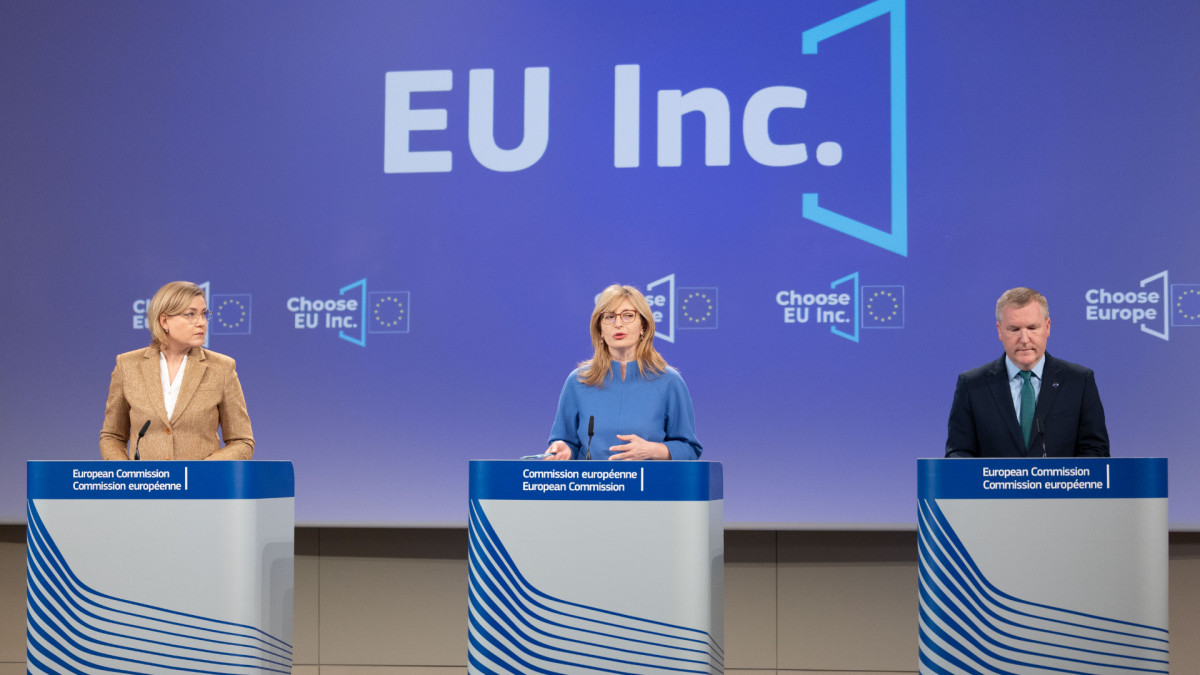
At last the European Parliament has received the regulation text to design a common corporate regime across the Union, which was initially dubbed the 28 regime and has now taken on the far more alluring name EU Inc. The proposal, which if all goes well could be applied by 2028, seeks to design a common framework for the incorporation of companies in the EU, breaking the current fragmentation —which is one of the main invisible internal barriers— through a virtual regime or zero regime in which a company can be registered digitally, in 48 hours and at a minimum cost. A Spanish company, for instance, that wants to expand into other European countries would no longer need to create local subsidiaries with their cumbersome processes. It could resort to this common vehicle to operate. The notion of the notary is also eliminated, with its additional costs, something that has sparked controversy.
The idea is central to Letta’s proposal to build more Europe and is also reflected in the Draghi Report, which is about to reach two years with a minimal degree of implementation. The Club of Exporters says that so far only 15% of its proposals have been fulfilled. The inspiration is the Delaware model, a distinctive regime of the American state that makes it possible to set up a company almost instantaneously, at no cost and within a highly predictable, simple and stable legal framework, with dedicated chambers for rapid dispute resolution; it attracts thousands of investors each year. The famous legal certainty.
“There is a need to clarify in the text the delimitation between regulation and national legislation to achieve the fundamental promise: cross-border legal certainty”
The text, which will be steered by German Social Democrat René Repasi, is watered down relative to the European Commission’s initial idea and quite vague when compared with Letta’s ambition. The former Italian prime minister dreams in his letter of a common Commercial Law Code, in the Delaware style, which has remained on the drawing board. And although there would be a single corporate shell, the court in which the registered office of each company is located would resolve the dispute. The text recommends the creation of specific chambers to resolve disputes in these legal forms, but stops short of that suggestion. There is a need to clarify in the text the delimitation between regulation and national legislation to achieve the fundamental promise: cross-border legal certainty. It is not improbable that this matter will undergo adjustments in the parliamentary process. The proposal also fails to recognize a common taxation system, a kind of sovereignty fence that capitals do not want to relinquish. And it marks the principle of shared equality between taxpayers and companies.
The consensus among experts is that the proposal that has reached Parliament is an undeniable advance over the previous situation, it flexibilizes, speeds up and reduces the cost of the preexisting framework and could be highly advantageous for startups seeking to grow —in financial jargon, scale—, for which the new regime is somehow tailor-made, although its final formulation, especially regarding the use of financial instruments, is susceptible to improvement, as this very technical article by three renowned European jurists notes.
The need for this common regime stems from the fact that many European entrepreneurial firms migrate to the United States when they must enter a funding phase to grow, since they have much easier access to financing instruments. The fragmented European market makes it difficult to raise a common capital that would enable that funding for the organic growth of companies. The new legal form allows the use of conversion instruments such as SAFE and KISS, widely used for startup financing. SAFE (Simple Agreement for Future Equity, or simple agreement for future equity) aims to allow early-stage startups to raise money from investors quickly, cheaply and simply, through conversion into equity. Since it is not a loan, there are no interests or maturity date. If the company goes bankrupt, the investor loses the value of the shares. KISS (Keep It Simple Security) is a very similar instrument that also seeks to simplify seed investments, sometimes including an interest rate or maturity date that SAFE does not have. Until now, signing a US SAFE in a European startup was a legal headache because local law did not recognize the “conversion of future equity” without going through cumbersome shareholder agreements and costly notarial deeds. EU Inc. resolves this by legally validating the functioning of the SAFE.
But there is also a consensus that the initiative falls short and does not resolve fundamental problems in European regulatory fragmentation, such as the Commercial Code, but above all, workers’ rights, which would be local in a pan-European-formed company.
“The coexistence of a common regime with twenty-seven different labor regimes will create tension between the corporate framework and the labor framework”
This is one of the main fears of the unions, which, although they applaud the decision of a common regime, point to the dangers of it not being accompanied by a jointly shared social pillar. The head of Studies and Discourse at the CCOO union, Carlos Gutiérrez, notes that the coexistence of a common regime with twenty-seven labor regimes “will create tension between the corporate framework and the labor framework”. Gutiérrez supports EU Inc., but laments that, lacking shared labor rights and its corresponding fiscal union, it would serve as a playing field for certain companies to exploit the most advantageous aspects of each country, and there would be a sort of social dumping. It is presumed that Eastern European countries, with lower wages and a less solid body of labor rights, would benefit from this initiative and some relocation would occur. “We want more Europe,” says Gutiérrez, but built in a paced, harmonized manner.
To the incongruity of free movement of people and goods, but not of capital, is now added a common corporate vehicle sustained in a fragmented way by two of the most relevant factors for a business: talent management and taxation. Given that the EU has its enemies at home and internal barriers are the main brake, any progress toward integration is welcome, even though we must not turn a blind eye to the fact that local nationalism continues to limit the European dream’s ambition.
