
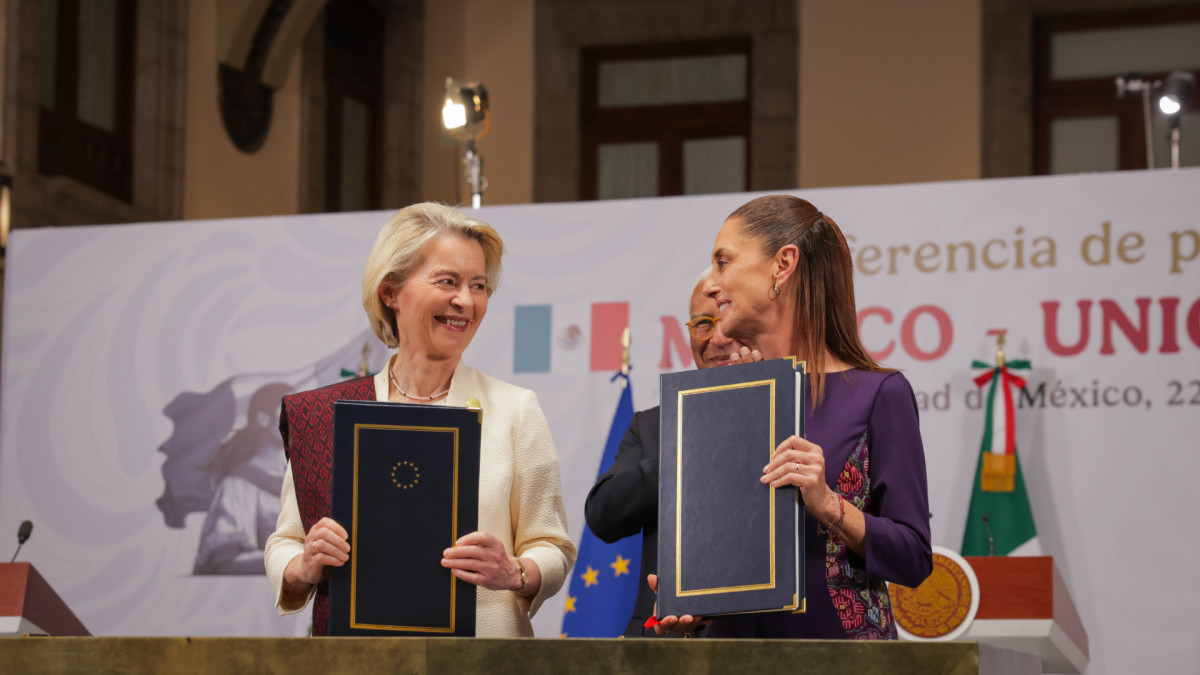
Eleven years ago, in a Brussels room, the European Union and Mexico looked at each other as if trying to decipher themselves in a foreign mirror: with curiosity and care; with intention, but also with distance. Since then, the relationship has been woven through threads of tariffs, promises of cooperation and speeches about promising futures. It has been a path with peaks of closeness, as well as long periods of distance. But today, after more than a decade of cordiality distant, Ursula von der Leyen, Claudia Sheinbaum, António Costa and Antonio López-Istúriz sealed, on paper and ink, the will of both regions to lay down new bridges in view of the convulsed geopolitical map of the current moment.
In 2015, as is logical between two commercial powers of such magnitude, tariffs were the first frontier that was attempted to be dismantled. Europe sought to carve out a larger space in Mexico (and it did so, especially through companies in sectors such as agro-industrial and automotive. It is worth noting that more than 11,000 European companies operate in Mexico and generate more than five million direct jobs, according to data from the European Commission); and Mexico, with many more challenges, sought to diversify its export portfolio beyond its American shadow. At that time, talks spoke of quotas, of preferential access, of how trade relations functioned as the key to opening the relationship toward less asymmetrical paths.
But beyond good intentions and ceremonial diplomatic rhetoric, there were figures that forced Europeans and Mexicans to negotiate in the realm of reality: both were compelled to ask themselves whether they could (economically speaking) trust the other, and whether the exchange of goods could be the bold bet for a relationship that would hardly be a priority for either side. They were, indeed, very different times: Mexico was beginning to see how the promising project of Enrique Peña Nieto (now residing in Spain) crumbled to its foundations; and the European Union showed, like never before, the cracks and the inequalities not overcome since the devastating economic crisis of 2008.
“Years passed and, during the six years of Andrés Manuel López Obrador’s government, Mexico’s relationship with Europe never had priority on its agenda”
Security then appeared on the agenda. It arrived as a reminder that the world is not reduced to containers and treaties. Mexico offered cooperation in the fight against organized crime, while Europe proposed technical support and funding. That led to diplomacy: embassies increasing meetings on their agendas, statements supporting the idea of “strategic partners”. However, the reality remained more pragmatic than romantic. The years passed and, during the six years of López Obrador’s government —marked by radical transformations in the Mexican political system— Mexico’s relationship with Europe never had priority on its agenda. Quite the opposite.
But today history is different. On May 22, in the Mexican capital, the European Union delegation and Claudia Sheinbaum did something more than sit at the table with open agendas: they celebrated the eighth summit between both parties, looked each other in the eye and signed a historic agreement that not only reconstitutes the relations between the twenty-seven and the Aztec country, but opens a new path of cooperation, of trade and of vision with shared values, in the face of a changing, convulsed and frenetic political panorama constantly stirred by the Trump Administration. Now, what are the keys to this agreement? What does (technically) the signing of that document mean in the process of commercial linkage and cooperation? And, above all, given the agitated and so changing global geopolitical scenario, what does the modernization and strengthening of the transatlantic alliance represent?
The keys to an agreement that reconstitutes Atlantic relations
Navigating the European Union’s X account, it is possible to find dozens of exalted posts about cooperation. “Europol and Mexican law enforcement are intensifying cooperation against organized crime”… “The Secretary of Economy, Marcelo Ebrard, and the European Commissioner for Trade and Economic Security, Maroš Šefčovič, inaugurated the Mexico-European Union Business Summit, heading toward the signing of the Modernized Global Agreement Mexico-EU”, and, thus, ad infinitum. Also, of course, videos and photos of the meeting between Ursula von der Leyen and a Mexican delegation of Indigenous women at the Anthropology Museum (one of the most important within the city with the most museums in the world), which highlight the importance of gender policies on both Atlantic shores.
However, aside from the good intentions and the polished diplomatic protocol of pre-signing activities, it is necessary to delve into the technical details of that agreement. Thanks to a document to which Agenda Pública has had access, via the European Parliament’s delegation for relations between the European Union and Mexico, the modernization of this document is “a new-generation association agreement between the European Union and Mexico that modernizes the Global Agreement in force since 2000”. In other words, this is not merely a trade treaty, but a comprehensive agreement that combines and integrates three pillars: the political, the cooperation and the commercial.
On the first pillar, the topics included are political dialogue, democracy and the rule of law (as priority elements), human rights and security, as well as international cooperation. The second refers to more specific topics, such as the energy transition (a key point for both sides and forming a strategic alliance in the face of the United States’ new energy policies), as well as the environment and climate change, in addition to technological innovation. Finally, the third pillar deals with tariff elimination (a complex topic, in which progress has only been made in the first phase, i.e., solving this item still has ahead future procedural steps), investment, public procurement and digital trade.
“The main legal innovation of the document between the EU and Mexico is the ‘split’ model, which divides the treaty into two parts to accelerate its application”
On the other hand, what is the novelty in this version of the agreement? The main legal innovation of the document between the EU and Mexico is the split model, split, which divides the treaty into two parts to accelerate its application. On one side, there is the Interim Trade Agreement, limited to matters of exclusive EU competence, such as trade, services and public procurement, which only requires approval from the Council and the European Parliament. On the other side, we have the Modernized Global Agreement, of mixed character, which includes political cooperation and institutional dialogue, and which does require ratification in national parliaments. Thus, the commercial part can come into force quickly, while the more complex political validation process is completed.
What to expect after signing?
First, it should be noted that negotiations for the modernization of this agreement began in 2016. Two years later, there was a principle of agreement and, practically, the technical details were not closed until 2020. Nevertheless, the final political conclusion was announced in January 2025, just as the global map again viewed protectionism as the first defense and in the face of the escalation of tariff threats from the newly installed United States administration.
Now, answering the question of the subtitle and referring to the European Parliament’s document, the signing does not equal entry into force of the agreement. Legally, the signing means the following: the authentication of the text, that is, it is officially established; it represents a formal commitment, in which both sides have expressed the will to comply with what is laid out in the document; and, finally, the activation of the approval processes, meaning that the ratification phase formally begins.
So, when will it come into effect? There are four steps to follow. First, the Council of the European Union must approve the text (a 55% majority, equivalent to fifteen member states out of twenty-seven — i.e., at least 65% of the Union’s population). Then, the European Parliament must give its consent. Third, the member states must complete their ratifications. And, fourth, Mexico will have to complete its internal processes for putting the agreement into operation.
“The good news would be, in any case, for the parties involved in the commercial matters, since the progress there rests with the Parliament and the Council”
In short, and as EU Parliament sources told this outlet, “the signing represents a historic step, but it is not the end of the road.” The good news would be, in any case, for the parties involved in the commercial matters, since the advances there rest with the Parliament and the Council. The challenge lies in the political stretch that each of the involved states will have to undertake in the rest of the process. And major agreements need to live up to the demands of great democracies, and that takes time.
Finally, it should be stressed that, in addition to building new commercial avenues for more promising horizons of economy, strengthening cooperation in security in the face of global criminal threats, and forging strategic alliances grounded in shared values, this new version of the agreement between the European Union and Mexico represents a new counterweight to the tariff dominance of the Trump Administration.
