
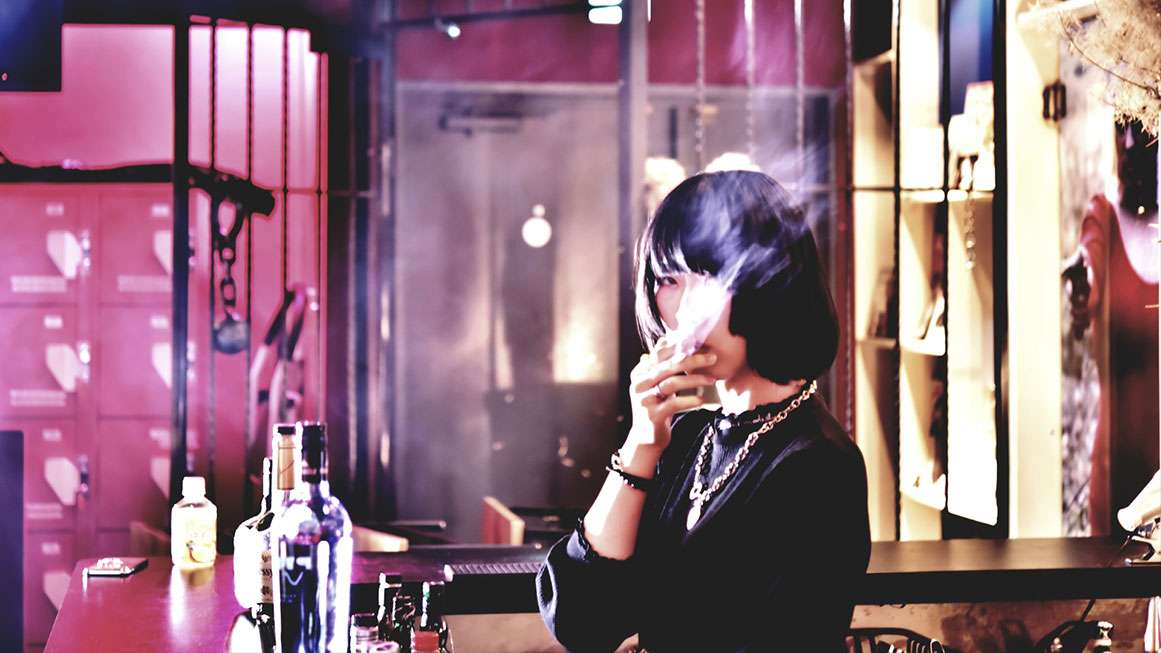
Owners of small dining spots and neighborhood bars hold the power to permit or ban smoking, while patrons decide for themselves whether to frequent them.
Step into three Tokyo bars, and you may encounter three distinctly different atmospheres: a venue thick with tobacco haze, a corner featuring a sealed glass smoking room quietly buzzing, and a place that is completely smoke-free.
Within the framework of regulations, the decision often rests with both the proprietor and the guest: owners determine the type of space they want to operate, and customers pick the setting they prefer. This contrasts with much of the United States, where indoor smoking is broadly prohibited by state or local laws. Approximately 82.4 percent of Americans live under fully smoke-free rules in workplaces, restaurants, and bars, effectively taking the choice out of the market.
Like many other nations, Japan subjects smoking to strict regulation. The 2020 revision of the Health Promotion Act introduced major limits on indoor smoking in public places such as parks, government buildings, hospitals, and most workplaces.
In many Japanese cities, smoking in public streets is also restricted. You can’t simply light up while standing outside or strolling along sidewalks. Instead, smokers must use designated points—compact smoking stations separated by glass or plastic partitions and equipped with ashtrays. Lighting up outside these zones can result in fines of up to 300,000 yen ($1,890).
At first glance, Japan’s system might seem stricter than the rules in the U.S., where indoor smoking is banned but outdoor smoking is generally tolerated. Yet Japan’s laws leave surprising room for flexibility, particularly within private venues such as bars and restaurants.
Article 25 of the Health Promotion Act does not simply mandate that every public venue be entirely smoke-free. Instead, it urges businesses to adopt “appropriate passive smoking prevention measures.” In practice, this leaves space for several exceptions.
One of the most important is the small-business exception. Restaurants and bars with a floor area of 100 square meters or less—the footprint of many neighborhood bars in Tokyo—may permit indoor smoking as long as a sign at the entrance states that smoking is allowed. Small businesses with no employees can also permit smoking.
That matters because small, owner-operated establishments are very common in Japan. Many bars consist of a counter, a handful of stools, and a single person running the entire operation. For some of these venues, the ability to smoke while drinking or eating is part of their appeal.
“I personally don’t enjoy smoking indoors, but at our bar there are definitely customers who view smoking at the counter as an essential part of the bar experience,” says Keith Tanaka, who runs a bar in Roppongi. “At the same time, we know that other guests are uneasy with smoke, so finding the right balance is never easy.”
Since “smoking on the street is also restricted,” Tanaka adds, customers who cannot smoke inside “often have to step out for a small designated smoking area, which can lower satisfaction and disrupt the flow of the experience. In practice, we do everything we can to manage the environment responsibly. We run strong ventilation, use several air circulators and air purifiers, and even operate large humidifiers because the air becomes too dry. That is the reality of trying to balance comfort, culture, and day-to-day bar operations.”
When venues are larger or employ staff, smoking is generally banned throughout the space. Yet owners may install designated smoking rooms that meet ventilation and sealing requirements. Anyone who has spent time in Tokyo’s nightlife districts has likely seen them: glass-walled rooms tucked into a corner of a restaurant or bar where customers can sit, drink, and order food while smoking.
Physical spaces aren’t the only way Japanese regulations address smoking. The rules also differentiate between cigarettes and newer tobacco products such as Philip Morris’s IQOS or Japan Tobacco’s Ploom. Because these products heat tobacco rather than burn it, regulators regard them as less intrusive and treat them differently from traditional cigarettes. As a result, some venues that prohibit regular cigarettes still permit heated tobacco products.
All of this can feel complex, but the underlying pattern is straightforward: Within the legal framework, owners can still shape the ambiance of their establishments.
During a recent visit to Tokyo, I asked a friend who owns a small bar why his venue allows some forms of smoking but not others. His answer was simple: he allows heated tobacco products because that’s what he smokes.
For customers, choosing a bar in Tokyo often means selecting an environment as well. Someone who dislikes cigarette smoke can avoid it, while someone who enjoys smoking with a drink can seek out places where that is permitted.
Japan once leaned more toward consumer choice than it does today. Before the 2020 restrictions, smoking inside restaurants and bars was far more common. Today’s patchwork of exemptions and designated spaces is, in many respects, a relic of that earlier system.
That remnant still offers something intriguing. In Tokyo, the air inside a bar is not determined entirely by government regulators. Sometimes it is the choice of the person behind the counter and the people who choose to walk through the door.
