
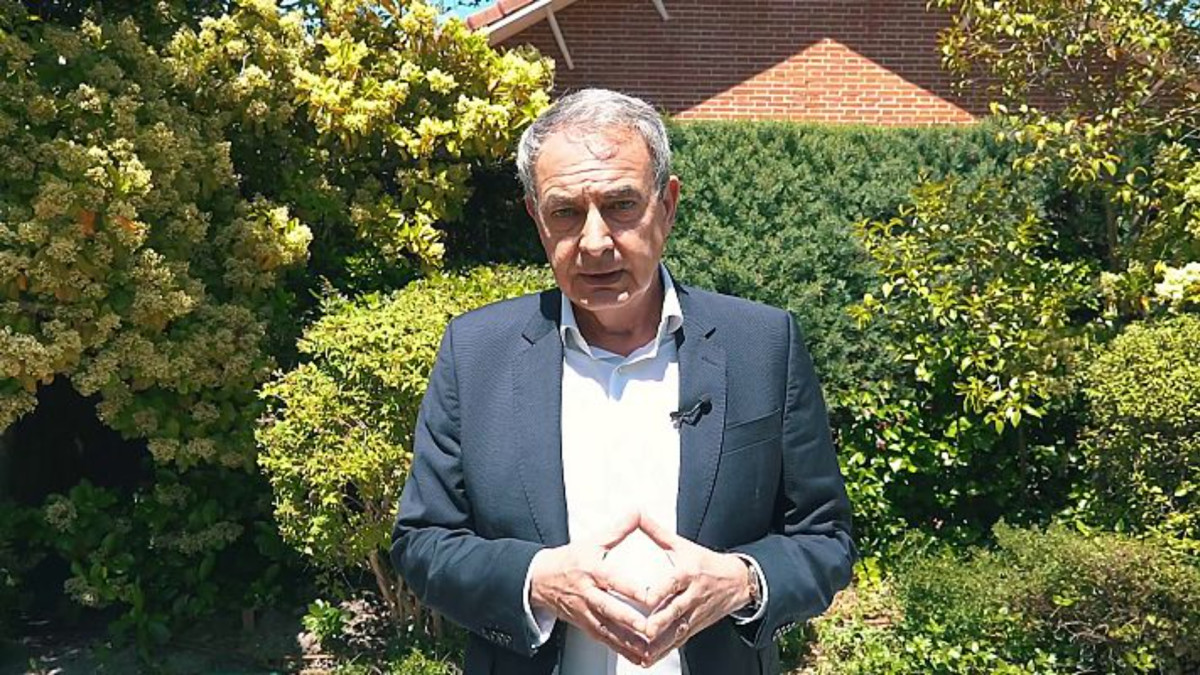
Last week we learned of the summons for the former Spanish Prime Minister José Luis Rodríguez Zapatero to appear as an investigated party by the judge of the Audiencia Nacional, José Luis Calama, as well as the ordering of various investigative diligences, including the search of his office as a former president and the seizure of telecommunication and computer devices, documents, etc.
The significance of the case and Zapatero’s political weight, along with the fact that this is the first time in our democracy that a former head of government is formally declared as investigated, have caused a political earthquake and have made the case dominate the news across all media outlets.
For this reason, after several days since the judicial resolution by Judge Calama became public, it is prudent to undertake a calm analysis of the order in question. It has been emphasized in this regard that it is a reasoned decision, developed over 84 pages, in which many details of the investigation are offered that would justify adopting a measure of such a high public impact.
“If there is suspicion of a citizen’s possible involvement in the commission of a crime, the appropriate course of action is to take his statement”
However, the first thing to say is that, from a procedural standpoint, the summons to declare as investigated is only a first step, conceived as a guarantee for the citizen. If there is suspicion of a citizen’s possible involvement in the commission of a crime, the proper course is to take a statement, giving him the opportunity to offer his version of the facts or, simply, to deny the alleged acts. And, for that, it is essential that he have the assistance of a lawyer, who can also advise him to exercise his right to silence.
It is evident the political impact of calling a former head of government to appear as investigated for serious offenses. Yet it is worth clearly explaining to the public that what would be irregular is to summon him to testify as a witness (as we have seen in other politically sensitive cases), without respecting the proper safeguards of defense, to declare him investigated (the term used to be “accused”) immediately thereafter.
Thus, a first comment warranted by Judge Calama’s order is that for a decision of this type robust evidentiary support is not strictly necessary in principle, but rather only a well-founded suspicion of the commission of a crime, which could be confirmed or not in light of the diligences of investigation that will be agreed upon in the case file.
To properly safeguard the rights of those investigated, it is advisable to formally declare them as such as soon as possible, making them formally part of the procedure and guaranteeing their right to legal assistance. One could say, then, that this declaration is not an act adopted “against” the investigated person, but a guarantee for them. For that reason, among others, the threshold of evidentiary sufficiency to adopt it cannot be very high either.
“The lower the level of evidentiary requirement needed to issue a resolution, the greater the care must be in not holding as proven facts that which is far from being proven”
Now, it is also worth asking whether the wording of the order drafted by the judge aligns with that very early stage of the investigation, in which important investigative diligences remain to be carried out and there is barely a chance to defend oneself, even before the defense has access to the dossier, which remains secret. The language here takes on crucial importance: the lower the level of evidentiary standard required to issue a resolution, the greater the caution needed to avoid asserting facts that are far from proven. And even more so when we face a case of such public importance as the present, because the damage inflicted can be much greater.
As mentioned, the order runs to 84 pages, many of which are unnecessary due to repetition or due to an lengthy and not particularly useful doctrinal digression about the crime. By contrast, allow me to mention a revealing datum offered by Professor Íñigo Ortiz de Urbina within the framework of the International Prize for Legal Culture, which we awarded last week in Girona to Luigi Ferrajoli and Perfecto Andrés Ibáñez. Ortiz de Urbina presented an empirical study on the opinions in which Perfecto Andrés served as rapporteur during his sixteen years on the Supreme Court. One finding of that study is significant here: the average length of the 1,347 judgments issued by Perfecto Andrés was five pages. More writing does not necessarily mean more motivation: an unnecessarily lengthy judicial decision can even cloak, beneath its rhetoric and length, a lack of foundation.
With this I do not intend to suggest that Zapatero’s indictment lacks substance, because I have already explained that, contrary to what is often thought and the image commonly presented by the media, that declaration, in pure terms, has a protective procedural meaning for the guarantees of the investigated. Yes, however, certain assertions that are repeated again and again in the order by the judge are problematic both evidentially and from the perspective of the presumption of innocence. Let us examine them:
The crimes investigated, according to the judicial resolution, are those of belonging to a criminal organization, influence peddling, misappropriation, falsification of documents, and money laundering. In that framework, the judge Calama states:
“The diligences of investigation carried out to date, in light of the analysis that follows, permit us to affirm the existence of an organized and stable structure, directed by José Luis Rodríguez Zapatero, aimed at the illicit exercise of influence before national and foreign authorities, as well as at obtaining administrative resolutions and economic advantages in favor of third parties”.
“The indications collected show that the clients of the network — among them administrators of companies such as Plus Ultra, Inteligencia Prospectiva or Sofgestor — paid substantial amounts for nonexistent advisory services, with the funds then redistributed to the circle around José Luis Rodríguez Zapatero and Julio Martínez Martínez”.
“In short, the investigation has identified a scheme of influence-peddling led by José Luis Rodríguez Zapatero, which uses shell companies, simulated documents and opaque financial channels to exert illicit influence, conceal the origin and destination of funds, and obtain economic benefits for third parties and for the network itself”. (All italics added).
Faced with such definitive statements, at least three questions are worth asking: 1) whether they are supported by the available evidence (many prefer to call them indicios) up to now; 2) whether they are necessary to ground Zapatero’s declaration as investigated, and 3) whether they are compatible with the presumption of innocence as a procedural rule.
First. The conclusion that can be drawn from a careful reading of Judge Calama’s order is clearly negative regarding the evidentiary basis of his conclusions (hasty, I would say): there is no message, conversation, or intervened document placing Rodríguez Zapatero at the apex of a criminal organization dedicated to influence peddling and money laundering; the advisory services for which invoicing occurred are not identified, nor on what basis such a claim is made; the concrete actions that would have been carried out personally by Mr. Zapatero or on his behalf, or before which authorities, nor the reason for the illicit nature of those actions; it does not specify which portion of the amounts charged to Mr. Zapatero correspond to supposedly nonexistent advisory services, to conferences, or to other public acts, etc.
Second. It is clear that it is not required to prove the facts with that level of detail before calling a citizen to declare as investigated, but it is necessary to make conclusive statements as forceful as those in the order we have seen. Therefore, pending what the dossier and subsequent investigations may reveal, one can say that those expressions, which have occupied headlines in national and international press, have no basis in the order and are unnecessary to support a resolution like the one adopted.
“They seem like phrases written more to provide newspaper headlines than to ground a judicial ruling as preliminary as declaring a citizen as investigated”
On the other hand, it is evident that such expressions were bound to have a high political and media impact. In fact, if you allow me, they seem like phrases written more to generate headlines than to ground a judicial resolution as preliminary as declaring a citizen as investigated. For the latter, it would have sufficed to say that it is being investigated whether the advisories for which invoicing occurred existed, what the nature of the actions before authorities was, who carried them out, and what was Zapatero’s role in all this. Clearly, the political impact would have been different, the damage to Zapatero’s reputation as well, while not diminishing the legal basis at this investigative stage.
Third. And here lies the final question: is it compatible with the right to the presumption of innocence to attribute so explicitly and directly, almost conclusively, a set of crimes to a citizen in a very early stage of the criminal procedure? The answer can be found in the jurisprudence of the Constitutional Court, the European Court of Human Rights, and the Court of Justice of the European Union on the interpretation of the Spanish Constitution, the Charter of Fundamental Rights of the European Union, and Directive 2016/343 of the European Union on the presumption of innocence.
To avoid enlarging this article unnecessarily, it is enough to cite here what the Court of Justice of the European Union stated in a very recent ruling (ECJ, April 30, 2026, case C-748/24). In the case that gave rise to that ruling, a Slovak court had attributed to the investigated citizen the commission of the offense in a preliminary judicial decision, still during the investigation and thus before the criminal trial. In its judgment, the Court recalls that:
“The principle of the presumption of innocence is violated if a judicial resolution or an official statement relating to an accused contains a clear declaration, made without a final conviction, according to which the person has committed the offense in question” (in the same sense, see the European Court of Human Rights’ ruling in Karaman v. Germany).
Moreover, “such a violation of the presumption can occur even in the absence of a formal declaration of guilt, since a motivation that allows thinking that a judge regards the interested party as guilty suffices to infringe that presumption” (see likewise the European Court of Human Rights’ rulings in Rigolio v. Italy, 8 March 2023, and Matijasevic v. Serbia, 19 December 2006).
“Our judges should be very careful with rights and avoid inflicting unjustified personal and political damage at such an early stage of the investigation”
To conclude, the answers to the three questions posed should not leave us indifferent: 1) the attribution of the crimes charged to Rodríguez Zapatero does not have sufficient support in the evidence described in the order itself; 2) it is unnecessary to ground the resolution by which he is summoned to declare as investigated; and 3) it violates the right to the presumption of innocence. Nothing prevents the progress of the investigations from proving the crimes investigated and the corresponding authorship, but our judges should be very careful with rights and avoid causing unjustified personal and political damages at such an early stage of the investigation. The quality of our democracy and of public debate also needs it. But this has not been minimally respected by Judge Calama’s order.
