
The four electoral calls held between December 2025 and May 2026 in Extremadura, Aragon, Castile and León, and Andalusia collectively form a map of political trends that transcends the electoral arena and shapes the geometry of territorial power in Spain.
Understanding these moves before they crystallize is precisely what allows anticipating the political and institutional scenarios that will determine the conditions of governability in the coming years. In that sense, in the latest report by Silván&Miracle, we step back to get the full picture of the political effects that this sequence of elections will have.
The right consolidates a base that was once socialist
The four electoral calls held in the four communities —together accounting for more than 27% of the Spanish population— deserve a joint reading. The results point to the consolidation of right-wing forces at the regional level, though with differentiated dynamics by territory. In Extremadura and Andalusia, a trend toward the electorate leaning to the right is confirmed; in Aragon and Castile and León, however, what is observed is the consolidation of a conservative majority that had already reached that level in previous elections.
“In all these communities the percentage of voters who supported a party from the right bloc exceeded 50%”
The role of Vox, however, has not been the same across all four territories. In Extremadura and Aragon, its growth has proven decisive to expand the conservative bloc, while in Andalusia that shift had already occurred in 2022. In any case, in all these communities the percentage of voters backing a party from the right bloc exceeded 50%.
What makes this cycle especially significant is that we are not talking about territories historically conservative. Extremadura and Andalusia were for decades the backbone of Spanish socialism, with social bases deeply rooted on the left. That map has changed in what appears to be a stable way is one of the most revealing political facts of recent regional politics and one of the factors that will most condition the scenarios ahead of the 2027 general elections.
The Alternative Left: laboratory of alliances
The other major development of this electoral cycle is the recognition of the weakness of the left’s alternative parties. Since the rupture of the Podemos-Sumar coalition, the space has fragmented and its electoral payoff has been seriously questioned. Movements and conversations have emerged seeking convergence, with an eye on slowing the rise of the radical right and maintaining influence in hypothetical coalition governments with the PSOE at the national level.
“Unity therefore appears as a necessary but not sufficient condition to slow the erosion of the space”
The results of this cycle offer a nuanced reading. Where a joint candidacy was articulated —the Extremadura case, in a context of a strong decline of the PSOE— the confluence translated into a notable result. In the rest of the territories, where there was no agreement, the dispersion of the vote resulted in an evident loss of representation. In any case, the diagnosis does not end with fragmentation. Even in scenarios of unified candidacies, the effects of the electoral system and the very weakness of the alternative progressive vote point to a ceiling hard to overcome. Unity therefore appears as a necessary but not sufficient condition to slow the erosion of the space.
What recent elections indicate, especially those in Andalusia and Aragon, is that the key to the survival of the alternative left may lie in territorial rooting. The results of the Chunta Aragonesista and Adelante Andalucía suggest that forces with a distinct identity and ties to the territorial agenda are the ones that resist best. Experiences such as Compromís in Valencia, Más Madrid, the BNG in Galicia or EH Bildu in the Basque Country confirm that territorial implantation is a structural condition for consolidating a stable electoral base on the left. This fragmentation of regional forces also has a significant political effect: it makes Pedro Sánchez the only national leader of the left bloc with real capacity to compete in the next general elections.
The campaigns go national and Vox takes advantage
One of the most evident features of this electoral cycle has been the nationalization of regional campaigns. Although they were formally regional elections, the public debate consistently shifted toward the national agenda and actors: the confrontation between the Government and the opposition, negotiations with parliamentary partners, or statements by national leaders systematically eclipsed the proposals of a regional scope.
“The nationalization of regional campaigns has created the ideal ground for Vox’s issues —identity, immigration, rejection of the central government— to colonize a debate that should revolve around health, education or housing”
The chart analyzes the media evolution of regional and national leaders during each regional campaign, in the media of the community where elections were held. Thus, it is seen how the media attention received by Sánchez was greater than that of the regional leaders, despite these being regional campaigns and territorial media systems. Only Moreno Bonilla was able to contest the attention of the Prime Minister.
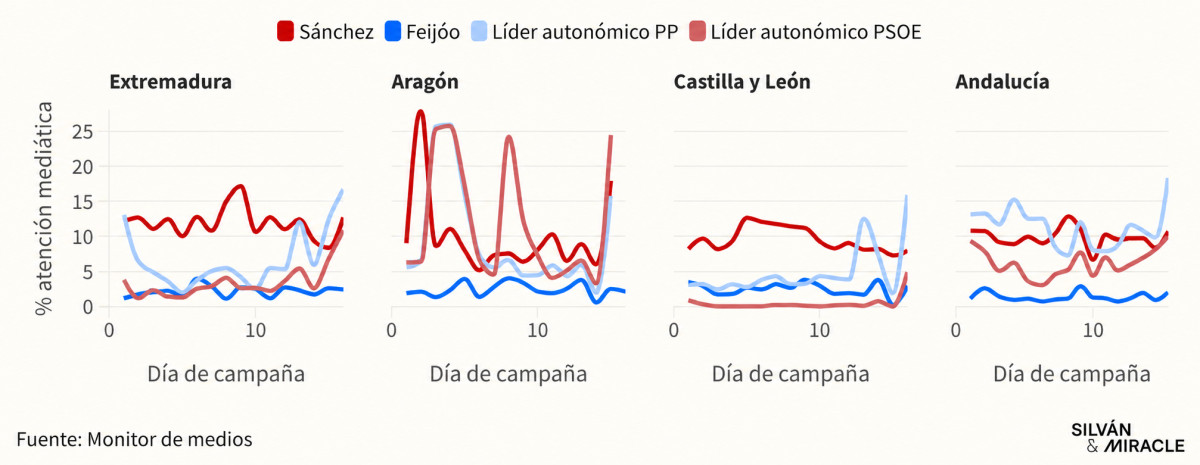
Con todo, este ciclo deja efectos destacados no solo en lo electoral, sino también en el plano del discurso político. La nacionalización de las campañas autonómicas ha creado el terreno ideal para que los temas propios de Vox —identidad, inmigración, rechazo al Gobierno central— colonicen un debate que debería girar en torno a sanidad, educación o vivienda. El mecanismo funciona en tres fases: Vox introduce un concepto en el debate, el PP se ve obligado a posicionarse para no perder electorado hacia su derecha, y los medios amplifican esa confrontación, desplazando aún más los asuntos autonómicos propios.
El caso más ilustrativo es el concepto de “prioridad nacional”, que fue uno de los más mencionados en los debates de Castilla y León y Andalucía, y Vox logró introducirlo en los acuerdos institucionales en Extremadura y Aragón. En la campaña andaluza, Moreno Bonilla tuvo que pronunciarse sobre él —calificándolo de efectista e inviable jurídicamente—, pero el mero hecho de tener que desmentirlo ya suponía una victoria discursiva para Vox al condicionar la conversación pública.
En definitiva, lo que el ciclo electoral autonómico 2025-2026 deja como lectura de fondo no es un resultado, sino una dinámica. The right consolidates its structural footing in territories once socialist, la izquierda alternativa no encuentra en la unidad de candidaturas la solución a su crisis, y Vox opera como actor catalizador que desplaza la agenda autonómica hacia los términos del debate nacional.
