
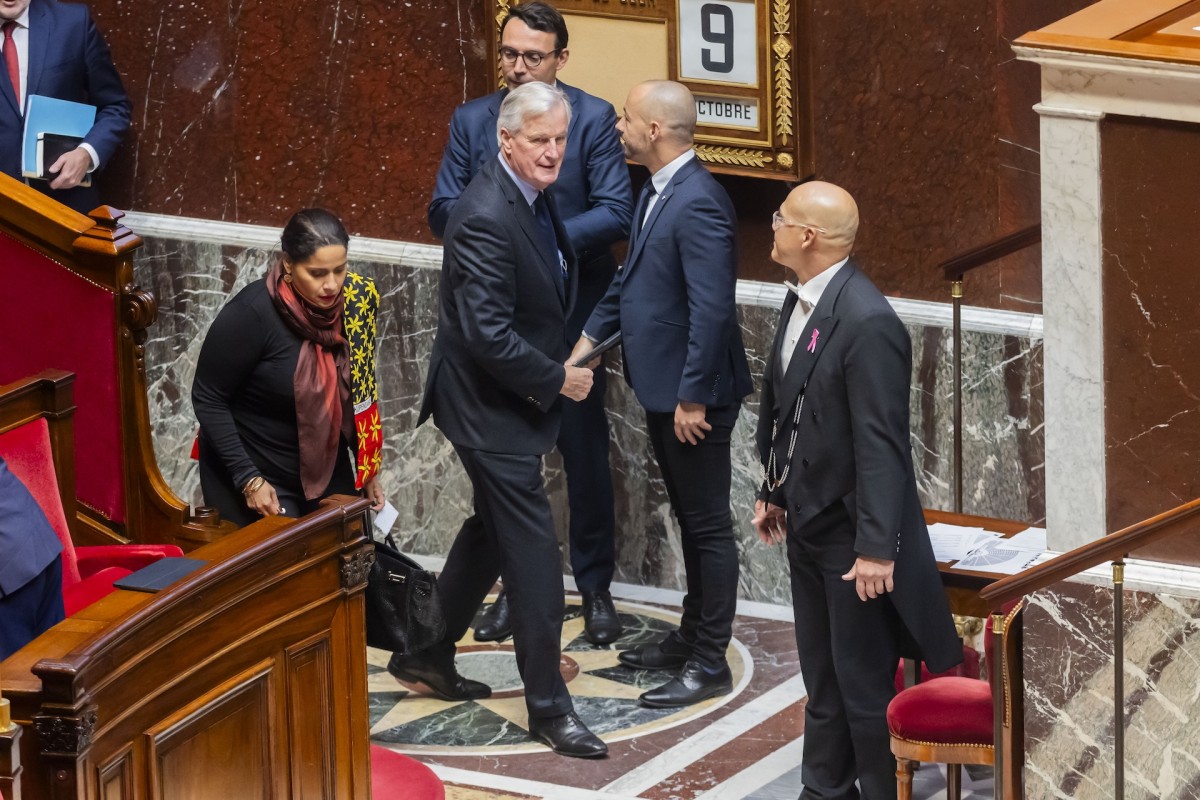
In early September, Emmanuel Macron made one of the most controversial decisions of his career by appointing Michel Barnier as prime minister, whose party had fallen far from achieving a parliamentary majority.
The results for Les Républicains, the party to which Barnier belongs, pale in comparison to those of the far-right Rassemblement National (RN) or the Nouveau Front Populaire (NFP) of the left-wing alliance, which won in both votes and seats, overturning all predictions.
This leaves the new government in a very weak position before a divided assembly, where the opposition is the majority and will not hesitate to block any measure deemed harmful or unpopular. Moreover, it faces a constant risk of facing a motion of censure, such as the one filed by the NFP on October 9, which has called government stability into question from the very first minute, depending on RN’s rejection, which has chosen not to align with the line set by the left-wing groups.
This division, on the other hand, favors Barnier, as it makes him emerge as a figure capable of handling the polarization that exists across the French parliamentary spectrum (unlike Macron and his closest circle), now that Marine Le Pen’s party leans away from claiming the role of the main opposition party.
“It would not be unusual for a future hypothetical motion to prosper if the prime minister’s cabinet adopted measures that are too unpopular”
However, given that the groups backing the government (Ensemble and Les Républicains) command around a third of the deputies in the chamber, it would not be unusual for a future hypothetical motion to prosper if the prime minister’s cabinet adopted measures that are too unpopular.
The first challenge for Barnier will therefore be to thread the needle to win support among the more moderate wings of Le Pen’s party (if any exist), and among the groups of the left coalition that approach the center more closely, such as the Socialist Party. It won’t be easy, for although it is likely that RN intends to promote a new profile as an institutional party and a unifying right that could carry them into 2027; their brand remains synonymous with polarization. In other words, you either love them or you hate them.
On the other hand, if Macron intended to divide the left bloc by appointing Barnier and attract the Socialist Party by appealing to a hypothetical sense of statehood, it seems he has not succeeded. For now, both Barnier and his interior minister, Retailleau, have signaled to Le Pen’s bloc that it is necessary to strengthen measures against irregular immigration and accelerate expulsions of those who entered the country illegally.
The government has set this issue as a priority, especially after the tragic murder of the young Philippine at the hands of a Moroccan immigrant who awaited deportation to his homeland. As for the so‑called “migrant crisis,” it is impossible to ignore the hypocrisy of a political class that, while advocating strict measures against irregular immigration, also defends an economic system that depends on a large volume of labor in precarious conditions and with extremely low wages. This same system is sustained, precisely, by the immigration that they claim to criticize so much.
“Both Barnier and his Interior Minister, Retailleau, have signaled to Le Pen’s bloc that it is necessary to reinforce measures against irregular immigration and accelerate expulsions of those who entered the country illegally”
However, despite the possibility of new measures to control irregular migration, as has already begun to occur in Germany under a supposedly progressive government, it is well known that the underlying issue is not that, but the enormous integration problem that France has faced for decades.
The integrative strategy in education and social policy from the early 1960s has run into the hard reality: there is no homogeneous country, but one that is multicultural and diverse. A country with a high percentage of people living in large cities, coexisting with a highly productive and proud rural environment, capable of mobilizing massively if its interests are threatened. France is also a nation that presents itself as technologically advanced in some regions, while in others it is in clear economic decline due to deindustrialization. Additionally, there exist parallel societies in many of the great urban centers, such as the Center facing the Banlieue, which would correspond in the collective imagination to a white and bourgeois France in contrast with a working-class and multiethnic France, that has gradually formed on the outskirts of cities over the last four decades.
Be that as it may, the question of how to integrate a country more polarized than it seems on the surface is on the table, and it is a matter that transcends Barnier’s cabinet. He will focus on ensuring stability for the rest of the term, and if that requires making concessions to the far right, embracing part of its discourse, so be it.
In a more immediate, and certainly more urgent frame for the new cabinet, the economic issue, or more specifically the budgetary issue, stands. The structural deficit of 5.5% and a debt that far exceeds 100% of GDP are incompatible with the new framework of European fiscal and governance rules, which advocate returning to a deficit below 3% by 2027, and a substantial reduction in indebtedness.
Barnier faces complex questions: How to reduce spending without raising taxes or reducing social transfers? How to rapidly increase revenue to avoid a sanction from the Commission? For the time being, he has taken cosmetic steps to differentiate himself from his predecessors, such as the intention to raise taxes on higher incomes. In this way, he would distance himself somewhat from Macron and the image of the orthodox liberal that accompanies him, although it remains to be seen how feasible such a measure would be, if it is ultimately implemented.
| Public balance of France’s accounts in 2022 and 2023 |
|
Source: Cour des Comptes. |
| It is worth recalling that the previous Élisabeth Borne cabinet, which enjoyed far greater parliamentary support, faced a motion of no confidence when it dared to reform the pension system as a way to reduce the long-term deficit. The French society was stretched to the limit in the days leading up to the law’s approval, and its repeal has been demanded by both the Nouveau Front Populaire and Rassemblement National, and Barnier has argued that, although he is open to negotiating some changes, he does not intend to repeal it entirely. |
In meeting deficit targets, the new government must resort to ingenuity and imagination to develop a credible spending stabilization plan for the Commission. It should be noted that this plan ought to have been presented already in September, and they are thus delayed, and a priori they should not reach December without having developed it.
“One of the major problems the new government will face is deciding which line items to cut and what scenario is realistic enough for 2027”
Although the new framework of fiscal rules allows for certain assumptions to justify an excessive deficit, such as spending aimed at meeting the Commission’s decarbonization and energy transition goals, one of the big problems the new government will face is deciding which budget lines to cut and what scenario is realistic enough for 2027. They will not have an easy time; the parliamentary minority will be a hard barrier to overcome, and no opposition party will be willing to pact on restrictive fiscal rules, whether for ideological or electoral reasons.
Thus, one should expect a government with little room for maneuver and marked parliamentary weakness, which must rely on the negotiating skills of its members. But if there is anyone capable of achieving impossible deals, it is Michel Barnier, the man who made Brexit a reality and on whom Macron has placed much of his hopes to carry the legislature through in the best possible way.
Will the veteran politician be able to steer through the turbulent waters of French parliamentarism and bring the legislature to a finish, or are we facing a new (or not so new) framework of polarization in which the National Assembly serves as a grinder of prime ministers, as in the Third and Fourth Republics? Perhaps what could emerge from the long dusk of socioliberal order is precisely that: an increasingly frequent alternation and a state of permanent collective annoyance. We will soon know whether Barnier will be able to exercise strong leadership to keep his government stable or whether he will resemble those fleeting cabinets of the 19th and 20th centuries.
