
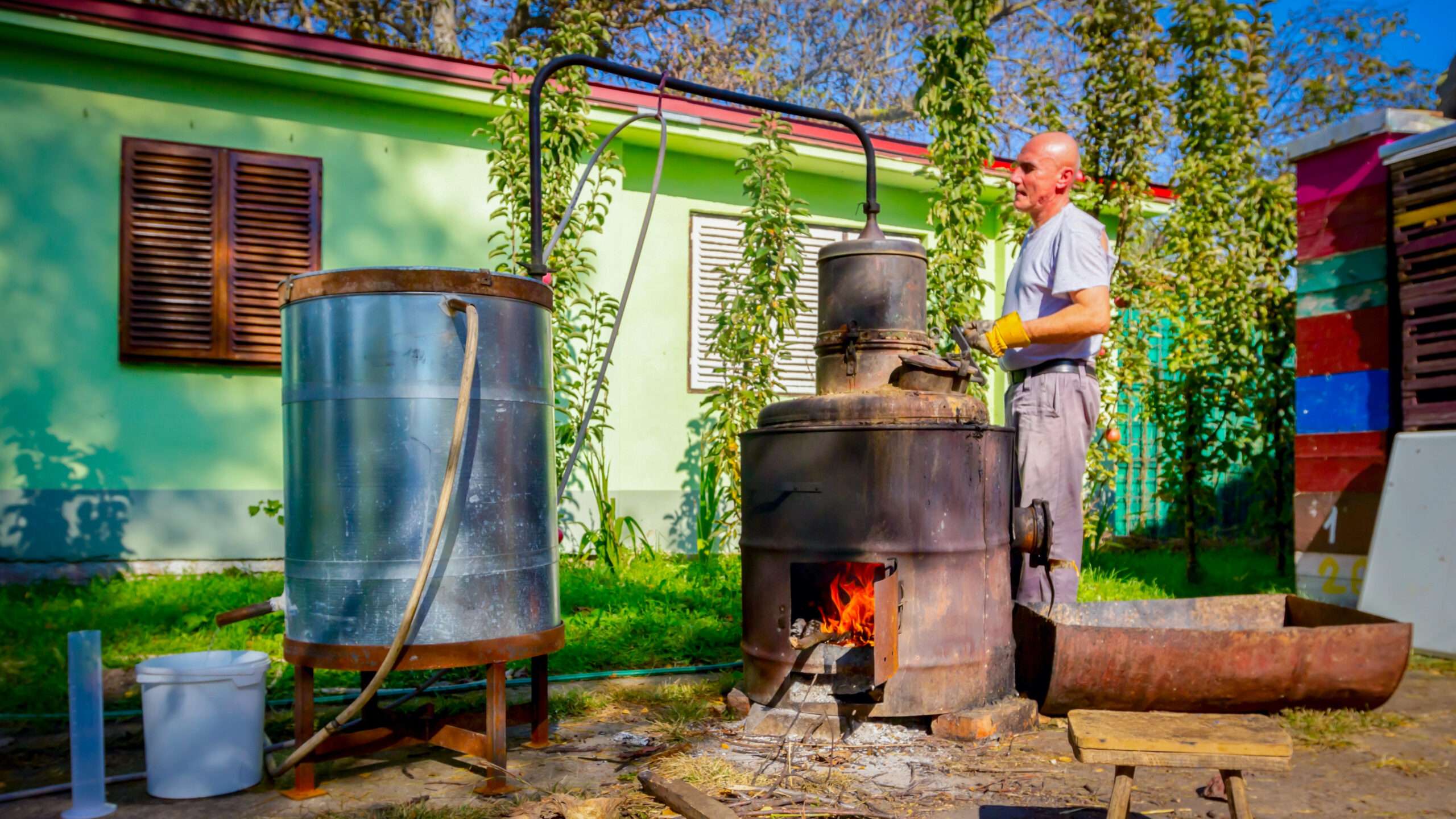
The courts may pave the way for permitting small-scale distillation, but tax policy continues to clutter the landscape.
In January, law enforcement in Alabama stopped a Florida resident on suspicions of moving 81 gallons of moonshine. He isn’t alone in this line of work. Bootlegging has a long, storied presence in the United States. In a nation that alternates between a fondness for and suspicion of alcoholic beverages, enterprising individuals seek to sidestep steep taxes on distilled spirits by making and selling the illicit product, while authorities defend the home-distillation ban in the name of revenue collection. People also shuttle liquor from states with lower taxes to those with higher ones. The result is a perpetual cat-and-mouse scenario that has produced legendary figures and even spawned customized smuggling vehicles that have left their imprint on NASCAR lore.
A Federal Ban Driven by Perverse Tax Reasoning
“Federal law prohibits individuals from producing distilled spirits at home,” explains the Alcohol and Tobacco Tax and Trade Bureau (TTB). This agency sits within the Treasury, distinct from other bureaus like the ATF, and its mandate includes filling federal coffers. Yet the high-stakes game between bootleggers and tax collectors dampens the flow of revenue that politicians say they rely on to justify restrictive rules. In a ruling by the U.S. Court of Appeals for the Fifth Circuit in McNutt v. U.S. Department of Justice, the court held that the home-distillation prohibition rests on the government’s taxing power, but that the measures imposing the ban—and their heavy penalties—go beyond that constitutional framework. They concluded that neither provision primarily generates revenue; instead, they ban at-home distilleries and, in doing so, effectively curb the production of spirits altogether. In other words, the provisions operate to reduce revenue rather than raise it.
To be sure, there would be compelling reasons to distill and market moonshine even if personal distillation were legal. The taxes discussed above are staggeringly high. A federal prohibition and elevated state excise taxes appear to push people toward illegal activity from opposite directions; both policies drive the same outcome.
An Illegal Industry Inspired by Strict Laws and High Taxes
“In general, distilled spirits face the stiffest tax rates of any alcoholic beverage,” wrote Jacob Macumber-Rosin and Adam Hoffer for the Tax Foundation last week. Beers and wines are taxed, but not to the same extent relative to their alcohol content. Additionally, 17 states maintain government monopolies over liquor sales in what are called “control” states, allowing officials to set prices above what competing markets would yield. Not surprisingly, control states tend to levy higher excise taxes than states with open and competitive markets, though Wyoming and New Hampshire are notable exceptions where government revenues rely more on liquor sales than on high taxes.
Tax rates differ markedly from one state to another. Washington imposes the nation’s highest excise tax at $36.68 per gallon, followed by Oregon at $23.74 per gallon. In contrast, Wyoming and New Hampshire—where the state’s liquor business is backed by a monopoly—exert effectively zero excise taxes, while Missouri charges $2.00 per gallon.
Exise taxes aren’t the entire story, though; various jurisdictions apply case and bottle fees, liquor-specific sales taxes, wholesale taxes, and licensing charges for retailers and distributors. When taxes are steep, there is a powerful incentive to make alcohol illicitly and sell it at prices that undercut legal options. Substantial differences in tax treatment between neighboring states also push people to buy liquor across borders and then resell it in higher-tax jurisdictions, mirroring the tobacco black market in many ways.
“Just as with cigarettes, large tax differentials across nearby borders spur cross-border shopping and smuggling,” observe Macumber-Rosin and Hoffer. “For instance, residents of Washington—the state with the highest liquor taxes—are estimated to account for about 8 percent of purchases in Idaho, a neighboring control state with a lower effective tax burden (though it remains the ninth-highest in the country). That 8 percent translates to roughly $25.3 million in sales.”
That discussion is only part of the picture; we haven’t yet accounted for the federal excise tax. “The first 100,000 proof gallons of distilled spirits manufactured in America in a calendar year are taxed at a reduced rate of $2.70 per proof gallon, which equates to $1.08 per gallon of 40 percent ABV spirits,” Macumber-Rosin and Hoffer note. “The subsequent 22.13 million proof gallons produced annually are taxed at $13.34 per proof gallon ($5.34 per gallon of 40 percent ABV). Any additional production within the United States and all imported spirits are taxed at the general rate of $13.50 per proof gallon ($5.40 per gallon of 40 percent ABV).”
Taxes Are Half the Price of a Bottle of Booze
All told, taxes account for roughly half of what a typical bottle of liquor costs. The Distilled Spirits Council of the United States—an industry association—estimates that federal, state, and local taxes combine to swallow more than 52 percent of the price of a standard bottle of spirits.
It’s no accident that bootlegging holds a meaningful place in American culture, with cars tweaked for evading law enforcement since the Prohibition era’s end. It also helps explain why Alabama law enforcement continues to encounter moonshine-laden vehicles. The chance to profit by illicitly producing moonshine or moving legally produced liquor from a low-tax area to a high-tax one will continue to lure many people, especially while the tax structure remains so lucrative for illicit operators.
Looking ahead, home distillation could gain real traction as a hobby if the Fifth Circuit’s interpretation of the law prevails when the issue reaches the Supreme Court. If, instead, the Sixth Circuit’s stance in Ream v. U.S. Department of the Treasury—that the home-distilling ban was lawful when enacted and remains so today—wins at the highest level, personal distillation may not gain legal status, though its popularity could still grow. Reason contributor Jacob Sullum has explored the strain between these rulings.
In the end, federal and state authorities have crafted an environment that strongly encourages an illegal market in distilled spirits. Since the home-distillation ban dates back to 1868 and taxes at both federal and state levels remain onerous, the system effectively invites anyone with a taste for risk to produce their own booze and sell it to others for profit.
You don’t need to hail from Florida to appreciate the appeal of testing your own liquor recipes or driving a stockpile of whiskey from one state to another. Americans have pursued such ventures for decades, and as long as high taxes continue to make illicit work profitable, they will persist—regardless of how the courts rule.
