
The Supreme Court has dismissed, in a ruling dated May 13, 2026, the appeal filed by the Central Syndicate of Irrigators of the Tagus–Segura Aqueduct (SCRATS) against the Tagus hydrological plan approved by Royal Decree 35/2023. The ruling, with costs imposed on the union, confirms the progressive regime of ecological flows for the river and joins the line already set by the Third Chamber, Fifth Section, on June 5, 2024, and reinforced in October 2025 with the dismissal of the Government of the Region of Murcia’s appeal against the same decree. Along with SCRATS have litigated in recent years the regional executives of the People’s Party in Murcia, the Valencian Community, Andalusia and Madrid; intervening on behalf of the plan have been the Association of Riverside Municipalities of Entrepeñas and Buendía, the Platform of Toledo in Defense of the Tagus, the Junta of Castilla-La Mancha and the Madrid Ecologist Platform.
“After the ruling, it is no longer possible to read the conflict as a simple dispute between donor and recipient communities.”
Beyond the technical dispute over minimum flows, what the High Court is confirming is the reordering, underway for a decade, of a hydro-social-economic model built in the 20th century around a precise view of water as a strategic resource for national development. The Tagus–Segura transfer has been for half a century its most visible infrastructure and also its political symbol. After the ruling, it is no longer possible to read the conflict as a simple dispute between donor and recipient communities. Spanish hydraulic planning today is crossed by multiple dynamics, internal and external, interlinked with each other, each with its own actors. The territorial rivalry among the autonomous communities over the distribution of the resource is the most visible aspect. The environmental rationality that the Water Framework Directive has introduced into river-basin plans has changed the rules of the game. Moreover, bilateral cooperation with Portugal around shared Iberian basins, including the Tagus, adds an international dimension little discussed in public debate. And, threading through all, the political, economic and social wrangling over the agrarian model and its link to water, especially in the southeastern Mediterranean—a region where intensive irrigation for export has for decades been a matter of identity.
A Hydraulic Paradigm Entering Its Final Phase?
The conflict over the Tagus–Segura transfer is the contemporary translation of a way of understanding water that began with the regenerationist movement at the end of the 19th century, an intellectual and political current born after the Disaster of 1898 that placed water issues at the center of the modernization program for the country. Thinkers such as Joaquín Costa identified then the Spanish economic lag with the poor use of water resources across peninsular Spain, between a humid Atlantic Spain and a dry Mediterranean Spain, and attributed to the State the mission of correcting it through large public works. That mission, begun with the Plan Gasset of 1902 and continued by the hydrographic confederations created in 1926 and by the National Plan for Hydraulic Works of the Second Republic, was systematized under Franco’s dictatorship, which built hundreds of reservoirs and planned major transfers. The inertia of the model persisted into the turn of the century, with plans that continued to rely on large diversions as a response to territorial deficits. The Tagus to Segura transfer, initiated in 1968 and inaugurated in 1979, was conceived as an infrastructure for productive transformation and, at the same time, as a factor of national symbolic cohesion. After the 1978 Constitution and the 1985 Water Law, water management was organized around the hydrographic confederations, with a competence distinction between intra-community basins, within regional competence, and interregional basins, within state competence, which has conditioned all subsequent territorial disputes.
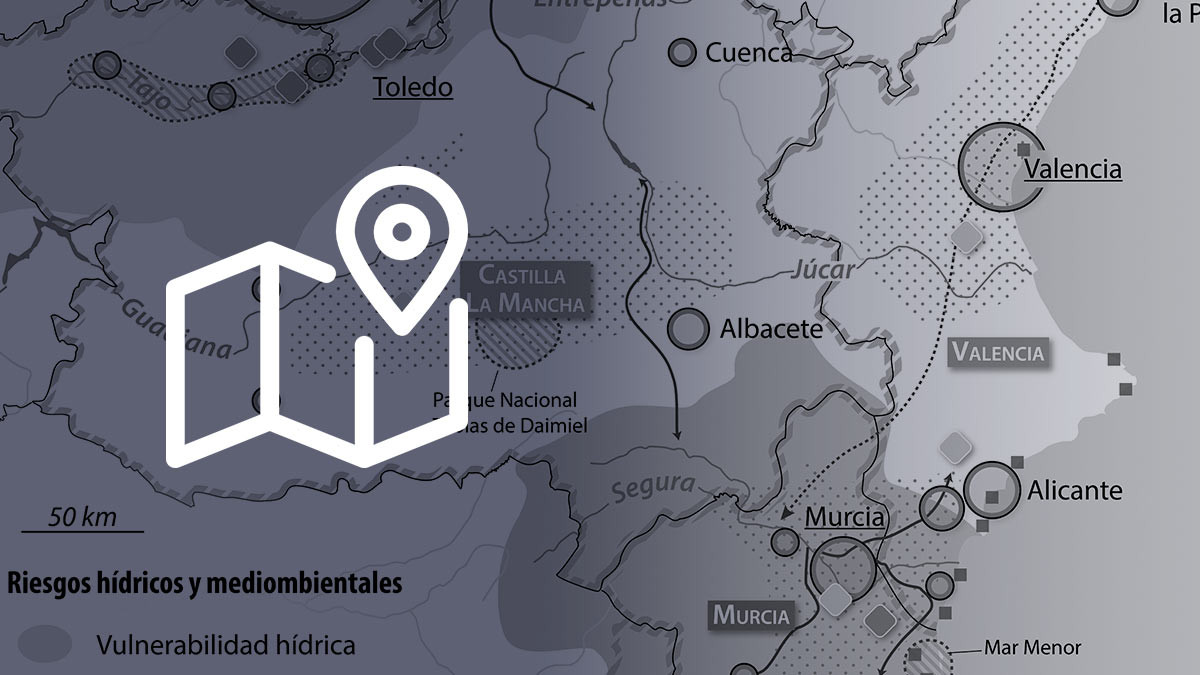
Pase over the map to zoom. Map 1. Water resources of the Iberian Peninsula: between rising stress and territorial imbalances. Cartography: Kartex Risk.
“The paradox of the hydraulic model is that the greater availability of water, rather than solving the problem, has stimulated its growth”
One hundred years after Costa, the balance of that wager is mixed. Today Spain has more than a thousand reservoirs, around four million hectares under irrigation, and a network of transfers spanning hundreds of kilometers, placing it among European countries with the greatest capacity to store and mobilize the resource. But at the same time, it suffers from a very high structural water stress. The European Commission estimates the resource exploitation index at around 42.5% and notes that diffuse agricultural pollution affects 34% of surface water bodies and 56% of groundwater. The paradox of the hydraulic model is that greater water availability, instead of solving the problem, has stimulated its growth. Irrigation, coastal urbanization and tourism expanded at the pace of the infrastructure and have generated deficits increasingly difficult to cover, particularly in the Segura basin, the most deficit-ridden in the country, where the current river basin plan estimates this structural gap at 310 hm³ per year. The succession of droughts in recent decades, longer and more frequent than in the 20th century, has ended up casting doubt on the medium-term viability of the very paradigm.
The Power Rivalries Among the Autonomous Communities
It was the political decentralization inaugurated by the 1978 Constitution that introduced a new scale to the conflict. From the 1990s onward, as autonomous governments consolidated, several communities, especially those with less established regional identities, began to use water as a central element of their political discourse. The case of Murcia is paradigmatic. Governed almost uninterruptedly by the People’s Party since 1995, it has made defending the Tagus–Segura transfer a core axis of its policy, crystallizing in the first decade of the century in the well-known slogan “Water for All,” after the cancellation of the Ebro transfer in 2004, foreseen by José María Aznar’s government in the 2001 National Hydrological Plan. The rise of Vox in 2019, a formation that became the most voted in the region and that maintains decisive influence in the regional government through its proximity to the Ingenio Foundation, has updated that claim by embedding it in a broader discourse against the 2030 Agenda and European climate policies.
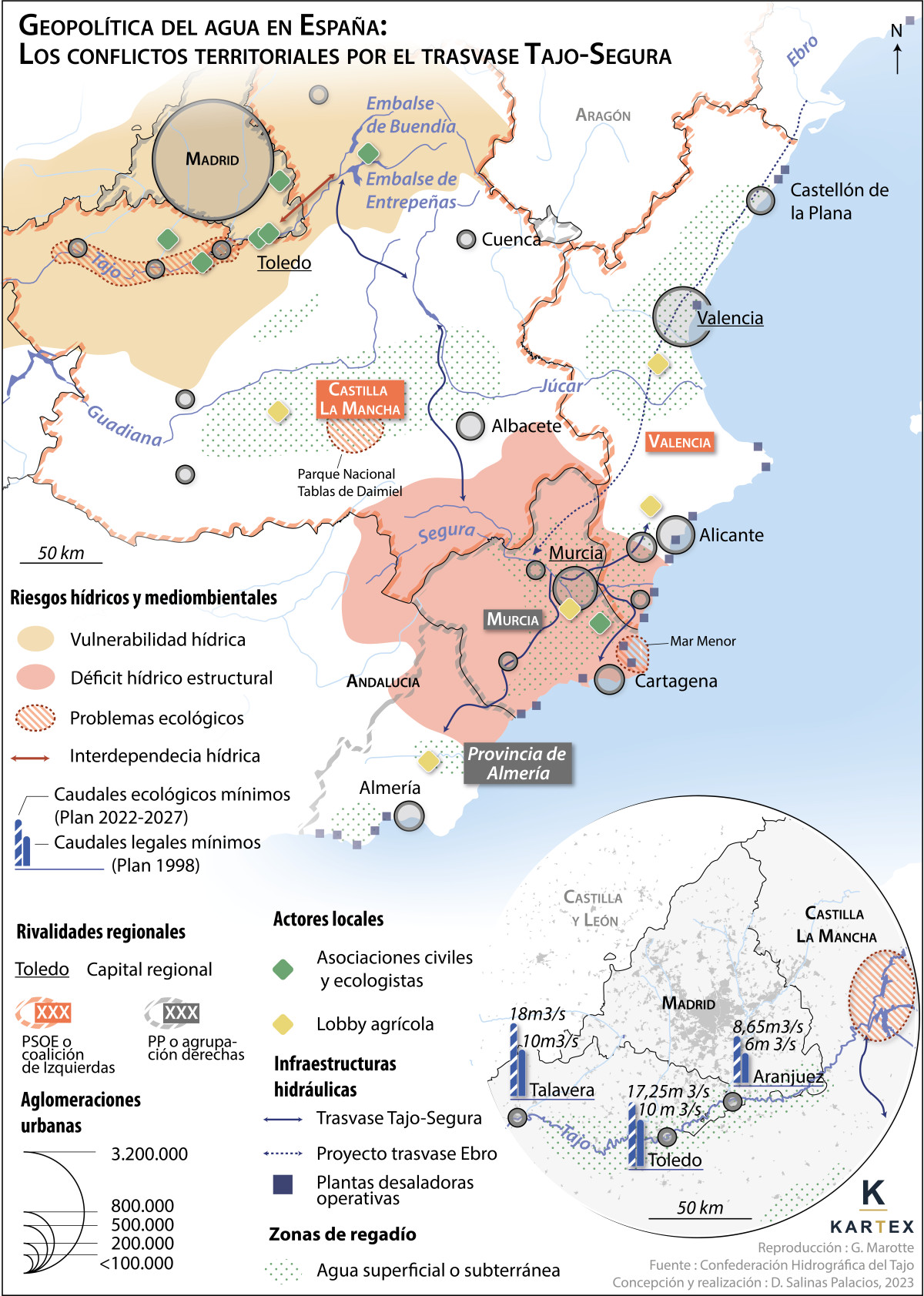
Pase over the map to zoom. Map 2. Water geopolitics in Spain: territorial conflicts over the Tagus–Segura transfer. Cartography: Kartex Risk.
In the donor basin, the dominant portrayal is the opposite. Castilla-La Mancha, governed almost uninterruptedly by the PSOE since 1983, except for the 2011–2015 interval, has built over these decades a territorial narrative centered on the status of being a resource-expropriated community. The transfer appears there as a legacy of Francoism and as a mechanism of imbalance that would have condemned the region to a subordinate position in the distribution of economic growth. The attempt to reserve in the 2010 statutory reform, for exclusive regional use, 4,000 hm³ per year, finally blocked by the Constitutional Court, was one of the clearest expressions of that narrative. The clash between the two communities is therefore not a disagreement between political parties, but a territorial power rivalry between administrations that defend opposing economic models, both highly dependent on water. On the one hand, a highly intensive coastal agro-export model. On the other, an inland model historically less intensive, but with a growing commitment to modernized irrigation. Both discourses have mobilized their respective electorates for decades.
“The clash between the two communities is not a disagreement between political parties, but a territorial power rivalry between administrations”
Alongside the intergovernmental clash, it is worth considering the real weight of the pressure groups of irrigation in the southeast. SCRATS, which brings together about 100,000 users; Proexport, the association of horticultural exporters; and the Ingenio Foundation, a corporate think tank created in 2020 and close to the Santiago Abascal formation, have for years produced studies, technical reports and media campaigns that have justified the continuity of the transfer. Their argument is familiar. They repeat, economically, the estimate of more than 20,000 jobs at risk and one billion euros of regional production committed in the event of a substantial cut. At the same time, they debate the criteria by which ecological flows are calculated and appeal, in political terms, to the constitutional principle of interregional solidarity. This mobilization capacity helps explain why the transfer paradigm has politically endured for so many years, even as its physical and legal premises were clearly eroded.
The Water Framework Directive and the Supreme Court Doctrine
The incorporation into the European Union and the transposition into Spanish law of Directive 2000/60/EC, known as the Water Framework Directive, modified the game rules by introducing a distinct environmental rationality into the Spanish engineering tradition. The directive required member states to achieve good ecological status of all water bodies between 2015 and 2027 through management plans organized in three successive cycles: 2009-2015, 2015-2021 and 2022-2027, and granted ecological flows a hierarchical role in planning. In Spain, its application has generated considerable legal conflict. The first Tagus plan, approved in 2014 by the government of Mariano Rajoy, set a minimum flow at Aranjuez of 6 m³/s, substantially lower than the 10.86 m³/s forecast in 2010 by the Zapatero administration, and it was annulled by the Supreme Court in 2019, at the request of environmental organizations, for not meeting the directive’s minimum standards. The revision of the third cycle, approved in 2023, establishes a progressive regime that rises to 8.65 m³/s in Aranjuez in 2027, 10 m³/s in Talavera de la Reina and 17.25 m³/s in Toledo.
“The transfer returns to being legally what it always was, a conditional use of the surpluses”
Against that planning, a coordinated judicial offensive was launched among the coastal PP administrations, irrigation pressure groups and SCRATS itself. The May 13 ruling dismisses their arguments one by one. The court rejects, first, the idea that there is a deliberate political will to liquidate the transfer, and recalls that flow fixation obeys a European mandate and the court’s own prior jurisprudence. Second, it rejects the technical challenge to the calculation, considering that the expert reports provided do not undermine the methodology of the Hydrological Planning Instruction. It also clarifies, in an important doctrinal precision, that the legal minimum of 6 m³/s at Aranjuez does not constitute a ceiling, but a lower threshold that does not prevent the plan from setting higher flows when necessary to achieve the good ecological status demanded by the Water Framework Directive. But most importantly, it articulates a legal principle that reorders the hierarchy of uses. The Tagus–Segura users, the ruling states, use exclusively surplus waters, so there is no guaranteed right to those resources until the environmental needs of the donor basin are fully met. In other words, the transfer is legally what it always was, a conditional use of the surpluses, and ecological flows become a prior constraint against any other economic use than human consumption. According to the calculations of the Castile-La Mancha government, full application of the new regime will reduce transferable contributions by around 40% from 2027 onward, to about 193 hm³ per year, compared with the historic average of 330 hm³ and the 600 hm³ that were projected in the original design.
The Iberian Dimension: The Tagus as a Shared River
It is worth remembering that the Tagus is not a Spanish river, but an Iberian one. It runs 1,092 kilometers from the Universales Mountains to the Tagus estuary in Lisbon. Sixty-eight percent flows through Spanish territory and 32% through Portuguese territory. Alongside the Duero, the Miño-Sil, the Guadiana and the Limia, it forms one of the five international basins governed by the Albufeira Convention, signed by both countries in 1998. The treaty obliges Spain to guarantee Portugal an annual minimum volume of 2,700 hm³, measured at the Cedillo dam control station at the frontier, and incorporates intraannual regulation conditions designed to avoid excessive flow concentrations in periods nonfunctional for ecosystems or for Portuguese uses. The entry into force of the Convention in 2000 formed part of a broader bilateral balance. Portugal accepted coexistence with the Tagus–Segura transfer as a fait accompli in exchange for Spain’s approval of the Alqueva dam project on the Guadiana, inaugurated in 2002.
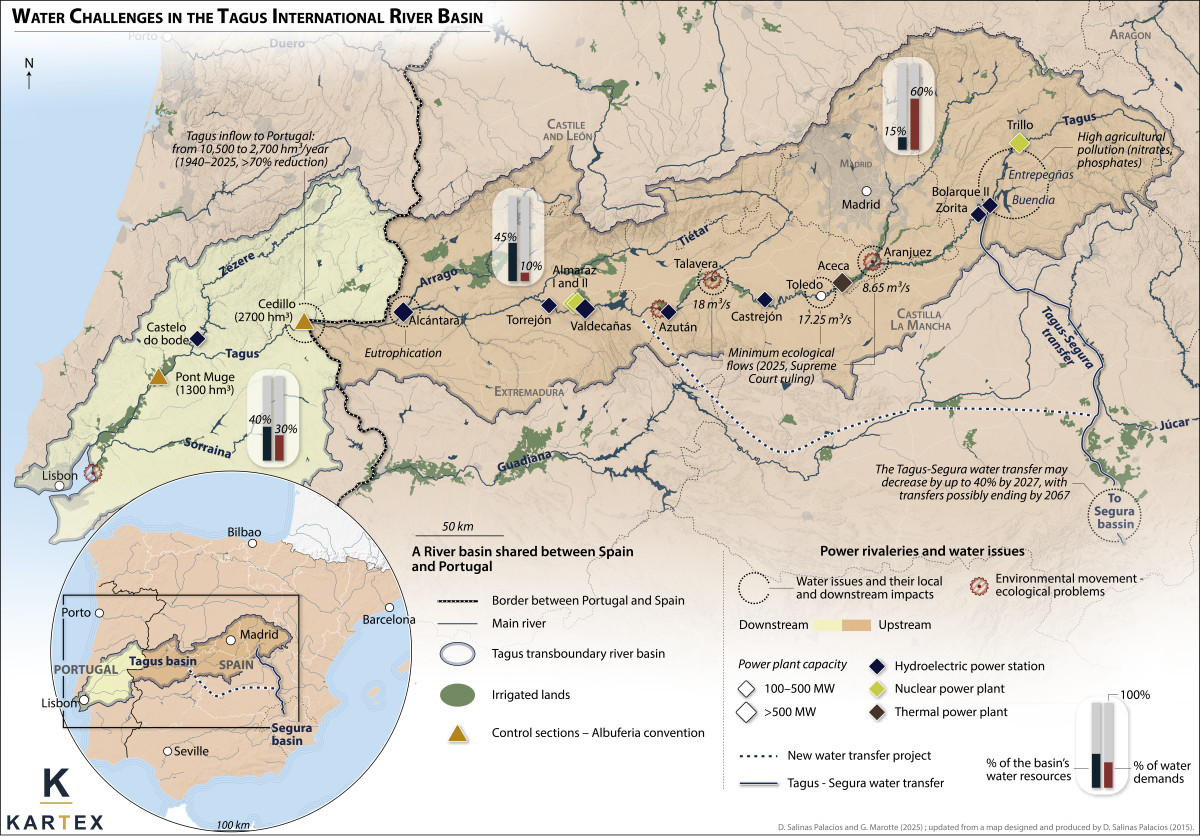
Pase over the map to zoom. Map 3. Water challenges in the international Tagus basin. Cartography: Kartex Risk.
The bilateral framework, however, generates a contradiction that the May 13 ruling again brings to the foreground. In the past, the Spanish state has tried to satisfy three almost incompatible obligations simultaneously. It had to divert a significant amount of water from the upper Tagus to the southeast, maintain a dignified ecological flow in the river’s middle stretch, which receives discharges from a metropolis of over seven million inhabitants (Madrid), and deliver to Portugal the volume agreed at Cedillo. The basin authority’s own series document the mismatch. A 28% drop in contributions to the Cedillo reservoir occurred in the 1980-2006 period compared with the pre-transfer situation, and during the 2009-2010 hydrological year the Spanish government invoked the drought clause of the Convention after transferring 293 hm³ to the Segura.
“The Spanish state has attempted to fulfill three hardly reconcilable obligations simultaneously.”
The last hydrological year, 2024-2025, illustrates how far the imbalance has become chronic: the 489 hm³ diverted to the Segura from the Tagus headwaters exceeded the 333 hm³ that continued down the river, so nearly 65% of the available water was redirected to the southeast. So far, successive Portuguese governments have preferred to avoid open confrontation with Madrid over the Tagus–Segura. However, climate change, projections from the Hydrological Studies Center (CEDEX), which anticipate further reductions of between 7% and 14% in the horizon 2040-2070, and the growing presence of Iberian civil society organizations such as ProTejo or Fundação Nova Cultura da Água have been eroding that low-profile consensus. The doctrine laid down by the Supreme Court, by placing ecological flow above the transfer, aligns for the first time clearly Spanish internal planning with the spirit of the Albufeira Convention and with that of the Water Framework Directive. Both the bilateral treaty and the European norm ultimately require that the river’s environmental functions be guaranteed before distributing its waters among the different uses.
In a Polarized Spain, When Will the Next National Hydrological Plan Arrive?
The application of the ruling opens, from 2027, a phase of redefining the Spanish hydraulic model with the next National Hydrological Plan serving as its main political vehicle. It is worth recalling, however, that the current PHN remains the one approved in 2001, with reforms introduced by Law 11/2005, which repealed the Ebro transfer, and that a thorough revision is seen by technical circles and policymakers as a trigger for considerable territorial tensions. No government has shown willingness in recent years to reopen the comprehensive debate, and major water conflicts have been resolved in a fragmented manner, focus by focus: Doñana through a specific framework of actions following the European Court of Justice ruling in 2021, the Mar Menor through the 2022 law on legal personality, and the Tagus–Segura itself through a contentious-administrative route with the ruling that motivates this analysis. The political transition does not wait for the planning horizon. The Minister for Ecological Transition, Sara Aagesen, announced in July 2025 that the new rules for exploiting the transfer would be ready in September of the same year, but at the time the ruling was issued they had not yet been published, which led Castilla-La Mancha to file in April 2026 a contentious-administrative appeal for inaction by the central government. On the content of the new plan two nationally identifiable positions clash: the one from the progressive coalition and the sectors aligned with the New Water Culture, which condition the transfer on demand management, accelerated desalination and reuse, and strict respect for ecological flows; and the one from the People’s Party and Vox, which continue to portray the transfer as an expression of interregional solidarity and call for partial rehabilitation of the Ebro project. The Supreme Court ruling does not settle that political divergence, but it narrows dramatically the legal space of the second option and obliges, regardless of which majority governs, to accept a substantial reduction of the transferable volume.
“What comes next will be decided less in the courts than in the political capacity to assume the physical limits of the territory”
The rebalancing between demand and resource, however, remains unresolved. The reduction of the transfer raises a problem that the ruling does not address, the issue of how to cover the structural deficit that historically justified the transferred water. The southeastern desalination plants already produce about 350 hm³ per year and support urban supply, but the intensive irrigation in the Levant has resisted using desalination for two decades due to costs up to five times higher. The new plan will have to combine affordable agricultural tariffs, reuse, resizing of irrigation, and governance attentive to the two international dimensions of the conflict. In the Segura basin itself, moreover, that 2022 Mar Menor law, born from a popular legislative initiative backed by more than 600,000 signatures, ratified by the Constitutional Court in 2024 and developed by royal decree in February 2025, enshrines from another angle the same principle as the May 13 ruling, namely that the aquatic environment has its own and prevailing rights over the economic uses that affect it. The eutrophication of the lagoon, linked to the intense irrigation in the Campo de Cartagena, has become through this path a legal expression of the paradigm shift. What comes next will be decided less in the courts than in the political capacity to assume the territorial limits and the European and Iberian commitments.
