
Europe has organized its economic balance around an apparently stable scenario. In it, Germany would produce, export and sustain the continent’s industrial core, while the rest of the economies would orbit around it with varying degrees of dependence. That model, which to a greater or lesser extent has worked in the past, is now entering a crisis.
Although Germany has been mired for years in a process of economic slowdown, the main problem is not in Berlin. What raises the greatest concern is that the European manufacturing heart is losing competitiveness against China. European Commission Vice-President Teresa Ribera recently phrased this in Agenda Pública, referring to China as “an industrial power growing at vertiginous speed.” And if Germany fails to adapt to that new global industrial environment, the consequences will extend far beyond its borders. Of course, they will also hit hard at countries like Spain, which could end up trapped in a new relationship of technological and industrial dependence with Beijing.
“The German export model is no longer competing against an emerging economy that needs European technology, but against an industrial superpower capable of displacing Europe”
This month, a report from the Centre for European Reform (CER) titled China Shock 2.0: The Cost of Germany’s Complacency has been published. In it, Sander Tordoir and Brad Setser warn forcefully and seriously about the magnitude of the Chinese challenge for Europe. The central thesis developed by the authors is that the German export model is no longer competing against an emerging economy that needs European technology, but against an industrial superpower capable of displacing Europe simultaneously from China, from third markets and, progressively, from the European market itself.
Germany no longer understands its own crisis
Despite the numerous and varied warnings, the first problem detected is Germany’s own diagnosis. Neither the previous government of Olaf Scholz nor the current chancellor, Friedrich Merz, has managed to correctly identify the country’s economic and industrial problems.
The debate in Germany remains obsessed with energy prices, European bureaucracy and climate regulations. Yet the report dismantles much of that narrative and notes that other European countries subjected to exactly the same regulatory framework —such as the Netherlands, Poland or Denmark— have grown much faster since 2019.
“Approximately 40% of Germany’s economic deterioration comes directly from the loss of external markets”
The fundamental difference lies elsewhere: in exports. According to CER’s calculations, roughly 40% of Germany’s economic deterioration comes directly from the loss of external markets. Another 40% is explained by the energy shock resulting from the break with Russia. And, therefore, only the remaining 20% would respond to internal factors such as bureaucracy or weak domestic demand.
Among all the cascade of consequences, one of the most worrying is in the labor sphere. The European giant could lose more than 400,000 jobs linked to its export relationship with China. The reason? The industrial complementarity between the two countries has ended.
During the first China shock, after Beijing joined the WTO in 2001, Germany benefited greatly by selling machinery, vehicles and capital goods to a Chinese economy that still needed to import advanced technology. However, the China shock 2.0 works exactly the opposite. Today, China no longer needs much of European engineering and competes directly against it.
China’s export-oriented machinery
The current dynamic is rapidly deepening a dangerous imbalance. While Chinese exports grow at a much faster pace than world trade, its manufacturing imports have remained virtually stagnant for a decade.
China absorbs global demand without opening its domestic market to the same extent. That expansion is driven by three major factors:
- Massive industrial subsidies.
- Artificially depressed domestic demand.
- A persistently undervalued exchange rate.
The IMF estimates that Chinese state subsidies amount to 4.4% of its GDP, around $800 billion annually. At the same time, the excess domestic savings and weak domestic consumption force overcapacity to be exported abroad. The result is mounting pressure on European strategic sectors, from automotive and machinery to renewable energies and clean technologies.
In this sense, electric cars have become the most visible symbol of the change. Europe had assumed for years that it would have time to adapt to electrification, but China has reached an enormous export capacity earlier than expected. Estimates projecting ten million vehicles exported by the end of the decade were rendered obsolete by 2025.
Meanwhile, the United States has radically tightened its trade policy. The Trump administration has raised tariff barriers and reduced incentives for European vehicles, closing one of the few markets where Germany still partially offset its losses in Asia. For all these reasons, Europe and China are entering a direct competition for the remaining world market.
Spain enters the Chinese equation
In this new scenario, Spain finds itself in a position where there is much to gain, but also significant risks. The Spanish economy has sought to strengthen its industrial weight within Europe and today has a window for reindustrialization with two main focal points: the energy transition and electric vehicles.
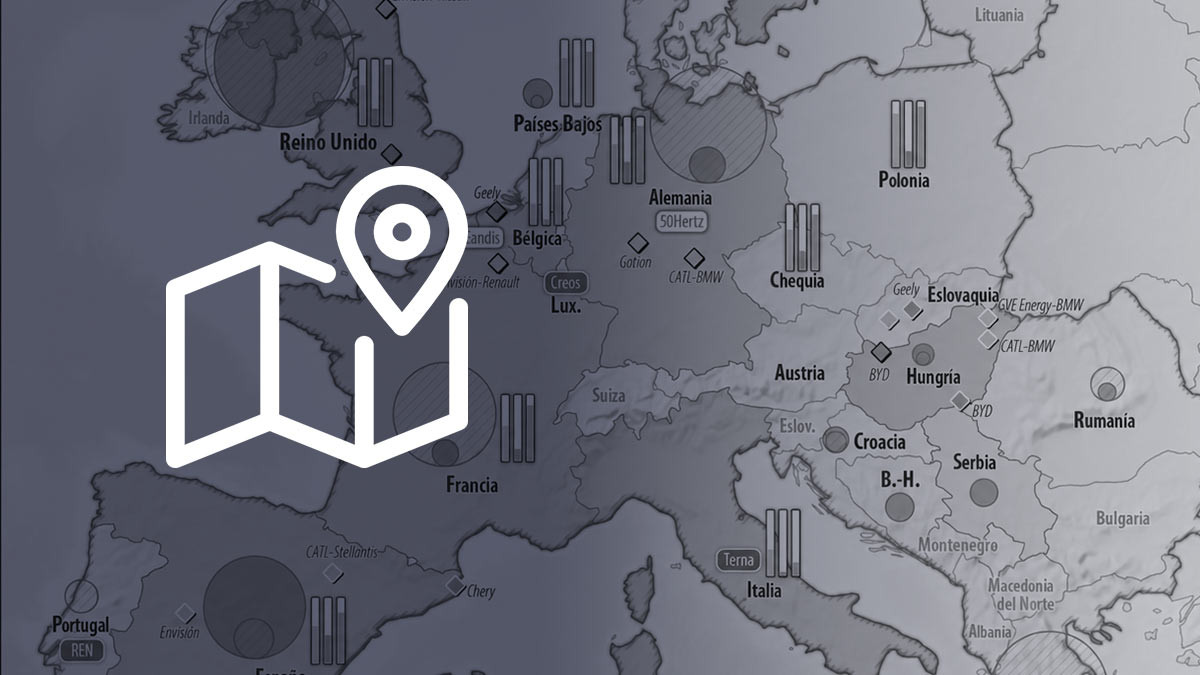
Against this roadmap, the European map of Chinese investments in green technologies and energy sectors invites rethinking how and where Spanish efforts should be directed.
Hover over the map to zoom. It shows the European distribution of Chinese investments in green technologies and energy sectors, with Spain as one of the main destinations for projects tied to batteries, electric vehicles and the industrial transition. | Map: Cassini
As Cassini’s mapping reveals, Spain is rapidly becoming one of Europe’s leading destinations for Chinese industrial projects linked to batteries, electric vehicles and low-carbon technologies.
Companies such as CATL, Chery or Envision seek to use Spanish territory as a production platform for the European market. The appeal rests on several reasons: 1) relatively competitive labor costs; 2) full access to the Single Market; 3) European subsidies and an urgent political need to attract industrial investment.
In the short term, this strategy could generate jobs and manufacturing activity. The problem is that, drawing on Europe’s accumulated experience, it is urgent to ask who truly controls the value added of the technology.
The myth of Chinese technological transfer
The idea that Chinese foreign direct investment can act as an industrial rescue mechanism for Europe through technology transfer is being highly questioned by empirical evidence. That expectation, according to the CER report, combines two excesses: first, optimism about the strategic intentions of Chinese firms; second, pessimism about European industrial capabilities.
Although many European capitals hope that the arrival of Chinese manufacturers will revitalize struggling sectors, the data show a far more asymmetric dynamic. Chinese investment in Europe remains relatively limited —about €10 billion in 2024— and highly selective. It concentrates mainly in knowledge-intensive and high value-added industries.
Therefore, the objective has not been to create new, complete European industrial value chains. Rather, the dominant pattern has been to acquire technological capacities that already exist. The report cites research on more than 160,000 companies in 159 countries that identifies a particularly significant behavior: about 41% of Chinese outward investments between 2012 and 2021 were directed at Europe and concentrated precisely in knowledge-intensive sectors.
“The European companies that are acquired experience an approximate 25% drop in return on assets and stagnation in patenting activity”
In this regard, we can focus on the post-acquisition effects. The European companies that are acquired experience about a 25% drop in return on assets and stagnation in patent activity. Meanwhile, Chinese parent companies multiply their patents granted: they roughly triple on average and can quadruple in the case of state-owned enterprises.For the authors, this does not simply reflect market decisions. It suggests that many Chinese firms accept lower financial returns because the real strategic objective is to accelerate the absorption of technology, engineering capabilities and industrial know-how into their territory. In other words, the dominant logic is not technology diffusion from China to Europe, but exactly the opposite.
The report also warns that this experience should moderate European expectations about future greenfield Chinese investments in batteries or electric cars. Additionally, historical evidence points to Chinese firms tending to protect their key technologies even when producing within Europe.
The Twenty-Seven also do not employ all their tools. China built its own automotive industry precisely using mechanisms that Europe today barely considers: high tariffs, mandatory joint ventures, restrictions on foreign ownership and strong local-content requirements. Beijing used market access as a tool to compel Western multinationals to transfer technology and production capacity. Europe, by contrast, continues to maintain one of the world’s most open markets without equivalent industrial bargaining instruments.
European naivety
Consequently, the challenge for the European continent is that it continues to confront this challenge with insufficient tools. Brussels has stepped up trade investigations and sectoral tariffs, especially against Chinese electric vehicles; this is true. However, the measures remain slow, fragmented and limited in the face of a systemic distortion across the entire Chinese economy.
Moreover, Germany itself continues to partially block a more aggressive European industrial policy for fear of retaliation and in the hope of preserving access to the Chinese market. Paradoxically, it is France and some sectors of the European Commission that have begun to more clearly defend the need for Buy European policies —buy European—, local-content requirements and strategic protective mechanisms.
“The country can attract investment and factories, but if it does not develop its own technological capacity, it could be reduced to a peripheral role”
The risk for Spain is particularly evident. The country can attract investment and factories, but if it does not develop its own technological capacity and a coordinated European industrial policy, it could be reduced to a peripheral role within value chains controlled from Asia.
Deindustrialization and irrelevance
Europe’s grand illusion was to think it could combine absolute trade openness, external energy dependence and strategic autonomy simultaneously. That balance has ended. The German crisis demonstrates that even the leading European industrial power can quickly lose ground to a competitor backed by continental scale, massive subsidies and strategic planning.
Spain still has room to take advantage of part of the ongoing industrial realignment. Nevertheless, there is a fundamental difference between reindustrializing and becoming an assembly platform dependent on foreign technology.
The German complacency in the face of China’s shock 2.0 is no longer merely a German problem. It is redefining the industrial balance of all of Europe while Spain, on this occasion, is not on the European periphery. The country is entering directly at the center of the European geoeconomic board, with all the risks and opportunities that entails.
